Facts
The plaintiff (respondent) filed a regular declaratory suit in the City Civil Court at Calcutta, alleging that the defendants (appellants) published a Chemistry book containing two chapters authored by him without permission or attribution
Source reference: para. 2, 19The Trial Court granted an ex parte ad interim injunction restraining the defendants from publishing the book in its entirety
Source reference: para. 9The defendants appealed, contending that the suit constitutes a "commercial dispute" under the Commercial Courts Act, 2015, and was improperly filed as a regular civil suit.
Source reference: para. 2-4They further argued the Trial Court failed to provide mandatory reasons for dispensing with prior notice to the defendants under Order XXXIX Rule 3 of the CPC
Source reference: para. 2-4Issues
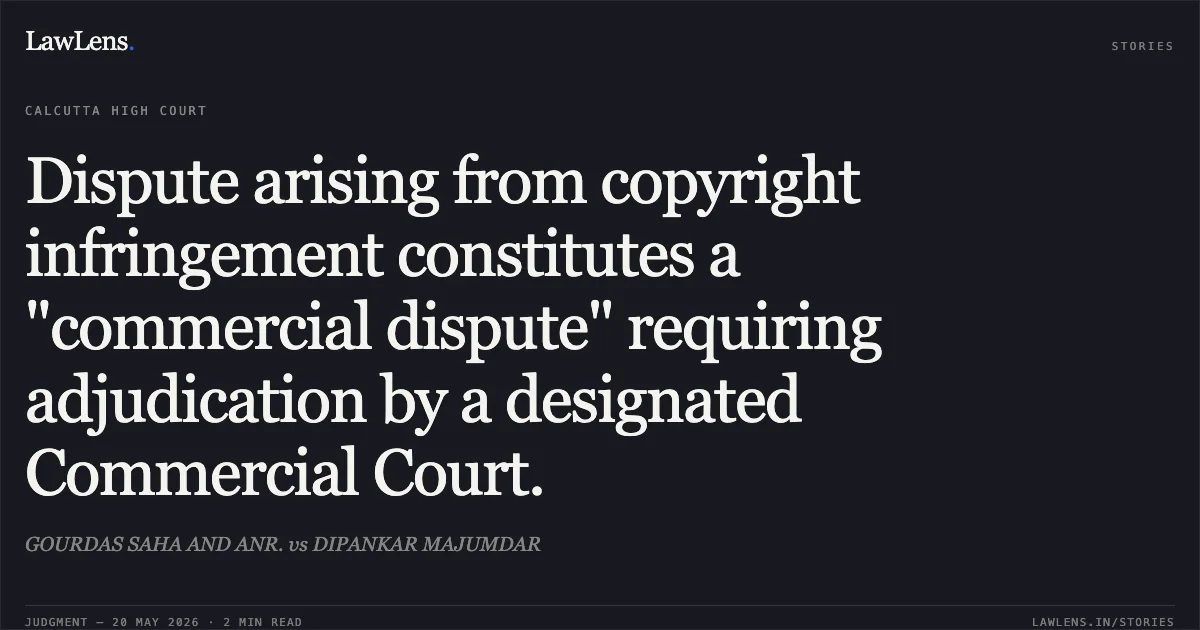
1. Whether a suit based on the infringement of copyright, valued above the specified threshold, constitutes a "commercial dispute" requiring adjudication by a designated Commercial Court
Source reference: para. 16/202. Whether the Trial Court’s failure to record specific reasons for the urgency of an ex parte injunction, as required by the proviso to Order XXXIX Rule 3 of the CPC, vitiates the order
Source reference: para. 22/23Law Applied
Section 2(1)(c)(xvii) of the Commercial Courts Act, 2015, which defines "commercial dispute" to include disputes arising out of intellectual property rights such as copyright
Source reference: para. 17Sections 55 and 57 of the Copyright Act, 1957, to establish the foundational nature of the plaintiff's claim
Source reference: para. 20Proviso to Order XXXIX Rule 3 of the Code of Civil Procedure (CPC), which mandates recording reasons for the opinion that the object of granting an injunction would be defeated by delay
Source reference: para. 22Precedents of Time City Infrastructure and Housing Limited vs. State of U.P. (2025) and Union of India vs. Essen Mining & Industries Limited (2005) regarding the imperative nature of recording reasons for ex parte orders
Source reference: para. 5-7Reasoning
The High Court found that the "plinth" of the plaintiff’s cause of action was his alleged copyright in the manuscript, placing the matter squarely under the definition of a commercial dispute
Source reference: para. 18-20Since the suit valuation exceeded the "specified value," it should have been instituted in a Commercial Court with the accompanying procedural rigors, such as Section 12A compliance
Source reference: para. 3, 20The Court observed that while the City Civil Court assigns commercial matters to specific Benches, this suit was erroneously entertained as an ordinary civil suit, resulting in a lack of jurisdiction
Source reference: para. 21The Court noted that the Trial Judge merely paid "lip-service" to the tests for injunction without citing specific materials or explaining why notice should be dispensed with under the proviso to Order XXXIX Rule 3
Source reference: para. 22-24This procedural lapse and the jurisdictional error rendered the ad interim order unsustainable
Source reference: para. 26Holding
The Court answered both issues in the affirmative, holding that the suit was a commercial dispute filed in the wrong forum and that the injunction order lacked the mandatory statutory reasoning required for ex parte relief.
The appeal was allowed, and the order dated November 24, 2025, passed by the Tenth Bench, City Civil Court at Calcutta, was set aside.
Source reference: para. 27Acts & Sections Cited
3 provisions across 2 statutes referred to in this judgment. Each provision opens on LawLens.
Commercial Courts Act, 20151
Copyright Act, 19572
Original Court PDF
GOURDAS SAHA AND ANR.vsDIPANKAR MAJUMDAR
Click to open original judgment
Original judgment, available to read, download and summarize on LawLens.in


