Facts
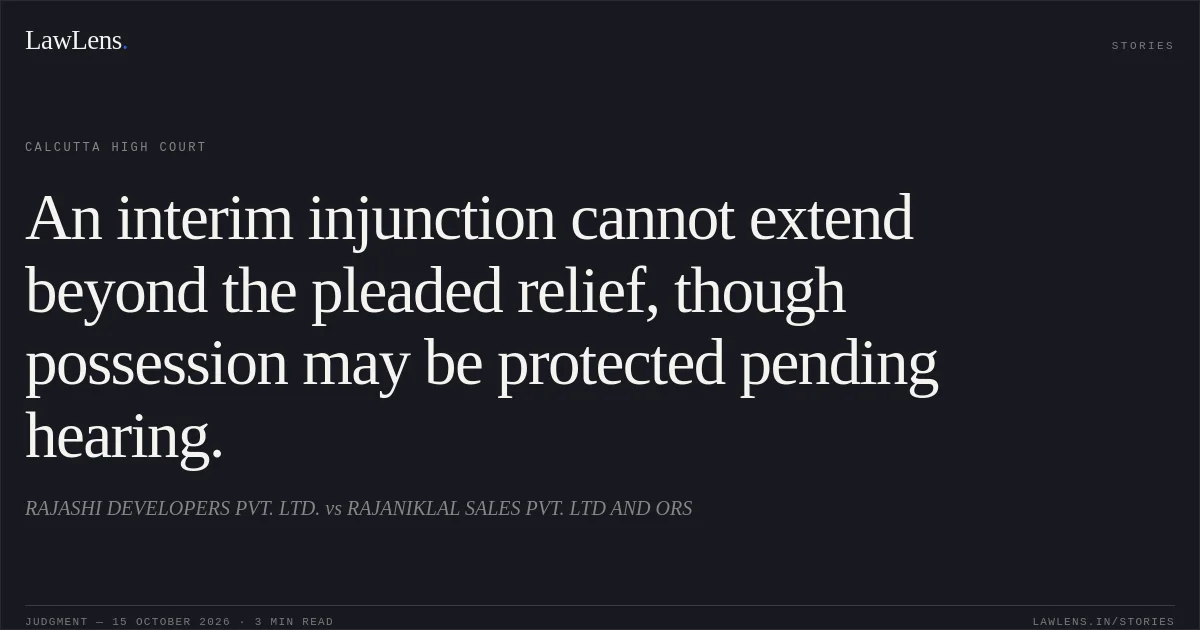
The plaintiff-company sued for a declaration that it was a monthly tenant of the suit premises and for an injunction protecting its possession.
Source reference: para. 1–8The Trial Court ordered both parties to maintain status quo as to the premises’ nature, character and possession.
Source reference: para. 1–8Defendant no. 4 appealed, arguing, among other things, that the suit was time-barred, defective for non-joinder and contradictory, commercial in nature, and that the status quo order exceeded the relief sought.
Source reference: para. 1–8The plaintiff relied on alleged threats to its possession on 2 September 2026 as the immediate trigger for filing suit on 3 September 2026.
Source reference: para. 9, 24–26Issues
1. Whether the suit was barred by limitation.
Source reference: para. 16(i), 18–322. Whether non-joinder of the alleged heirs of the original landlady prevented interim relief.
Source reference: para. 16(ii), 33–393. Whether the discrepancy in the principal prayer and the plaint’s pleaded tenancy relationship disclosed a contradictory claim or no cause of action.
Source reference: para. 16(iii), 40–444. Whether the dispute was a commercial dispute under the Commercial Courts Act, 2015, and whether the specified-value test applied.
Source reference: para. 16(iv), 45–495. Whether the Trial Court’s status quo order granted relief beyond the prayers in the suit and injunction application.
Source reference: para. 16(v), 50–53Law Applied
The Court considered the Limitation Act, 1963, including the limitation principles discussed in Calcutta Landing & Shipping Co. Limited v. Manbasa Devei and Others, 2022 SCC OnLine Cal 1623; it treated limitation, on the pleadings before it, as a potentially mixed question of fact and law.
Source reference: no citationIt applied the principle that a plaint must be read as a whole when assessing its cause of action and reliefs, and that non-joinder is not, by itself, a bar to interim relief where the alleged omitted parties are not necessary to the suit as framed.
Source reference: no citationUnder Section 2(1)(c)(vii) of the Commercial Courts Act, 2015, a dispute must first qualify as a commercial dispute involving an agreement relating to immovable property used exclusively in trade or commerce; Section 12 governs specified value by reference to the value of the property that is the subject matter of the dispute.
Source reference: no citationInterim relief must also remain within the prayers sought.
Source reference: no citationReasoning
The Court read the plaint as a whole and held that the 2023 letters did not, on their face, threaten the plaintiff’s tenancy or possession; the pleaded threat arose on 2 September 2026, making it premature to find the suit time-barred at the interim stage.
Source reference: para. 19–31It found no basis to treat the original landlady’s alleged heirs as necessary parties, noting that no threat was attributed to them and that defendant no. 2 had been impleaded.
Source reference: para. 33–39The reference to defendant no. 1 in the principal prayer was treated as an apparent, curable error because the rest of the plaint claimed tenancy through the original landlady and defendant no. 2.
Source reference: para. 40–44Although the premises were described as a godown, the pleadings did not establish that they were used in connection with an ongoing trade or commercial enterprise; the commercial-dispute issue therefore could not be conclusively decided at that stage.
Source reference: para. 45–49The Court held that status quo as to the nature and character of the premises exceeded the relief sought, but that protection of the plaintiff’s possession was supported by the material before it.
Source reference: para. 50–53Holding
The appeal was partially allowed.
The Court modified the Trial Court’s order to restrain the defendants from disturbing the plaintiff’s peaceful possession until disposal of the temporary injunction application, but set aside the directions imposing status quo on the plaintiff and as to the premises’ nature and character.
Source reference: para. 54–55The defendants were directed to file objections to the injunction application, which the Trial Court was asked to decide expeditiously; CAN 1 of 2026 was disposed of, with no order as to costs.
Source reference: para. 56–58Acts & Sections Cited
2 provisions across 1 statute referred to in this judgment. Each provision opens on LawLens.
Commercial Courts Act, 20152
Original Court PDF
RAJASHI DEVELOPERS PVT. LTD.vsRAJANIKLAL SALES PVT. LTD AND ORS
Click to open original judgment
Original judgment, available to read, download and summarize on LawLens.in