Facts
The applicant, a TGT (English) at Jawahar Navodaya Vidyalaya, Mariahu, was suspended on 14 March 2005.
Source reference: para. 2The Tribunal stayed the suspension order on 31 May 2005 and subsequently quashed it on 9 November 2005, directing payment of full pay and allowances from the date of suspension.
Source reference: para. 2–4The respondents revoked the suspension on 28 October 2005 and communicated the order to the applicant in November 2005.
Source reference: para. 2–4The applicant maintained that he had attempted to rejoin, including by sending joining reports, but the respondents said he did not formally assume charge.
Source reference: para. 2–4, 6He ultimately submitted a joining report on 31 January 2007 and was permitted to join from 1 February 2007.
Source reference: para. 2–4, 6The respondents treated 29 October 2005 to 31 January 2007 as unauthorised absence causing interruption in service and denied pay and allowances for that period.
Source reference: para. 2–4, 6Issues
1. Whether the applicant’s absence from 29 October 2005 to 31 January 2007 was authorised or could be treated as a period of duty, entitling him to pay and allowances
Source reference: para. 6, 8–152. Whether the respondents’ orders treating that period as an interruption or break in service were sustainable under the applicable Fundamental Rules
Source reference: para. 6, 12–16Law Applied
Fundamental Rule 17(1) provides that an officer draws the pay and allowances attached to a post from the date the officer assumes its duties and ceases to draw them when those duties cease; its proviso denies pay and allowances for absence from duty without authority.
Source reference: para. 7Fundamental Rule 17-A(iii) provides that an individual employee’s unauthorised absence or desertion of post is deemed to cause an interruption or break in service, unless the competent authority decides otherwise for the limited purposes specified in that rule.
Source reference: para. 7The Tribunal also considered Rule 10(1) of the CCS (CCA) Rules, 1965, under which the applicant had initially been suspended.
Source reference: para. 2Reasoning
The Tribunal found that the applicant had not actually assumed charge or discharged duties at Mariahu during the disputed period.
Source reference: para. 6, 8–10His communications and joining reports, including the report sent by post, did not establish that he had formally resumed duty; the record showed that he joined only on 1 February 2007.
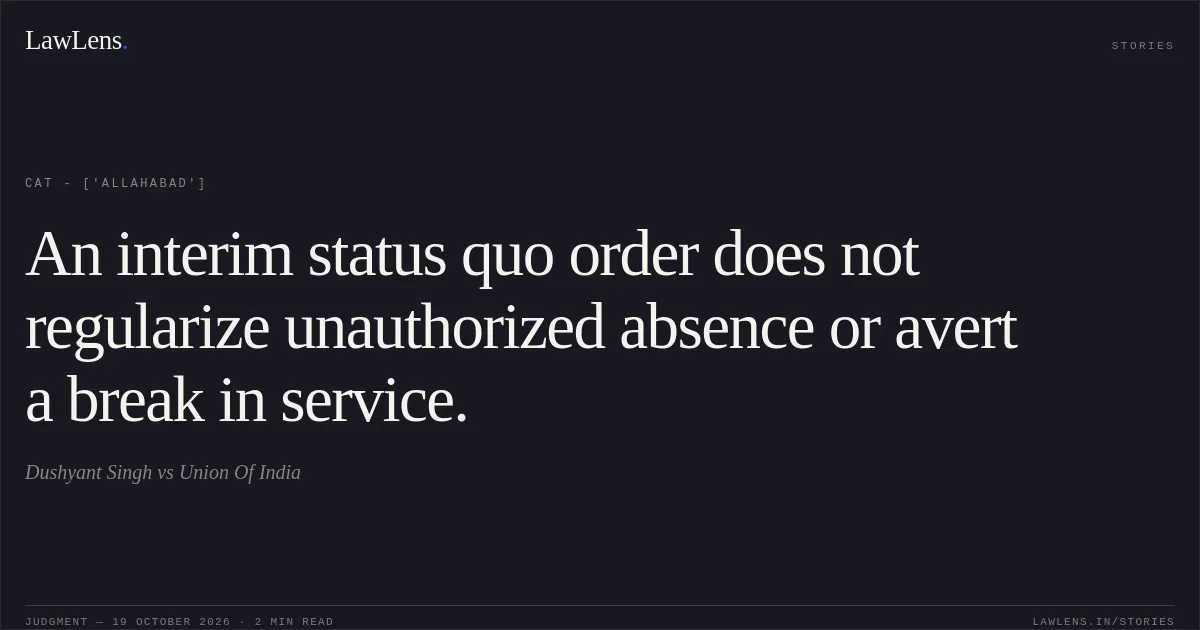
Source reference: para. 6, 8–10The status quo order in the applicant’s transfer case neither granted leave nor authorised his absence, and it could not retrospectively validate the period before that order was made.
Source reference: para. 7, 11, 15Applying FR 17(1) and FR 17-A(iii), the Tribunal concluded that the absence was unauthorised and that no competent-authority order regularising it had been produced.
Source reference: para. 12–16Holding
The Tribunal held that the applicant had not established a right to treat 29 October 2005 to 31 January 2007 as duty or to receive pay and allowances for that period.
It upheld the impugned orders and dismissed the O.A. with no order as to costs; pending miscellaneous applications were deemed disposed of.
Source reference: para. 16–17Acts & Sections Cited
1 provisions across 1 statute referred to in this judgment. Each provision opens on LawLens.
Administrative Tribunals Act, 19851
Original Court PDF
Dushyant SinghvsUnion Of India
Click to open original judgment
Original judgment, available to read, download and summarize on LawLens.in