01Facts
The petitioners claimed ownership and possession of lands situated in Survey Nos. 348, 349, 350 and 351 of Kongara Khurd-A Village, Maheshwaram Mandal, Ranga Reddy District, on the basis of Occupancy Rights Certificates (ORCs) issued on 4 June 2002.
¶ 3Their names were subsequently mutated in the revenue records, and pattadar passbooks and title deeds were issued in their favour.
¶ 7–9The lands were included in AP Gazette No. 6 dated 9 February 1989, Serial No. 2151, as waqf properties under Section 52 of the Waqf Act, 1954, and were again included through an addendum published on 8 February 2007.
¶ 1The petitioners contended that neither survey nor notice was undertaken before the notifications were issued.
¶ 3.2The Waqf Board disputed the petition on the grounds of delay and laches, absence of locus standi, availability of an alternative remedy before the Waqf Tribunal, and the independent validity of the 2007 addendum.
¶ 5–5.202Issues
i.Whether the inclusion of the petitioners’ lands in AP Gazette No. 6 dated 9 February 1989 as waqf property was lawful when the statutory procedure under the Waqf Act, 1954, including survey and notice requirements, was allegedly not followed
¶ 1, 3.2, 10–11ii.Whether the addendum dated 8 February 2007, insofar as it included the petitioners’ lands as waqf properties, was legally sustainable
¶ 1, 12–13iii.Whether the writ petition was liable to be dismissed on the grounds of delay and laches or availability of an alternative remedy before the Waqf Tribunal
¶ 5–5.103Law Applied
The Court applied the statutory scheme of the Waqf Act, 1954, including Section 52, and the requirement that statutory authorities must follow the prescribed procedure before declaring private lands to be waqf properties.
¶ 1, 3.2, 10It relied on B. Gowra Reddy v. Government of Andhra Pradesh, AIR 2002 AP 313; (2002) 3 ALT 439, in which the High Court had set aside the 9 February 1989 notification insofar as it related to the affected petitioners because the provisions of the Waqf Act, 1954, had not been followed.
¶ 10The Court also treated the reasoning in W.P. No. 35945 of 2025, decided on 15 September 2026, as applicable to the identical issues raised in the present case.
¶ 11A notification or addendum identifying land as waqf property must have a lawful statutory basis and cannot survive when the foundational notification is invalid.
¶ 13–14Provisions in the judgment · 1
Waqf (Amendment) Act, 2025 Section 52
04Reasoning
The Court found that the petitioners had produced material demonstrating their possession and recognised revenue rights, including the ORCs, pattadar passbooks and title deeds.
¶ 7–9In contrast, although the Waqf Board asserted that a survey had been conducted and notices had been issued, it placed no supporting material on record.
¶ 8The Court therefore applied the principle in B. Gowra Reddy and held that the 1989 notification was vitiated by non-compliance with the statutory procedure.
¶ 10–11As to the 2007 addendum, the Court noted that it did not specify the statutory provision or enactment under which it had been issued and that the Waqf Board had taken no steps for nearly eighteen years to evict the petitioners or recover possession.
¶ 12Since the original 1989 notification was invalid, the addendum, insofar as it concerned the petitioners’ lands, could not independently remain valid.
¶ 13The Court accordingly rejected the respondents’ objections and followed the reasoning and directions issued in W.P. No. 35945 of 2025.
¶ 11, 1405Holding
The writ petition was allowed.
¶ 14The Court set aside AP Gazette No. 6 dated 9 February 1989, Serial No. 2151, issued under Section 52 of the Waqf Act, 1954, and the addendum published on 8 February 2007, insofar as they related to the petitioners’ lands in Survey Nos. 348, 349, 350 and 351.
¶ 14The reasons and directions in the order dated 15 September 2026 in W.P. No. 35945 of 2025 were directed to form part of the present order.
¶ 15Pending miscellaneous petitions were closed, with no order as to costs.
¶ 15Original Court PDF
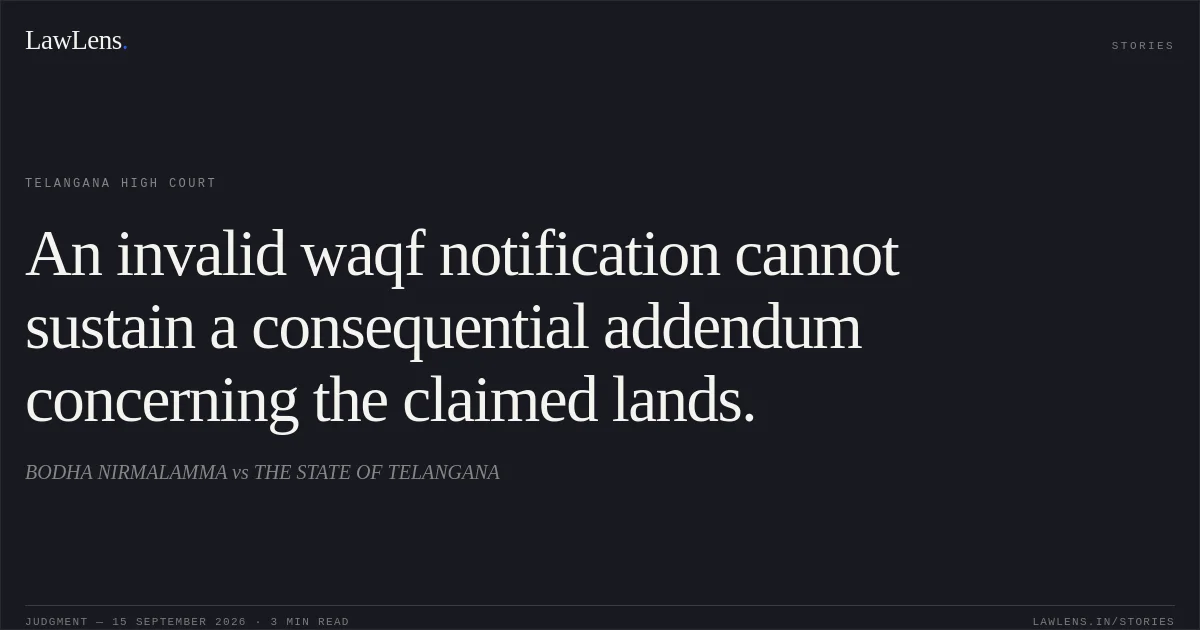
BODHA NIRMALAMMAvsTHE STATE OF TELANGANA
Click to open original judgment
Original judgment, available to read, download and summarize on LawLens.in