Facts
On 22 April 2006, Sarfaraz Sikandar Malvi was travelling as a pillion rider on motorcycle No. GJ-6-AQ-6176 when it was allegedly hit by tempo No. GJ-6-Z-5642, driven rashly and negligently while travelling from Dabhoi to Vaghodia.
Source reference: p.1; paras. 2–2.2He sustained grievous injuries and subsequently died. The legal representatives instituted Motor Accident Claim Petition No. 1201 of 2006 before the Motor Accident Claims Tribunal, Vadodara.
Source reference: p.1; paras. 2–2.2The Tribunal awarded compensation of ₹6,41,200 with interest at 9% per annum from the date of filing until realization.
Source reference: p.1; paras. 2–2.2IFFCO Tokio General Insurance Co. Ltd. appealed, principally disputing its liability to satisfy the award on the ground that the tempo driver possessed only an LMV licence and lacked a specific transport-vehicle endorsement.
Source reference: p.2; para. 2.3; p.3; para. 4Issues
1. Whether the insurer could avoid liability on the ground that the tempo driver held an LMV driving licence without a separate endorsement authorising him to drive a transport vehicle?
Source reference: p.3; paras. 4–52. Whether a driver holding an LMV licence may drive a transport vehicle having a gross vehicle weight below 7,500 kg without an additional transport-vehicle authorisation?
Source reference: p.4; para. 7Law Applied
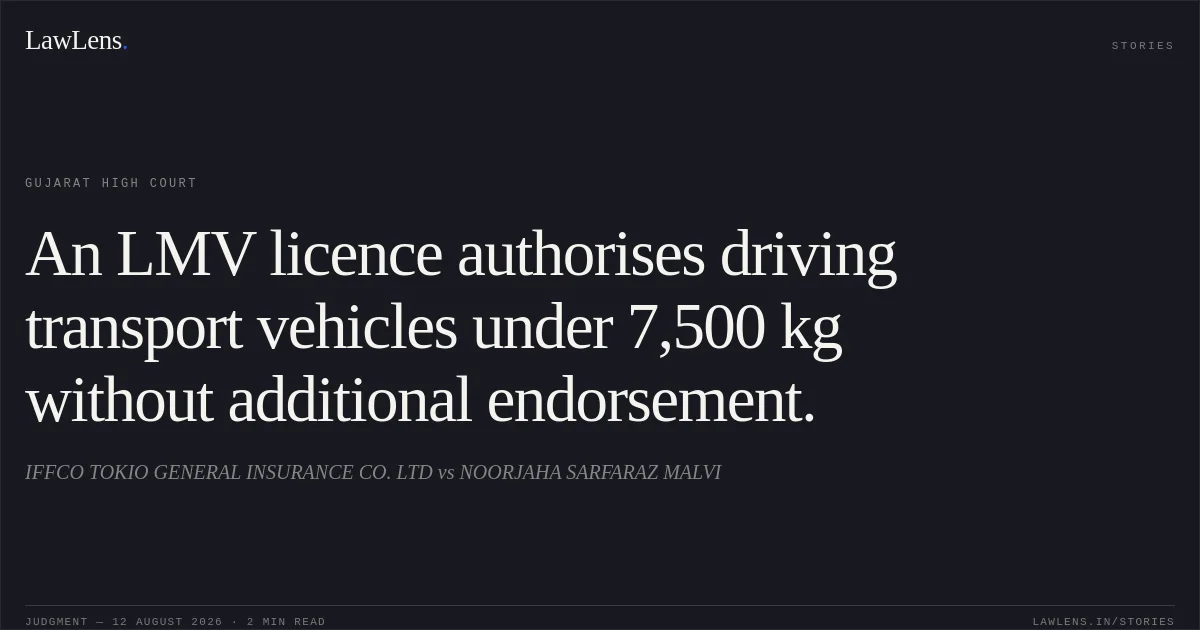
The Court applied Sections 2(21), 3(1), and 10(2)(d)–(e) of the Motor Vehicles Act, 1988, as interpreted in Mukund Dewangan v. Oriental Insurance Co. Ltd., (2017) 14 SCC 663, holding that an LMV licence is sufficient to drive a transport vehicle whose gross vehicle weight is below 7,500 kg, without a separate transport-vehicle endorsement.
Source reference: pp. 3–5; para. 7This principle was affirmed by the Constitution Bench in Bajaj Alliance General Insurance Co. Ltd. v. Rambha Devi & Ors., (2025) 3 SCC 95, which held that LMV and transport vehicles are not wholly distinct licensing classes and that the additional transport-vehicle eligibility requirements generally apply to vehicles exceeding 7,500 kg, subject to special categories such as hazardous-goods vehicles.
Source reference: pp. 3–5; para. 7Reasoning
The vehicle’s Registration Certificate showed a gross vehicle weight of 1,050 kg and an unladen weight of 415 kg, placing it well below the 7,500-kg threshold.
Source reference: p.4; para. 7The driver’s licence authorised him to drive an LMV.
Source reference: p.4; para. 7Applying Mukund Dewangan, as affirmed and explained in Rambha Devi, the Court held that the absence of a separate transport-vehicle endorsement did not constitute a breach sufficient to exonerate the insurer.
Source reference: pp. 4–5; paras. 7–8Since the insurer’s sole challenge concerned its liability to satisfy the award, and the factual requirements for the LMV rule were established, the appeal lacked merit.
Source reference: pp. 4–5; paras. 7–8Holding
The Court answered the issues against the insurer and held that the LMV licence was legally sufficient to authorise the driver to operate the tempo, since its gross vehicle weight was below 7,500 kg.
The First Appeal was dismissed, thereby affirming the Tribunal’s award of ₹6,41,200 with 9% annual interest.
Source reference: p.5; para. 9The Tribunal was directed to disburse the compensation to the claimants after due verification and deduction of any deficit court fees.
Source reference: p.6; paras. 10–12Any statutory amount deposited before the High Court was directed to be transmitted to the Tribunal; there was no order as to costs.
Source reference: p.6; paras. 10–12Acts & Sections Cited
3 provisions across 1 statute referred to in this judgment. Each provision opens on LawLens.
Motor Vehicles Act, 19883
Original Court PDF
IFFCO TOKIO GENERAL INSURANCE CO. LTDvsNOORJAHA SARFARAZ MALVI
Click to open original judgment
Original judgment, available to read, download and summarize on LawLens.in