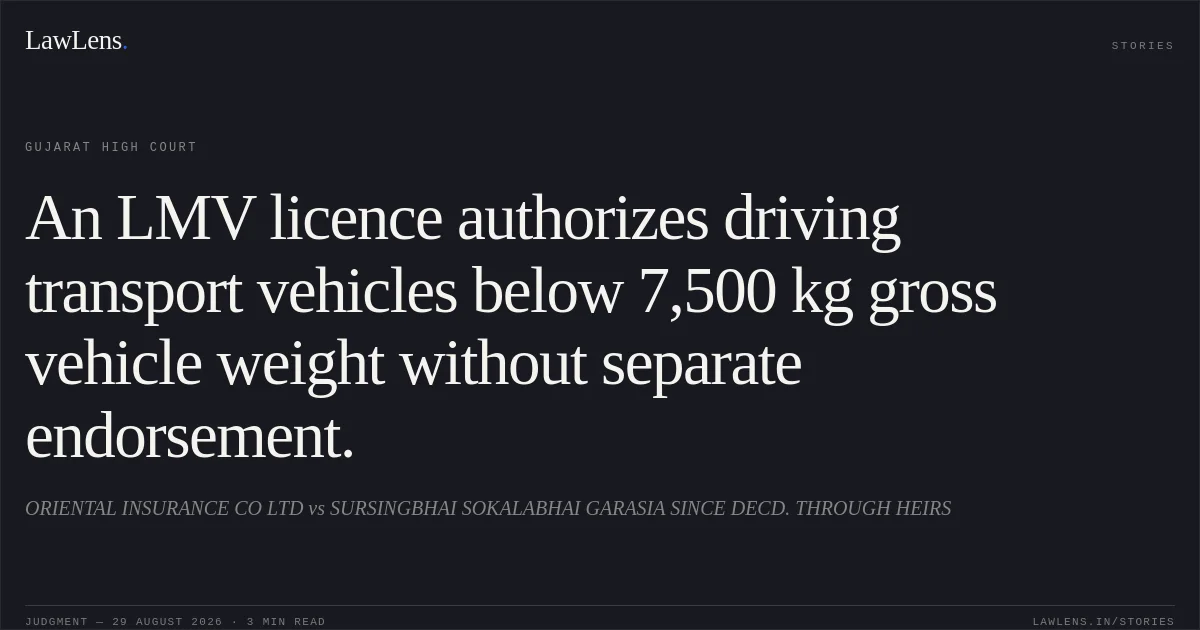
Facts
On 27 October 2008, Sursingbhai Sokalabhai Garasia was travelling as a passenger in jeep bearing registration No. GJ-08-V-7216. The jeep’s rear wheel burst while it was allegedly being driven at excessive speed and negligently, causing it to leave the road and collide with a date-palm tree. The deceased sustained grievous injuries and subsequently died.
Source reference: pp.1–3; paras. 1–2.3His legal heirs filed Motor Accident Claim Petition No. 734 of 2008 before the Motor Accident Claims Tribunal, Dahod. The Tribunal awarded ₹5,26,400 with interest at 6% per annum from the date of filing until realization. The Insurance Company challenged the award, contending that the driver possessed only an LMV licence and was not authorised to drive the transport vehicle.
Source reference: pp.1–3; paras. 1–2.3Issues
Whether the driver, who held a driving licence for a Light Motor Vehicle (LMV), possessed a valid and effective licence to drive the jeep involved in the accident, which was claimed by the insurer to be a transport vehicle.
Source reference: pp.3–4; para. 4Whether the Insurance Company was entitled to be exonerated from satisfying the compensation award on the ground of breach of the policy condition relating to the driver’s licence.
Source reference: pp.3–4; paras. 4, 6Law Applied
Under Section 2(21) of the Motor Vehicles Act, 1988, a vehicle whose unladen weight does not exceed 7,500 kg falls within the definition of a Light Motor Vehicle.
Source reference: p.4; para. 6The Supreme Court’s decision in Mukund Dewangan v. Oriental Insurance Co. Ltd., (2017) 14 SCC 663, and the authoritative ruling in Bajaj Allianz General Insurance Co. Ltd. v. Rambha Devi & Ors., (2025) 3 SCC 95, establish that a person holding an LMV licence may drive a transport vehicle falling within the LMV category without obtaining a separate transport-vehicle authorisation under Section 10(2)(e) of the Motor Vehicles Act. The additional licensing requirements for transport vehicles principally apply to vehicles exceeding 7,500 kg, subject to special statutory requirements for specified vehicles such as those carrying hazardous goods.
Source reference: p.4; para. 6Reasoning
The driver’s licence, proved at Exhibit 25, was valid from 26 August 2003 to 25 August 2023 and therefore remained valid on the date of the accident, 27 October 2008.
Source reference: pp.4–5; para. 6Although the insurer relied on the vehicle’s classification as a transport vehicle, the registration certificate, proved at Exhibit 26, showed that the jeep’s unladen weight was 1,740 kg. It consequently fell within the LMV category. Applying Mukund Dewangan and Rambha Devi, the Court held that the driver’s LMV licence was sufficient to authorise him to drive the vehicle, notwithstanding its use as a transport vehicle. The insurer therefore failed to establish a licensing breach warranting exoneration from liability.
Source reference: pp.4–5; para. 6Holding
The High Court held that the driver possessed a valid licence to drive the offending jeep and that the Insurance Company was not entitled to avoid liability.
Finding no infirmity in the Tribunal’s award of ₹5,26,400 with interest at 6% per annum, the Court dismissed the appeal. The Tribunal was directed to disburse the amount to the claimants after deducting any deficit court fees and completing due verification; any statutory amount deposited in the High Court was directed to be transmitted to the Tribunal. No order as to costs was made.
Source reference: pp.5–6; paras. 7–11Acts & Sections Cited
3 provisions across 1 statute referred to in this judgment. Each provision opens on LawLens.
Motor Vehicles Act, 19883
Original Court PDF
ORIENTAL INSURANCE CO LTDvsSURSINGBHAI SOKALABHAI GARASIA SINCE DECD. THROUGH HEIRS
Click to open original judgment
Original judgment, available to read, download and summarize on LawLens.in
![A police constable cannot be removed for unauthorized absence without a Rule 359-compliant inquiry.. Mohammad Sidiq Khan vs D/o Home Ut Of Jammu & Kashmir. CAT - ['Srinagar']. LawLens](/stories/thumbnails/a-police-constable-cannot-be-removed-for-unauthorized-absence-without-a-rule-359-compliant-7b43fc316bd94f22a62676153bbc9d54.webp)
![A Review DPC lacks authority to determine or alter inter se seniority.. SAURABH KUMAR vs REVENUE. CAT - ['Patna']. LawLens](/stories/thumbnails/a-review-dpc-lacks-authority-to-determine-or-alter-inter-se-seniority-4b21640f20af46fcabdfc8273d2ce959.webp)