Facts
The petitioner joined M/s. Religare Wellness Limited as its Chief Executive Officer on 02.01.2009 and was appointed Whole-Time Director on 28.03.2013; he resigned from the directorship with effect from 31.07.2020.
Source reference: paras. 2.2, p.3Respondent No. 2, an employee of the company, was terminated on 19.07.2011 and successfully challenged the termination before the Industrial Tribunal-cum-Labour Court, which directed his reinstatement with 40% back wages by award dated 06.11.2015.
Source reference: para. 2.3, p.4Although the company allegedly offered reinstatement, respondent No. 2 pursued execution proceedings and approached the Labour Inspector for enforcement of the award.
Source reference: paras. 2.4–2.6, pp.4–5The Labour Inspector instituted Complaint No. COMA-81/2016 dated 25.05.2016 under Sections 29, 31 and 32 of the Industrial Disputes Act, 1947, against the petitioner in his individual capacity, alleging non-implementation of the award by the company. The company itself was not arrayed as an accused.
Source reference: paras. 2, 2.6, pp.2, 5On the same date, the Chief Judicial Magistrate, Gurgaon, summoned the petitioner. The petitioner challenged the complaint, summoning order and consequential proceedings under Section 482 Cr.P.C., contending that he had been prosecuted merely because of his designation as CEO and that no independent criminal liability was pleaded against him.
Source reference: paras. 2.7–2.9, pp.5–6Issues
1. Whether an officer of a company can be prosecuted for the company’s alleged non-compliance with an industrial award merely by virtue of holding the designation of CEO, without specific allegations establishing his personal criminal liability?
Source reference: paras. 3–4, pp.7–8; paras. 8.1–8.2, pp.14–152. Whether the complaint and summoning order were legally sustainable when the company, against which the alleged non-compliance was principally attributed, had not been arrayed as an accused?
Source reference: paras. 8.1–8.5, pp.14–173. Whether continuation of the complaint and consequential proceedings against the petitioner constituted an abuse of process warranting exercise of the High Court’s inherent jurisdiction under Section 482 Cr.P.C.?
Source reference: paras. 6–8.7, pp.9–18Law Applied
The Court applied Sections 29, 31 and 32 of the Industrial Disputes Act, 1947, concerning penal consequences for breach or non-compliance with an award and the liability of persons connected with the offending establishment.
Source reference: para. 2, p.2Under Section 482 Cr.P.C., corresponding to Section 528 of the BNSS, the High Court may quash criminal proceedings to prevent abuse of process or secure the ends of justice, but must exercise that power sparingly and without conducting a mini-trial.
Source reference: paras. 6–7.2, pp.9–14Applying State of Haryana v. Bhajan Lal, the Court recognised that quashing is permissible where the allegations, even if accepted in their entirety, do not constitute an offence or do not disclose a prosecutable case against the accused.
Source reference: para. 6.3, pp.11–13M/s. Neeharika Infrastructure Pvt. Ltd. v. State of Maharashtra was relied upon for the principle that the High Court should not assess the reliability or ultimate probability of the prosecution case while exercising inherent jurisdiction.
Source reference: paras. 7–7.2, pp.13–14Relying on Sunil Bharti Mittal v. CBI, Aneeta Hada v. Godfather Travels & Tours (P) Ltd. and Standard Chartered Bank v. State of Maharashtra, the Court held that criminal liability is ordinarily personal; vicarious liability of directors or officers cannot be presumed without statutory authorisation and specific foundational averments, and ordinarily there can be no vicarious liability of an officer where the company itself has not been prosecuted.
Source reference: paras. 4, 8.3, pp.8, 15–16Reasoning
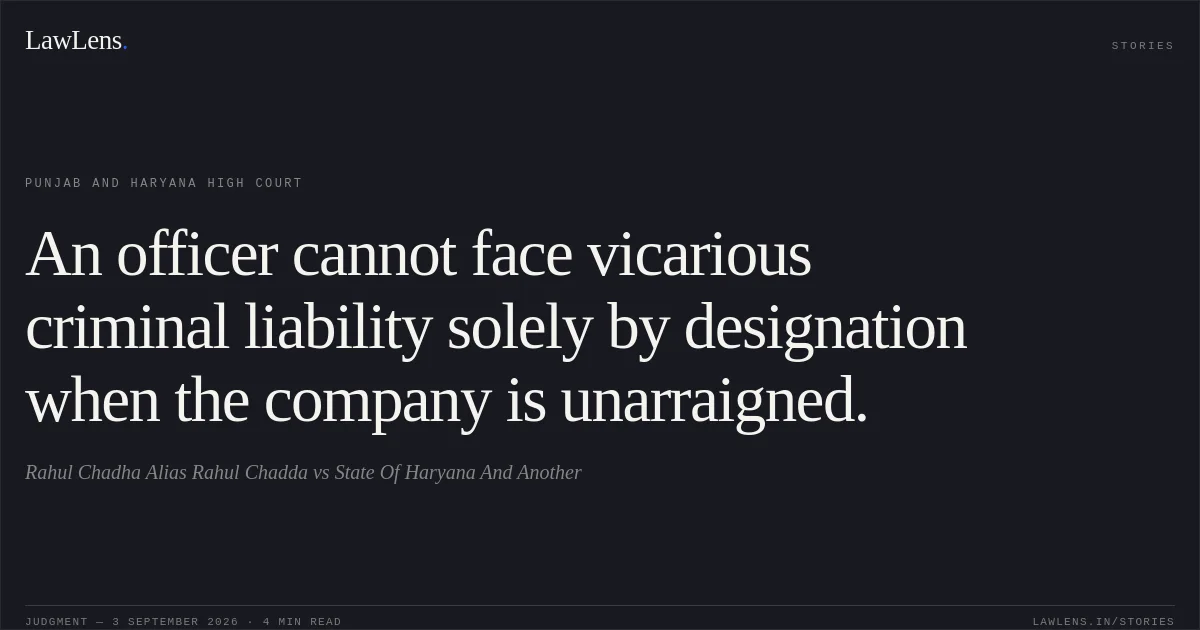
The Court found that the gravamen of the complaint concerned the alleged acts or omissions of M/s. Religare Wellness Limited, the entity responsible for implementing the industrial award. The petitioner was implicated only because he had been the company’s CEO, without specific allegations showing that he personally committed the offence or that the statute independently imposed liability upon him by virtue of his office.
Source reference: paras. 8.1–8.2, pp.14–15Since the company itself was not made an accused, the foundational corporate offender was absent from the prosecution. The Court held that the corporate veil could not be pierced mechanically and that designation alone could not establish individual criminal culpability.
Source reference: paras. 8.3–8.5, pp.15–17Accordingly, the complaint did not disclose a legally sustainable basis for proceeding against the petitioner, and continuation of the prosecution would subject him to criminal process without the necessary statutory and factual foundation, thereby constituting abuse of process.
Source reference: paras. 8.5–8.7, pp.16–18The Court therefore found it unnecessary to undertake an evidentiary inquiry into the company’s alleged offer of reinstatement or the merits of the award’s execution.
Source reference: no citationHolding
The Court allowed the petition and quashed Complaint No. COMA-81/2016 dated 25.05.2016, the summoning order of the same date, and all consequential proceedings qua the petitioner.
It held that the petitioner could not be prosecuted merely on account of his position as CEO, particularly when the company to which the alleged non-compliance was attributed had not been arrayed as an accused and no specific basis for personal criminal liability had been pleaded.
Source reference: para. 8.8, p.18The order was expressly confined to the petitioner and was not treated as an opinion on the maintainability of proceedings against any other person or entity.
Source reference: para. 8.8, p.18All pending miscellaneous and interconnected applications were disposed of as infructuous.
Source reference: para. 9, p.18Acts & Sections Cited
5 provisions across 3 statutes referred to in this judgment. Each provision opens on LawLens.
Code of Criminal Procedure, 19733
Negotiable Instruments Act, 18811
Bharatiya Nagarik Suraksha Sanhita, 20231
Original Court PDF
Rahul Chadha Alias Rahul ChaddavsState Of Haryana And Another
Click to open original judgment
Original judgment, available to read, download and summarize on LawLens.in