Facts
The petitioner was prosecuted pursuant to an FIR lodged by his wife alleging that, during pending matrimonial proceedings at Vijaypur, he abused and assaulted her within the court premises, causing injuries and damage to articles.
Source reference: para. 2–3The police filed a charge-sheet under Sections 323, 294, 324, 427 and 509 read with Section 34 IPC, and the Trial Court framed corresponding charges.
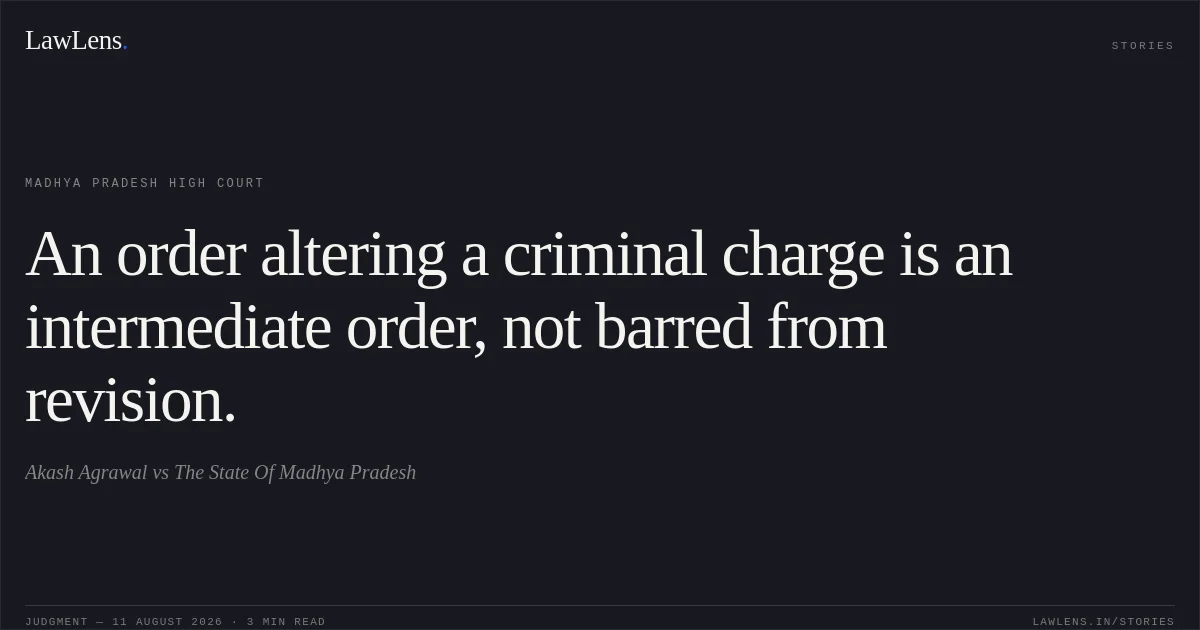
Source reference: para. 2–3After the prosecution evidence was concluded and the matter was fixed for final arguments, the Trial Court invoked Section 216 Cr.P.C. and altered the charge by substituting Section 325 IPC for Section 324 IPC.
Source reference: para. 4The petitioner’s criminal revision against that order was dismissed by the Additional Sessions Judge on the ground that the order was interlocutory and therefore barred by Section 397(2) Cr.P.C.
Source reference: para. 13–14The petitioner consequently approached the High Court under Section 528 BNSS/Section 482 Cr.P.C., contending that the alteration of charge had serious consequences and that the revision was maintainable.
Source reference: para. 1, 14Issues
1. Whether an order of the Trial Court altering a charge under Section 216 Cr.P.C., particularly at the stage of final arguments, is a purely interlocutory order attracting the bar under Section 397(2) Cr.P.C.
Source reference: para. 152. Whether the Revisional Court erred in dismissing the petitioner’s revision as not maintainable without examining whether the impugned order was an intermediate order.
Source reference: para. 213. Whether the High Court should itself adjudicate the legality of substituting Section 325 IPC for Section 324 IPC, or remand the matter for consideration by the Revisional Court on merits.
Source reference: para. 23Law Applied
The Court considered Section 397(2) Cr.P.C., which bars revisional interference against purely interlocutory orders, and Section 482 Cr.P.C./Section 528 BNSS concerning the High Court’s inherent jurisdiction.
Source reference: para. 14It also considered Section 216 Cr.P.C., which empowers a criminal court to alter or add to a charge before judgment.
Source reference: para. 4Relying on Amar Nath v. State of Haryana, (1977) 4 SCC 137, the Court stated that a purely interlocutory order is interim or temporary and does not decide or affect important rights or liabilities.
Source reference: para. 17Under Madhu Limaye v. State of Maharashtra, (1977) 4 SCC 551, an order may be non-final yet still constitute an intermediate order against which revision is maintainable.
Source reference: para. 18The relevant test is whether the order affects the accused’s rights or decides an important aspect of the trial.
Source reference: para. 19Reasoning
The Trial Court’s order was passed after completion of the prosecution evidence and at the stage of final arguments, altering the charge from Section 324 IPC to the more serious offence under Section 325 IPC.
Source reference: para. 4Such an alteration directly affected the petitioner’s substantive defence and exposed him to materially different criminal liability.
Source reference: no citationApplying the distinction between purely interlocutory and intermediate orders laid down in Amar Nath and Madhu Limaye, the High Court held that the order had serious consequences for the petitioner’s rights and the continuation of the proceedings and therefore could not be treated as a purely interlocutory order.
Source reference: para. 20The Revisional Court consequently committed a jurisdictional error by rejecting the revision solely on the ground of non-maintainability, without examining the character and effect of the Trial Court’s order.
Source reference: para. 21–22The High Court did not determine whether Section 325 IPC was substantively made out, despite the petitioner’s arguments regarding the absence of medical evidence of grievous hurt.
Source reference: para. 6–10Holding
The High Court held that the order altering the charge under Section 216 Cr.P.C. was not purely interlocutory and that the criminal revision could not have been dismissed as barred under Section 397(2) Cr.P.C.
Exercising its inherent jurisdiction, the Court set aside the Revisional Court’s approach and remanded the matter to the Revisional Court to decide the petitioner’s criminal revision afresh on merits in accordance with law.
Source reference: para. 23The Court expressly clarified that it had not expressed any opinion on the merits of the alteration of charge or on the merits of the criminal case.
Source reference: para. 23–24Acts & Sections Cited
12 provisions across 3 statutes referred to in this judgment. Each provision opens on LawLens.
Bharatiya Nagarik Suraksha Sanhita, 20231
Code of Criminal Procedure, 19733
Indian Penal Code, 18608
Original Court PDF
Akash AgrawalvsThe State Of Madhya Pradesh
Click to open original judgment
Original judgment, available to read, download and summarize on LawLens.in