Facts
The petitioners faced prosecution under Sections 323, 294, 324, 427 and 509 read with Section 34 of the IPC, based on a complaint by petitioner No. 1’s wife alleging that the petitioners abused and assaulted her within the court premises during pending matrimonial proceedings.
Source reference: p.2The Trial Court initially framed charges under Sections 294, 323/34, 324/34, 427 and 509 IPC.
Source reference: p.2After the prosecution evidence had concluded and the case had reached the stage of final arguments, the Trial Court exercised power under Section 216 Cr.P.C. and substituted Section 325 IPC for Section 324 IPC.
Source reference: p.3The petitioners challenged that order in revision, contending that there was no medical or other material showing grievous hurt, but the Revisional Court dismissed the revision as not maintainable on the ground that the Trial Court’s order was interlocutory and barred by Section 397(2) Cr.P.C.
Source reference: pp.3–4The petitioners thereafter invoked the High Court’s inherent jurisdiction under Section 482 Cr.P.C./Section 528 BNSS.
Source reference: p.4Issues
1. Whether an order altering the charge under Section 216 Cr.P.C. from Section 324 IPC to Section 325 IPC is a purely interlocutory order, thereby attracting the bar under Section 397(2) Cr.P.C.?
Source reference: para. 152. Whether the Revisional Court committed a jurisdictional error by dismissing the revision as not maintainable without examining whether the impugned order was an intermediate order affecting the accused’s rights?
Source reference: paras. 20–223. Whether the High Court should itself determine the correctness of substituting Section 325 IPC, or remand the matter to the Revisional Court for consideration on merits?
Source reference: paras. 21–23Law Applied
The Court considered Section 216 Cr.P.C., which empowers a criminal court to alter or add to a charge before judgment; Section 397(2) Cr.P.C., which bars revision against purely interlocutory orders; and Section 482 Cr.P.C./Section 528 BNSS, preserving the High Court’s inherent jurisdiction to prevent abuse of process and secure the ends of justice.
Source reference: paras. 14–16Relying on Amar Nath v. State of Haryana, (1977) 4 SCC 137, the Court reiterated that a purely interlocutory order is one that is interim or temporary and does not determine or affect important rights or liabilities.
Source reference: paras. 17–19Relying on Madhu Limaye v. State of Maharashtra, (1977) 4 SCC 551, it held that an order may be non-final yet still constitute an intermediate order, against which revision is maintainable.
Source reference: paras. 17–19The relevant test is whether the order substantially affects the accused’s rights or decides an important aspect of the criminal trial.
Source reference: para. 19Reasoning
The Trial Court’s alteration of the charge from Section 324 to the more serious offence under Section 325 IPC occurred after completion of prosecution evidence and at the stage of final arguments, thereby exposing the petitioners to materially different criminal liability.
Source reference: p.3Applying the principles in Amar Nath and Madhu Limaye, the High Court held that such an order could not automatically be characterised as a purely temporary or interlocutory order, because it had serious consequences for the petitioners’ substantive rights and the continuation of the proceedings.
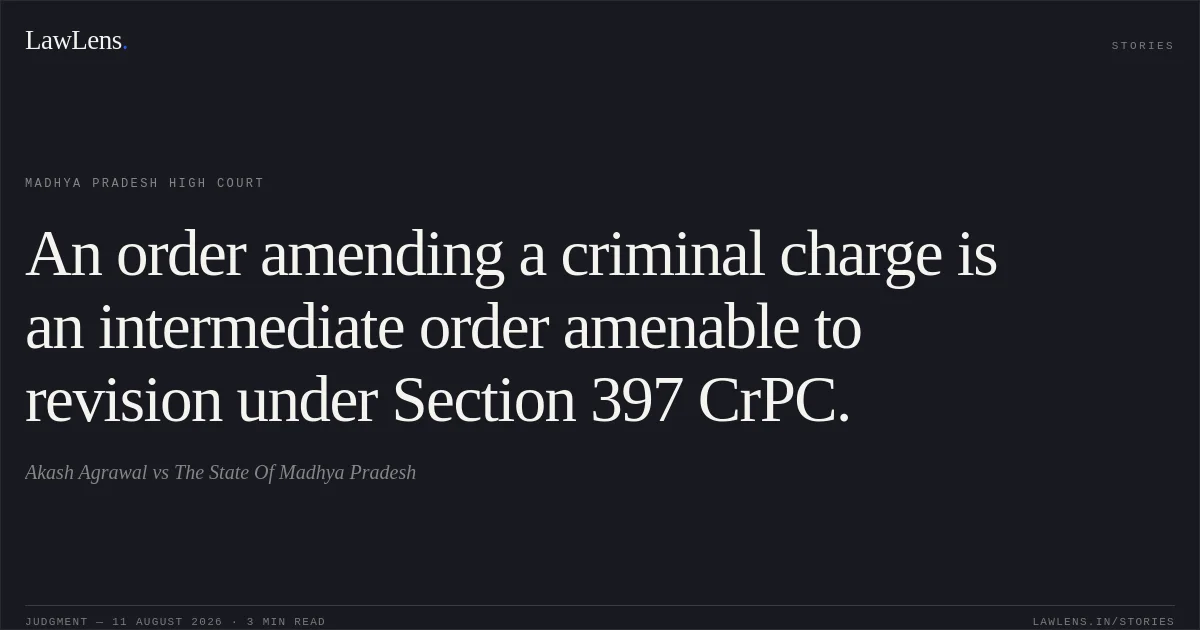
Source reference: paras. 18–20The Revisional Court therefore erred in treating the revision as barred under Section 397(2) Cr.P.C. without first determining whether the order was an intermediate order amenable to revision.
Source reference: paras. 20–22However, the High Court did not adjudicate the petitioners’ contention that the evidence failed to establish grievous hurt under Section 320 IPC or that Section 325 IPC was otherwise not attracted; it confined its decision to the maintainability of the revision.
Source reference: para. 23Holding
The High Court held that the Trial Court’s order altering the charge could not be treated, without further examination, as a purely interlocutory order.
The Revisional Court consequently committed a jurisdictional error in dismissing the revision as not maintainable.
Source reference: paras. 20–22Exercising inherent jurisdiction under Section 482 Cr.P.C., the High Court disposed of the petition and remanded the criminal revision to the Revisional Court for fresh decision on merits in accordance with law.
Source reference: para. 23The Court expressly clarified that it had expressed no opinion on the merits of the charge under Section 325 IPC or on the underlying prosecution case.
Source reference: para. 23Acts & Sections Cited
12 provisions across 3 statutes referred to in this judgment. Each provision opens on LawLens.
Bharatiya Nagarik Suraksha Sanhita, 20231
Code of Criminal Procedure, 19733
Indian Penal Code, 18608
Original Court PDF
Akash AgrawalvsThe State Of Madhya Pradesh
Click to open original judgment
Original judgment, available to read, download and summarize on LawLens.in