Facts
The petitioner challenged two orders made in R.A. No. 80/2023: an order dated 9 January 2024 allowing the respondent’s application under Section 5 of the Limitation Act to condone a delay of four years and four months, and an order dated 12 January 2024 granting a temporary stay of execution in O.S. No. 20/2014.
Source reference: pp. 3–5, paras 1, 3–5The appellate court issued notice on the limitation application on 31 October 2023. The petitioner appeared on 8 January 2024, and the application was allowed the following day.
Source reference: pp. 5–8, paras 6–8The order recorded that the application was unopposed but gave no reasons for condoning the delay.
Source reference: pp. 5–8, paras 6–8The stay order had expired by 12 March 2024.
Source reference: p. 4, para 4Issues
Whether the petitioner was given a sufficient opportunity to object to the application seeking condonation of delay before it was allowed
Source reference: pp. 5–8, paras 5–8Whether the appellate court’s order condoning the delay was sustainable despite giving no reasons for its decision
Source reference: pp. 7–8, paras 8–9Whether any further relief was required concerning the temporary stay order that had expired
Source reference: p. 4, para 4Law Applied
Section 5 of the Limitation Act empowers a court to condone delay where sufficient cause is established; an application invoking that provision must be determined after a fair opportunity to the opposing party.
Source reference: pp. 7–11, paras 9–10Under the principles of natural justice, a party must have a meaningful opportunity to present objections.
Source reference: pp. 7–11, paras 9–10Judicial and quasi-judicial orders must provide intelligible reasons demonstrating application of mind.
Source reference: pp. 7–11, paras 9–10The Court relied on Uttar Pradesh State Road Transport Corporation v. Jagdish Prasad Gupta, (2009) 12 SCC 609, which holds that reasons are necessary to ensure clarity, accountability and effective review, and Kranti Associates (P) Ltd. v. Masood Ahmed Khan, (2010) 9 SCC 496, which explains that reasoned decisions restrain arbitrariness and are an essential component of fair decision-making.
Source reference: pp. 7–11, paras 9–10The temporary stay application arose under Order XLI Rule 5 read with Section 151 of the Code of Civil Procedure, 1908.
Source reference: p. 4, para 3Reasoning
The petitioner appeared on 8 January 2024, and the limitation application was decided on 9 January 2024. The High Court found that this interval did not provide sufficient opportunity to file objections; the fact that the order recorded the application as unopposed did not cure that deficiency.
Source reference: pp. 5–8, paras 6–8Further, the appellate court stated only that the grounds and documents were satisfactory, without explaining why a delay of four years and four months should be condoned. That failure to give reasons made the order unsustainable under the cited authorities.
Source reference: pp. 7–11, paras 8–10The separate stay order had already expired, so no further order was necessary on that issue.
Source reference: p. 4, para 4Holding
The High Court set aside the order dated 9 January 2024 allowing the Section 5 application and directed that the petitioner be permitted to file objections within two weeks.
The respondents may file a rejoinder, after which the appellate court must decide the application afresh; the parties’ rights and contentions were left open.
Source reference: p. 11, paras 11–13The challenge to the temporary stay order required no further relief because the order had expired.
Source reference: pp. 4, 11, paras 4, 13The writ petition was disposed of accordingly.
Source reference: pp. 4, 11, paras 4, 13Acts & Sections Cited
2 provisions across 2 statutes referred to in this judgment. Each provision opens on LawLens.
Limitation Act, 19631
Code of Civil Procedure, 19081
Original Court PDF
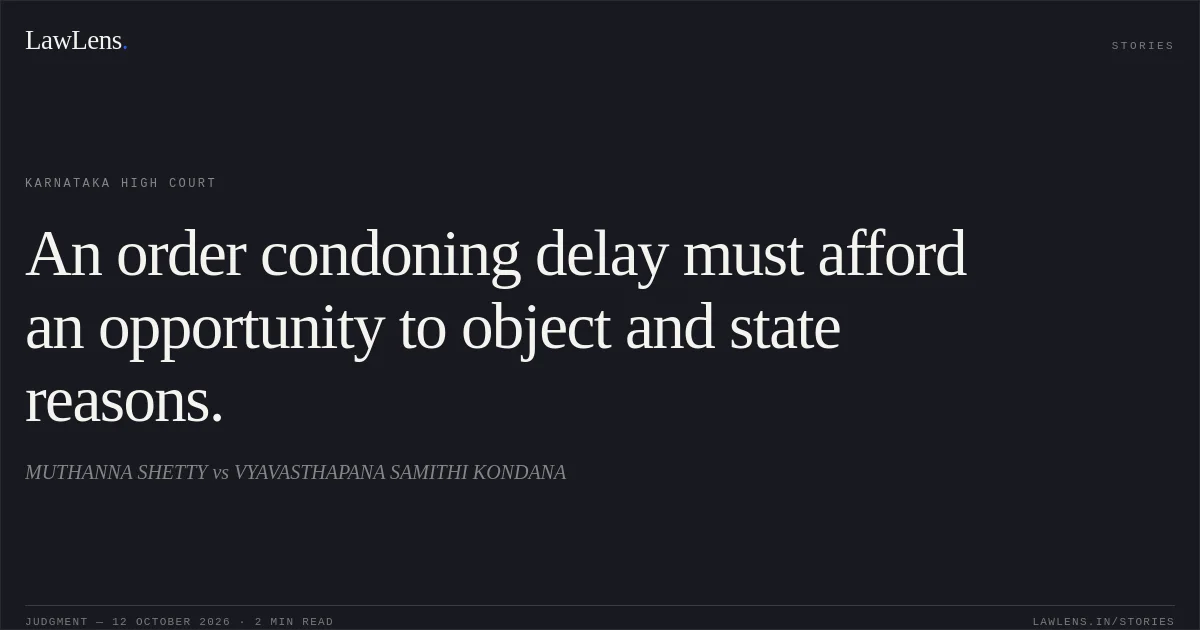
MUTHANNA SHETTYvsVYAVASTHAPANA SAMITHI KONDANA
Click to open original judgment
Original judgment, available to read, download and summarize on LawLens.in