Facts
The Petitioner is the father-in-law of Opposite Party No. 2 (Informant). Following a matrimonial dispute, the Informant filed an FIR under Sections 498A, 294, 323, 406, 506, and 34 of the IPC and Section 4 of the Dowry Prohibition Act.
Source reference: p. 2The Petitioner was granted bail, and subsequently, the Informant filed an application under Section 437(5) Cr.P.C. for cancellation of that bail.
Source reference: p. 3On 31.01.2025, the Ld. JMFC, Balasore, dismissed the cancellation application and warned the parties against filing "frivolous and vexatious petitions".
Source reference: p. 3The Public Prosecutor challenged this order via a Criminal Revision before the Sessions Judge, Balasore. The Petitioner raised a preliminary objection that the Magistrate's order was an "interlocutory order" and thus barred from revision under Section 397(2) Cr.P.C.
Source reference: p. 3The Sessions Judge rejected this objection on 11.07.2025, holding the revision maintainable.
Source reference: p. 3Issues
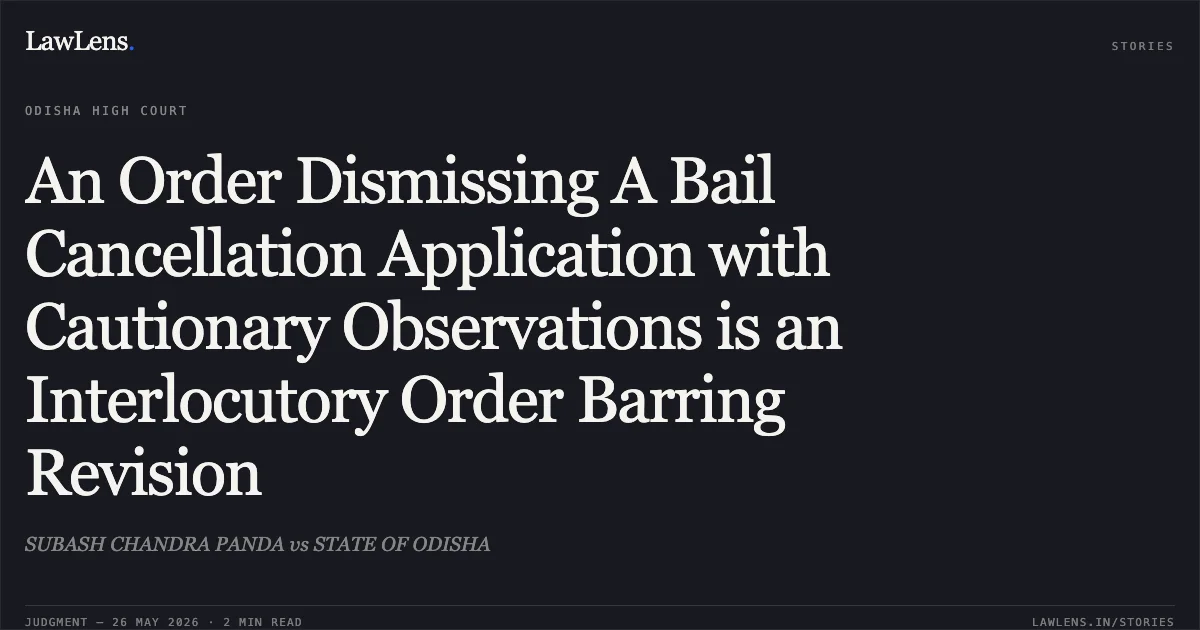
1. Whether the order passed by the Magistrate dismissing a bail cancellation application while warning against frivolous petitions constitutes an "interlocutory order" under Section 397(2) Cr.P.C., thereby barring a criminal revision.
Source reference: p. 10, para. 12Law Applied
Section 397(2) of the Code of Criminal Procedure (Cr.P.C.), which prohibits the exercise of revisional powers against interlocutory orders.
Source reference: p. 10The interpretation in Amar Nath v. State of Haryana, which established that "interlocutory order" denotes orders of a purely interim nature that do not decide important rights or liabilities.
Source reference: p. 8, 10The principle in Madhu Limaye v. State of Maharashtra, clarifying that orders affecting substantive rights or "matters of moment" are "intermediate orders" and are revisable.
Source reference: p. 5, 8S. Kuppuswamy Rao v. The King regarding the definition of finality in judicial decisions.
Source reference: p. 5Reasoning
The High Court examined whether the Magistrate’s cautionary remark—warning the informant not to file frivolous petitions—transformed the nature of the order from interlocutory to final and reasoned that the expression "interlocutory order" must be given a restricted meaning.
Source reference: p. 10It found that the Magistrate did not impose a blanket prohibition on legal recourse but merely issued a procedural warning to prevent the abuse of court process.
Source reference: p. 10-11The Court disagreed with the Sessions Judge’s view that the order had a "chilling effect" on substantive rights and concluded that because the direction was aimed at preventing frivolous litigation and did not decide any substantive rights in the main criminal proceeding, it remained strictly interlocutory in nature.
Source reference: p. 11Holding
The Court held that the Magistrate’s order dated 31.01.2025 was an interlocutory order and thus the Criminal Revision No. 13 of 2025 before the Sessions Judge was not maintainable under Section 397(2) Cr.P.C.
The CRLMC was dismissed, the interim order was vacated, and the Court declined to quash the underlying FIR or criminal proceedings under Section 482 Cr.P.C., stating that defense pleas cannot be examined at this stage.
Source reference: p. 12, para. 17-18Acts & Sections Cited
11 provisions across 5 statutes referred to in this judgment. Each provision opens on LawLens.
Code of Criminal Procedure, 19733
Bharatiya Nagarik Suraksha Sanhita, 20231
Protection of Women from Domestic Violence Act, 20051
Indian Penal Code, 18605
Dowry Prohibition Act, 19611
Original Court PDF
SUBASH CHANDRA PANDAvsSTATE OF ODISHA
Click to open original judgment
Original judgment, available to read, download and summarize on LawLens.in