Facts
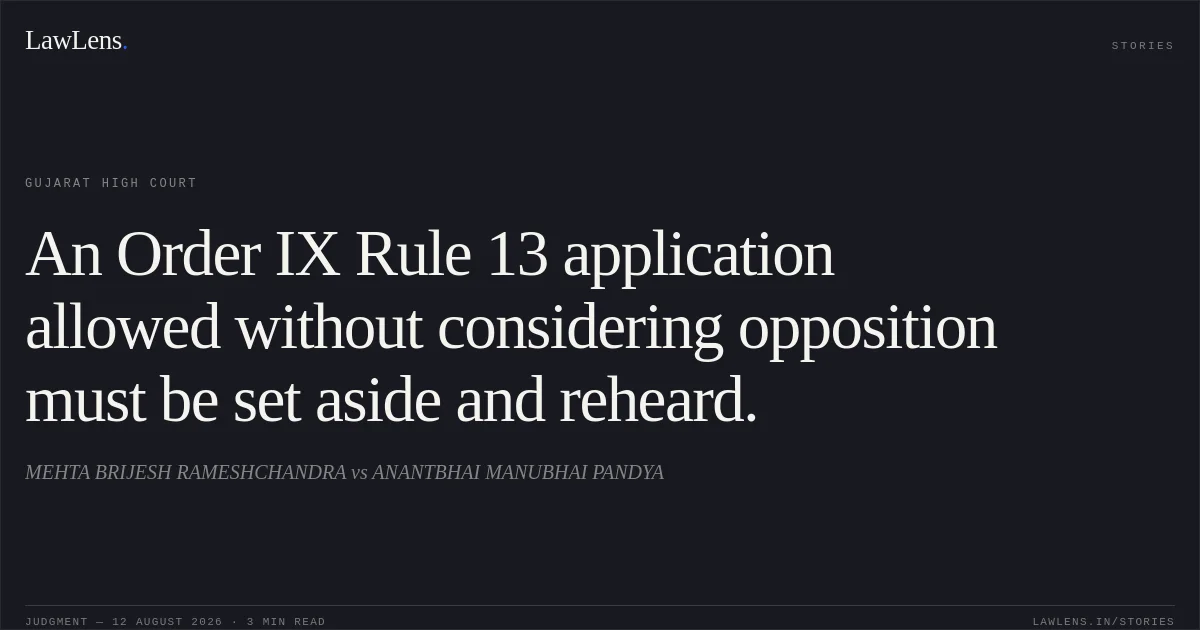
The petitioners invoked the supervisory jurisdiction of the High Court under Article 227 of the Constitution of India to challenge the order dated 11 December 2025 passed by the Additional Judge, Small Cause Court, Rajkot, in Misc. Civil Application No. 3 of 2024.
Source reference: p.2, para. 2By that order, the Trial Court recalled its earlier judgment and set aside the decree dated 25 October 2023 in Regular Civil Suit No. 21 of 2023, on an application filed by the respondent under Order IX Rule 13 of the Code of Civil Procedure, 1908 (CPC).
Source reference: p.2, para. 2The petitioners contended that the Trial Court had failed to consider their reply and written submissions opposing the application, and had also overlooked the alleged delay in filing the application.
Source reference: p.2, para. 4The respondent did not dispute that the reply and written submissions had been filed, but maintained that the restoration application was not delayed.
Source reference: p.2, para. 5The High Court also recorded that, pursuant to execution, possession of the suit property had been taken by the petitioners and the respondent’s goods were being retained under an inventory prepared by the Court Commissioner.
Source reference: p.4, para. 9Issues
Whether the Trial Court’s order allowing the respondent’s application under Order IX Rule 13 CPC was liable to be quashed because it failed to consider the petitioners’ reply and written submissions.
Source reference: p.3, para. 6Whether the Trial Court was required to consider the issue of limitation and, if necessary, permit the respondent to file an application for condonation of delay.
Source reference: p.4, para. 8Whether consequential directions were required concerning the respondent’s goods lying in the custody of the petitioners after execution of the decree.
Source reference: p.4, para. 9Law Applied
The Court exercised its supervisory jurisdiction under Article 227 of the Constitution of India to ensure that the subordinate court followed the procedure prescribed by law and considered the material pleadings and submissions of the parties.
Source reference: p.2, para. 2Order IX Rule 13 CPC governs applications for setting aside an ex parte decree and requires adjudication after affording the concerned parties an effective opportunity of hearing.
Source reference: no citationThe Court further applied the principle of natural justice that a judicial order must consider the pleadings, replies, and written submissions placed on record by the parties.
Source reference: p.3, para. 6It also directed that the question of limitation be examined in accordance with law and that, if the application was time-barred, the applicant be given an opportunity to seek condonation of delay.
Source reference: p.4, para. 8Reasoning
The High Court found that there was no dispute that the petitioners had filed a reply and written arguments opposing the respondent’s Order IX Rule 13 application, yet the Trial Court allowed the application without noticing or considering those materials.
Source reference: p.3, para. 6Such omission constituted a procedural failure affecting the fairness and legality of the decision.
Source reference: no citationAccordingly, in exercise of its Article 227 jurisdiction, the High Court set aside the impugned order and remanded the application for fresh adjudication.
Source reference: no citationThe Trial Court was directed to hear all concerned parties, remain uninfluenced by its earlier order, and specifically examine limitation; if the application was found to be beyond time, the respondent was to be allowed to file a delay-condonation application.
Source reference: p.3, para. 7; p.4, para. 8Regarding the goods, the Court permitted the respondent to collect them without prejudice to his rights and contentions, subject to a ten-day period and further communication by the petitioners if necessary.
Source reference: p.4, para. 9Holding
The petition was partly allowed.
The High Court quashed and set aside the Trial Court’s order dated 11 December 2025, restored Misc. Civil Application No. 3 of 2024 to its original file, and remanded it for fresh decision under Order IX Rule 13 CPC after hearing all parties and considering the issue of limitation.
Source reference: p.3, para. 7; p.4, para. 8The respondent was permitted to take custody of his goods within ten days, failing which the petitioners could communicate with him at the address supplied in his application and, in the absence of a response, dispose of the goods in accordance with law.
Source reference: p.4, para. 9Rule was made absolute to that extent, and the connected Civil Application for fixing an early-hearing date was disposed of as infructuous.
Source reference: p.4, para. 10Original Court PDF
MEHTA BRIJESH RAMESHCHANDRAvsANANTBHAI MANUBHAI PANDYA
Click to open original judgment
Original judgment, available to read, download and summarize on LawLens.in