Facts
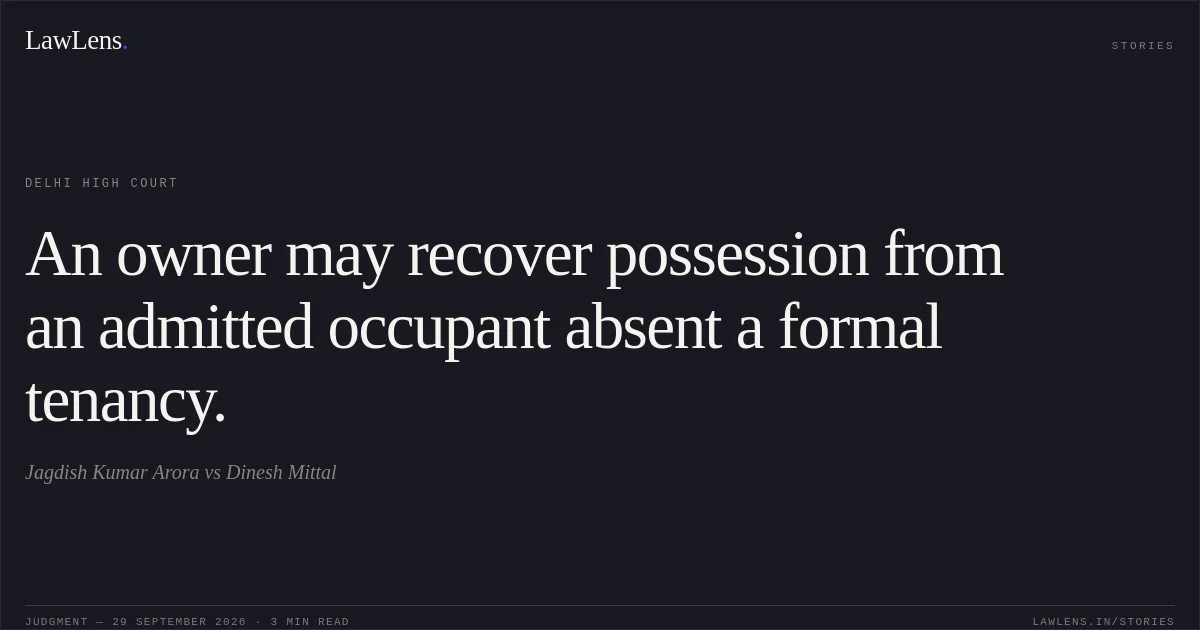
The respondent-owner sued for possession of the basement of his property, asserting that the appellant had agreed to take it on rent, paid a security deposit of ₹2,50,000, received possession, and carried out fit-out work there. No formal registered lease was executed, and the appellant disputed that possession had been delivered to him.
Source reference: para. 55–60; p. 12–13The appellant also relied on a pending earlier suit for rent and related reliefs, contending that the possession suit was barred under Order II Rule 2 CPC. The trial court decreed possession under Order XII Rule 6 CPC on the basis of admissions in the written statement. The appellant challenged that decree in this appeal.
Source reference: para. 55–60; p. 12–13Issues
1. Whether the appellant’s pleadings contained sufficient admissions to support a decree for possession under Order XII Rule 6 CPC, despite his denial of possession and the absence of a registered lease
Source reference: para. 61–69; p. 13–15; para. 72–79; p. 16–182. Whether the absence of a registered lease deed prevented the court from finding that possession had been delivered under an arrangement to pay rent
Source reference: para. 80–83; p. 18–203. Whether the possession suit was barred by Order II Rule 2 CPC because the respondent had earlier sued for rent and related reliefs
Source reference: para. 84; p. 21Law Applied
Order XII Rule 6 CPC permits judgment on admissions where the relevant admissions are sufficient to grant the relief sought.
Source reference: no citationUnder Sections 105 and 107 of the Transfer of Property Act, 1882, a lease transfers a right to enjoy property for consideration; subject to the statutory requirements for certain leases, other leases may be created by an oral agreement accompanied by delivery of possession.
Source reference: para. 80–82; p. 18–20Relying on Anthony v. K.C. Ittoop & Sons, (2003) 6 SCC 394, the Court stated that an unregistered lease instrument does not prevent examination of the parties’ conduct and pleadings to determine whether a lease was otherwise created.
Source reference: para. 80–82; p. 18–20The Court also held that, where ownership is admitted, recovery of possession does not depend on establishing a landlord–tenant relationship if the defendant is occupying the property in another capacity.
Source reference: para. 79; p. 18A claim for possession founded on a distinct cause of action is not barred merely because an earlier suit sought rent.
Source reference: para. 84; p. 21Reasoning
The appellant’s written statement admitted the negotiations to take the premises on rent, the agreed rent and lock-in period, payment of the security deposit, and the fit-out work carried out in the premises. The Court treated those admissions as establishing that possession had been delivered, notwithstanding the appellant’s assertion that the keys remained with the respondent’s watchman; retaining keys for security did not negate the appellant’s possession and use of the premises.
Source reference: para. 70–77; p. 16–18The lack of a registered lease did not displace those admissions or establish that possession had never been given; the appellant’s own account supported occupation under the agreed arrangement.
Source reference: para. 80–83; p. 18–20The earlier suit sought rent and related reliefs, whereas the present suit sought possession on a distinct cause of action, so Order II Rule 2 CPC did not bar it.
Source reference: para. 84; p. 21Disputes concerning rent and recoveries could be addressed in the separate proceedings.
Source reference: para. 83; p. 20; para. 85; p. 21Holding
The Court held that the appellant’s admissions established his possession of the premises and that the respondent was entitled to recover possession as the admitted owner. The absence of a registered lease and the Order II Rule 2 objection did not prevent a possession decree under Order XII Rule 6 CPC.
The appeal was dismissed, and the pending applications were disposed of accordingly.
Source reference: para. 79, 84–86; p. 18, 21Acts & Sections Cited
3 provisions across 2 statutes referred to in this judgment. Each provision opens on LawLens.
Code of Civil Procedure, 19081
Transfer of Property Act, 18822
Original Court PDF
Jagdish Kumar AroravsDinesh Mittal
Click to open original judgment
Original judgment, available to read, download and summarize on LawLens.in