Facts
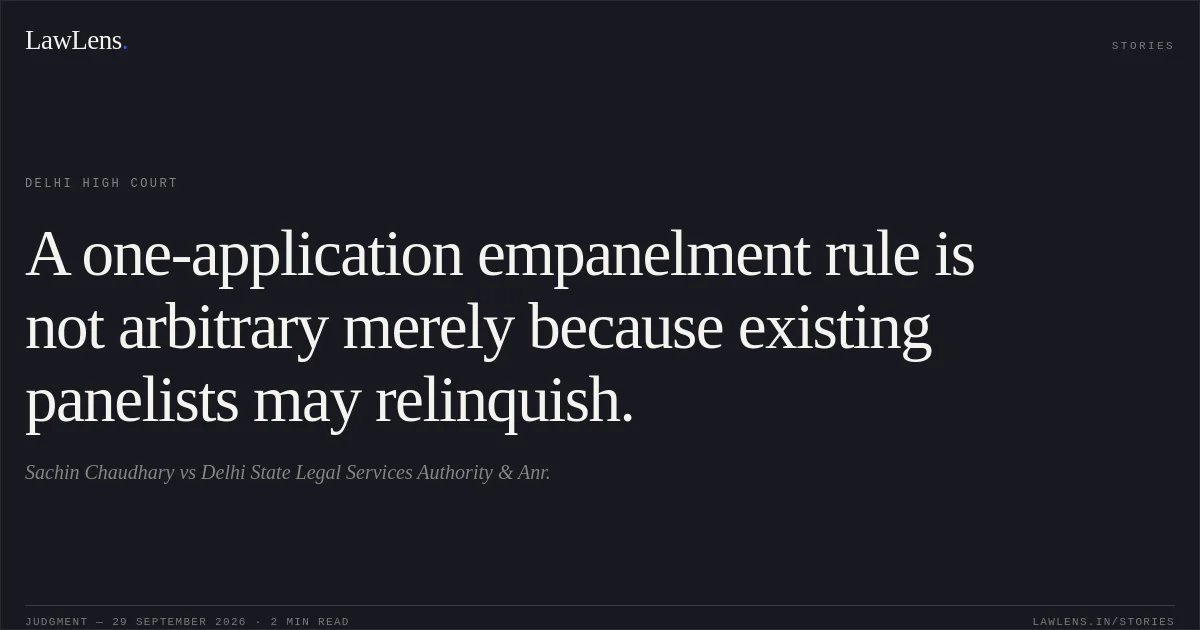
The petitioner challenged Clause A(C) of a DSLSA notice dated June 1, 2026, which allowed each candidate to apply for only one preferred panel and one DLSA and provided for summary rejection of multiple applications
Source reference: p.2He argued that the restriction was arbitrary, particularly because Clause A(D) required an advocate already empanelled elsewhere to relinquish one panel if selected under the notice.
Source reference: pp. 2–3The application process closed on June 17, 2026, and selection-related steps had begun in the three DLSAs.
Source reference: p.4The petitioner sought, among other relief, invalidation of Clause A(C) and reopening of the application process.
Source reference: pp. 1–2Issues
1. Whether Clause A(C), restricting candidates to one application for one panel and one DLSA, was arbitrary or otherwise unlawful, including in light of Clause A(D).
Source reference: pp. 2–32. Whether the Court should grant relief after the application period had closed and the empanelment process had progressed.
Source reference: p.4Law Applied
The prescription of qualifications, eligibility conditions, and the procedure and criteria for selection primarily lies within the domain of the employer or authority conducting the selection. Judicial review of such decisions is limited; the Court does not sit in appeal over the authority’s choice of selection procedure and will interfere under Article 226 only where a condition is shown to suffer from patent illegality or manifest arbitrariness
Source reference: p.3A rule addressing an existing empanelment does not, by itself, create a right to submit multiple applications in a new selection process.
Source reference: pp. 3–4Reasoning
The Court found that Clauses A(C) and A(D) governed different circumstances and stages: Clause A(C) regulated the number of applications in the current process, while Clause A(D) addressed what a candidate already empanelled elsewhere must do upon selection.
Source reference: pp. 3–4The latter therefore did not undermine the former.
Source reference: pp. 3–4As Clause A(C) formed part of the selection procedure and applied uniformly, the petitioner had not established patent illegality or manifest arbitrariness warranting interference under Article 226.
Source reference: p.4The Court also noted that the application period had ended and that interviews, document verification, or scrutiny had commenced across the three DLSAs, leaving no effective relief to be granted at that stage.
Source reference: p.4Holding
The Court held that the petitioner had not shown Clause A(C) to be arbitrary or unlawful and declined to interfere with the empanelment procedure.
It also found that, given the closure of applications and progress of the process, no effective relief could be awarded.
Source reference: p.4The writ petition was dismissed, and any pending applications were disposed of.
Source reference: p.4Original Court PDF
Sachin ChaudharyvsDelhi State Legal Services Authority & Anr.
Click to open original judgment
Original judgment, available to read, download and summarize on LawLens.in