Facts
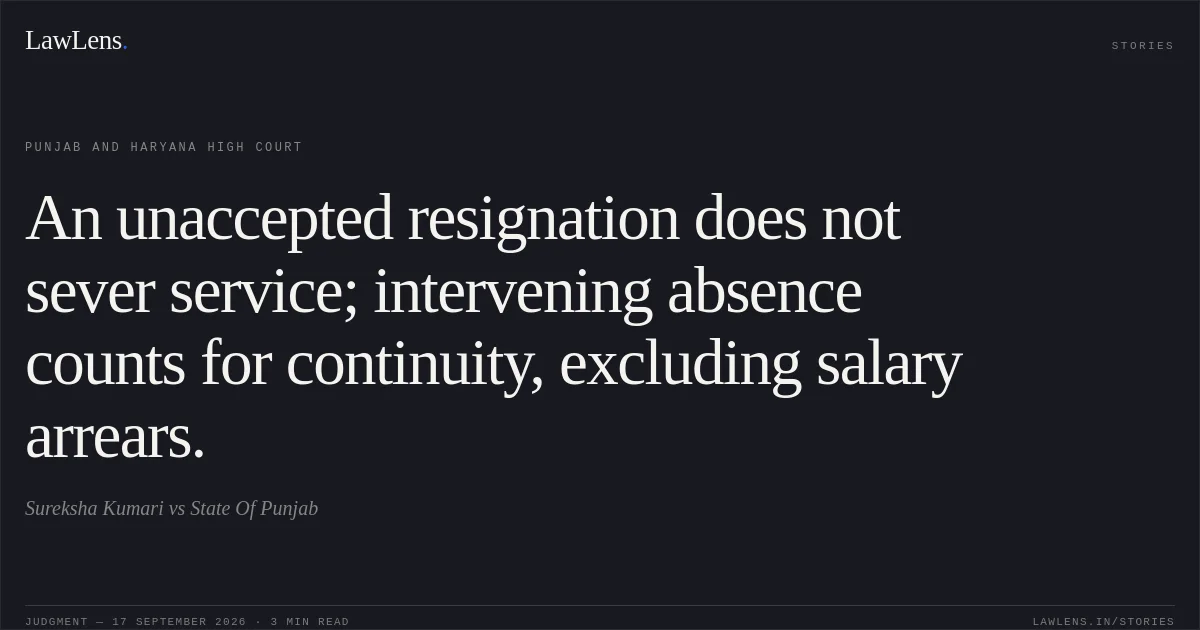
The plaintiff was appointed as a Social Studies Mistress on 22 February 1967 and joined service on 18 March 1967. She later tendered her resignation on 12 September 1970 and was relieved on 5 November 1970. In December 1970, she requested withdrawal of her resignation. The Education Department subsequently permitted her to rejoin, and she resumed duty on 30 July 1971. She contended that her resignation had never been accepted by the competent authority and that her initial date of joining, 18 March 1967, ought to govern her seniority, qualifying service, gratuity, provident fund and other service benefits. The Department treated her as having joined afresh on 30 July 1971 and regarded the intervening period as a break in service
Source reference: paras. 4–5The Trial Court decreed the suit, directing that the plaintiff be treated as having joined service from 18 March 1967 for all service benefits. The First Appellate Court reversed that decree, holding against the plaintiff. She then preferred the present Regular Second Appeal
Source reference: paras. 7–8Issues
Whether the plaintiff’s resignation dated 12 September 1970 was accepted by the competent authority and thereby became effective?
Source reference: paras. 12.1–13Whether Rule 7.5 of the Punjab Civil Services Rules, Volume I, Part I, concerning forfeiture of service on resignation and withdrawal of resignation, applied to the plaintiff’s case?
Source reference: paras. 9.1, 10.1, 12–13.1Whether the period between the plaintiff’s original appointment on 18 March 1967 and her resumption of duty on 30 July 1971 was liable to be counted for seniority and consequential service benefits?
Source reference: para. 15Whether the plaintiff’s failure to challenge departmental communication dated 13 November 1975 amounted to implied consent to her being treated as a fresh appointee?
Source reference: para. 14Law Applied
The Court applied Rule 7.5 of the Punjab Civil Services Rules, Volume I, Part I. Under sub-rule (1), resignation ordinarily entails forfeiture of past service unless withdrawn in public interest; sub-rules (4) and (6) govern withdrawal of a resignation that has become effective and provide that permission to withdraw it includes condonation of the interruption, although the interruption does not count as qualifying service
Source reference: para. 12The Court interpreted the Rule as presupposing that the resignation had been accepted and had become effective, particularly because sub-rules (4)(ii), (iii) and (v) refer to the date on which the resignation became effective and the post vacated on its acceptance
Source reference: para. 12.1The Court further applied the settled principle that an employee may withdraw a resignation before its acceptance by the competent authority, since the employer–employee relationship continues until acceptance
Source reference: para. 13.1Reasoning
The Court found no order or other material establishing that the plaintiff’s resignation had ever been accepted by the competent authority. On the contrary, the departmental communication dated 28 July 1971 expressly recorded that the resignation had not been accepted because it had been forwarded belatedly, and that the plaintiff had sought its withdrawal before acceptance
Source reference: para. 13Consequently, Rule 7.5, which applies to an effective resignation subsequently permitted to be withdrawn, was held inapplicable
Source reference: paras. 12.1, 13.1Since the resignation had not become effective, the plaintiff’s service relationship continued and her original appointment date remained relevant for seniority and other service benefits. The First Appellate Court’s reliance on the 1975 departmental communication was also rejected because there was no evidence that the communication had been conveyed to the plaintiff; therefore, her failure to object could not constitute implied consent to fresh appointment
Source reference: para. 14The Court nevertheless distinguished between counting the period for service-related purposes and payment of salary: the period of actual absence was to be excluded for arrears of salary
Source reference: para. 15Holding
The appeal was allowed. The High Court set aside the judgment and decree of the First Appellate Court and restored the plaintiff’s entitlement to have her service reckoned from 18 March 1967, rather than 30 July 1971, for seniority and consequential benefits, including refixation of pay and pensionary benefits
The period of absence was not to attract arrears of salary. The benefits, together with interest at 7% per annum from the date of accrual until realization, were directed to be paid within two months of receipt of the certified copy of the order
Source reference: para. 16Acts & Sections Cited
1 provisions across 1 statute referred to in this judgment. Each provision opens on LawLens.
Code of Civil Procedure, 19081
Original Court PDF
Sureksha KumarivsState Of Punjab
Click to open original judgment
Original judgment, available to read, download and summarize on LawLens.in