Facts
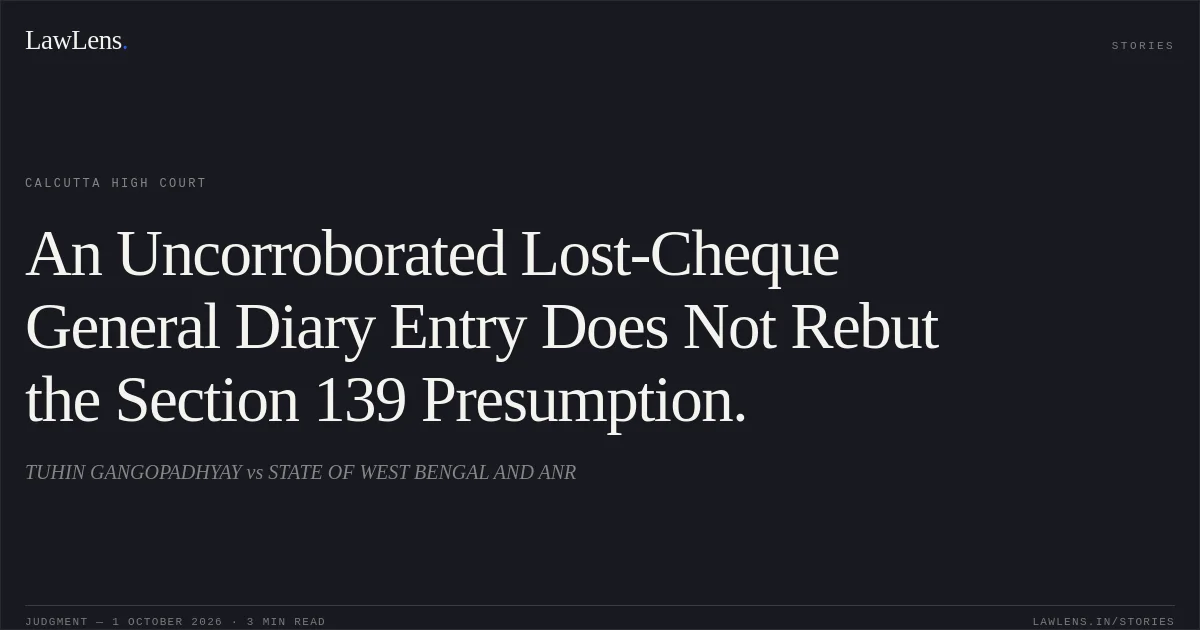
The complainant alleged that the petitioner borrowed ₹30,000 for his cloth business and issued a cheque for that amount, which was dishonoured with the bank’s endorsement referring to a stop-payment/attachment order.
Source reference: para. 3–4After service of a demand notice and non-payment, the complainant filed a complaint under Section 138 of the Negotiable Instruments Act, 1881 (“NI Act”).
Source reference: para. 3–4The petitioner denied borrowing the money and said that he had lost a money bag containing a blank signed cheque; he relied on a General Diary entry and bank stop-payment instructions.
Source reference: para. 5–7The Magistrate convicted him and imposed three months’ simple imprisonment and compensation of ₹30,000; on appeal, the conviction was affirmed, the imprisonment reduced to seven days, and the financial amount increased to ₹35,000.
Source reference: para. 8–9The petitioner challenged the concurrent findings in revision.
Source reference: para. 10Issues
1. Whether the revision should be dismissed in limine because the petitioner allegedly misrepresented his employment status
Source reference: para. 18(i), 20–232. Whether the petitioner rebutted the presumptions under Sections 118(a) and 139 of the NI Act by relying on the lost-cheque defence, the General Diary entry, bank communications, and oral evidence
Source reference: para. 18(ii), 24–263. Whether the absence of a written loan agreement and non-disclosure of the alleged cash loan in the complainant’s Income Tax Returns negated the existence of a legally enforceable debt
Source reference: para. 18(iii), 27–294. Whether the failure to arraign “Madhukari Textile” as an accused rendered the prosecution against the petitioner non-maintainable
Source reference: para. 18(iv), 30–315. Whether the concurrent findings of conviction suffered from perversity, illegality, or a miscarriage of justice warranting revisional interference
Source reference: para. 18(v), 32–34Law Applied
Sections 118(a) and 139 of the NI Act require presumptions of consideration and legally enforceable liability once execution or the drawer’s signature on a cheque is admitted or proved; the accused may rebut them on a preponderance of probabilities, but a bare denial is insufficient.
Source reference: para. 25–26, 36The Court relied on Rajaram v. Maruthachalam and Rajco Steel Enterprises v. Kavita Saraff in considering rebuttal and financial capacity, and on Kuntegowda v. Thurubaiah for the statutory presumptions and limits on revisional review.
Source reference: para. 14, 26–29, 32–34It treated the absence of a written loan agreement or ITR entry as relevant but not automatically fatal, particularly for a modest hand loan.
Source reference: para. 28–29, 36It held that a sole proprietorship is not a separate legal entity from its proprietor, so the trade name need not be separately arraigned.
Source reference: para. 30–31, 36Revisional jurisdiction under Sections 397/401 read with Section 482 of the Code of Criminal Procedure, 1973, does not permit a fresh appellate reappraisal absent patent illegality, perversity, or miscarriage of justice.
Source reference: para. 32–33, 36Reasoning
The Court rejected the suppression objection, finding that describing oneself as unemployed while operating a modest proprietary business did not amount to material fraud warranting dismissal of the revision.
Source reference: para. 21–23It held that the admitted cheque signature triggered the statutory presumptions and that the General Diary entry, bank instructions, and defence testimony did not, in the Court’s assessment, sufficiently establish the lost-cheque account to rebut them.
Source reference: para. 24–26, 33It found that the absence of a written agreement or ITR disclosure did not invalidate this ₹30,000 loan, particularly where the petitioner had not established a probable challenge to the complainant’s financial capacity.
Source reference: para. 27–29The firm-joinder argument failed because the business was a proprietorship, not a separate juristic person.
Source reference: para. 30–31Finally, the concurrent findings disclosed no ground for revisional interference.
Source reference: para. 32–34Holding
The High Court dismissed the revision and affirmed the conviction under Section 138 of the NI Act.
It modified the sentence by exempting the petitioner from the seven-day simple-imprisonment term while upholding compensation of ₹35,000 and the default sentence; the Trial Court was directed to credit sums already deposited and disburse the compensation to the complainant.
Source reference: para. 34–35, 39–42Acts & Sections Cited
12 provisions across 2 statutes referred to in this judgment. Each provision opens on LawLens.
Code of Criminal Procedure, 1973
Negotiable Instruments Act, 18813
Original Court PDF
TUHIN GANGOPADHYAYvsSTATE OF WEST BENGAL AND ANR
Click to open original judgment
Original judgment, available to read, download and summarize on LawLens.in