Facts
The petitioner, who retired from service on 30 November 2003, alleged that ₹20,859 was recovered from his retiral dues on 6 May 2004 without issuance of notice or grant of an opportunity of hearing.
Source reference: para. 2, para. 5He also claimed entitlement to leave encashment for 300 days under the Finance Department circular dated 8 March 2019 and asserted that similarly situated retired employees had received that benefit.
Source reference: para. 2, para. 5In 2026, he invoked Article 226 of the Constitution seeking refund of the recovered amount with interest and payment of 300 days’ leave encashment.
Source reference: para. 1The State opposed the petition and sought its dismissal.
Source reference: para. 3Issues
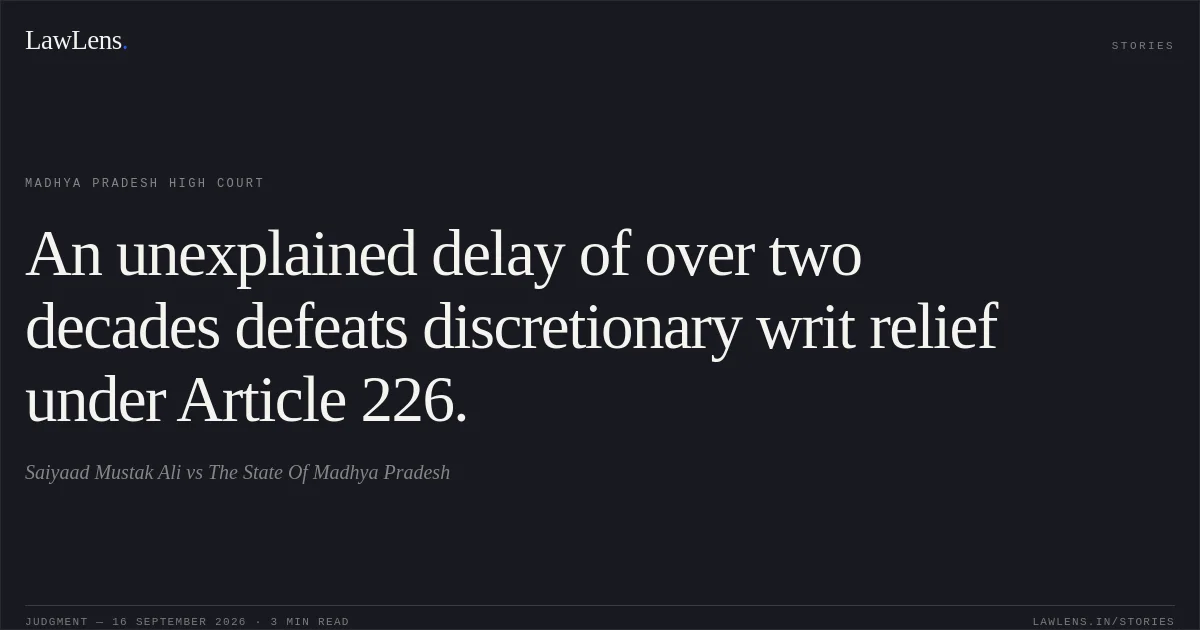
Whether the petitioner’s challenge to the recovery of ₹20,859 and claim for consequential relief could be entertained under Article 226 despite an unexplained delay of more than two decades.
Source reference: para. 5, para. 10Whether the petitioner was entitled to refund of the recovered amount and leave encashment for 300 days on the merits of his claims.
Source reference: para. 1–2Law Applied
The High Court applied the equitable and discretionary doctrine of delay and laches governing relief under Article 226.
Source reference: no citationRelying on Esha Bhattacharjee v. Managing Committee of Raghunathpur Nafar Academy, (2013) 12 SCC 649, the Court held that while courts should adopt a liberal and justice-oriented approach, inordinate delay, negligence, lack of bona fides, and prejudice to the opposing party remain relevant considerations.
Source reference: para. 6Under State of Orissa v. Mamata Mohanty, (2011) 3 SCC 436, a litigant cannot revive a stale claim merely because relief was later granted to a similarly situated person.
Source reference: para. 7Karnataka Power Corpn. Ltd. v. K. Thangappan, (2006) 4 SCC 322, establishes that delay and laches may justify refusal to exercise the High Court’s discretionary writ jurisdiction, even where a fundamental right is alleged to be affected.
Source reference: para. 8The Court also relied on Ashok Kumar v. District Magistrate, Basti, (2012) 3 SCC 311, for the principle that a person who has slept over his rights is ordinarily not entitled to discretionary relief.
Source reference: para. 9Reasoning
The alleged recovery occurred on 6 May 2004, shortly after the petitioner’s retirement on 30 November 2003, but the writ petition was filed only in 2026, after an unexplained lapse of more than twenty years.
Source reference: para. 5The petitioner neither furnished a cogent explanation for the delay nor identified any circumstance preventing him from approaching the Court earlier.
Source reference: para. 5Applying the principles of delay and laches, the Court held that the extraordinary and unexplained delay disentitled the petitioner to discretionary relief under Article 226.
Source reference: no citationThe petitioner’s reliance on the alleged grant of similar benefits to other retired employees could not cure the delay, as a subsequent favourable case or benefit to another person does not revive a stale claim.
Source reference: para. 7Since the petition was rejected on the threshold ground of delay and laches, the Court did not adjudicate the legality of the recovery, the natural-justice objection, or the substantive entitlement to 300 days’ leave encashment.
Source reference: no citationHolding
The High Court declined to entertain the writ petition because the petitioner approached the Court more than two decades after the alleged recovery without any satisfactory explanation for the delay.
The petition seeking refund of ₹20,859, interest, and payment of 300 days’ leave encashment was accordingly dismissed on the ground of delay and laches, without determination of the claims on their merits.
Source reference: para. 11Original Court PDF
Saiyaad Mustak AlivsThe State Of Madhya Pradesh
Click to open original judgment
Original judgment, available to read, download and summarize on LawLens.in