Facts
The plaintiffs alleged that they executed a registered sale deed dated 5 March 2015 in favour of the defendant as security for a loan, and that the parties simultaneously entered into an unregistered resale agreement requiring repayment within three years.
Source reference: para. 4(a), 13–14They further claimed that an endorsement dated 25 February 2018 extended the time by one year, and that they later tendered the balance consideration of ₹19,00,000.
Source reference: para. 4(a), 13–14The defendant denied the resale agreement and endorsement, asserted that the sale deed was an absolute sale, and pleaded forgery and limitation.
Source reference: para. 4(b)The trial court decreed specific performance but declined permanent injunction; the defendant appealed.
Source reference: paras. 7–8Issues
1. Whether the suit was bad for non-joinder of Arivalagan.
Source reference: para. 172. Whether the sale deed dated 5 March 2015 had been acted upon as an absolute sale.
Source reference: para. 173. Whether the resale agreement and its extension endorsement were forged, and whether the defendant proved forgery.
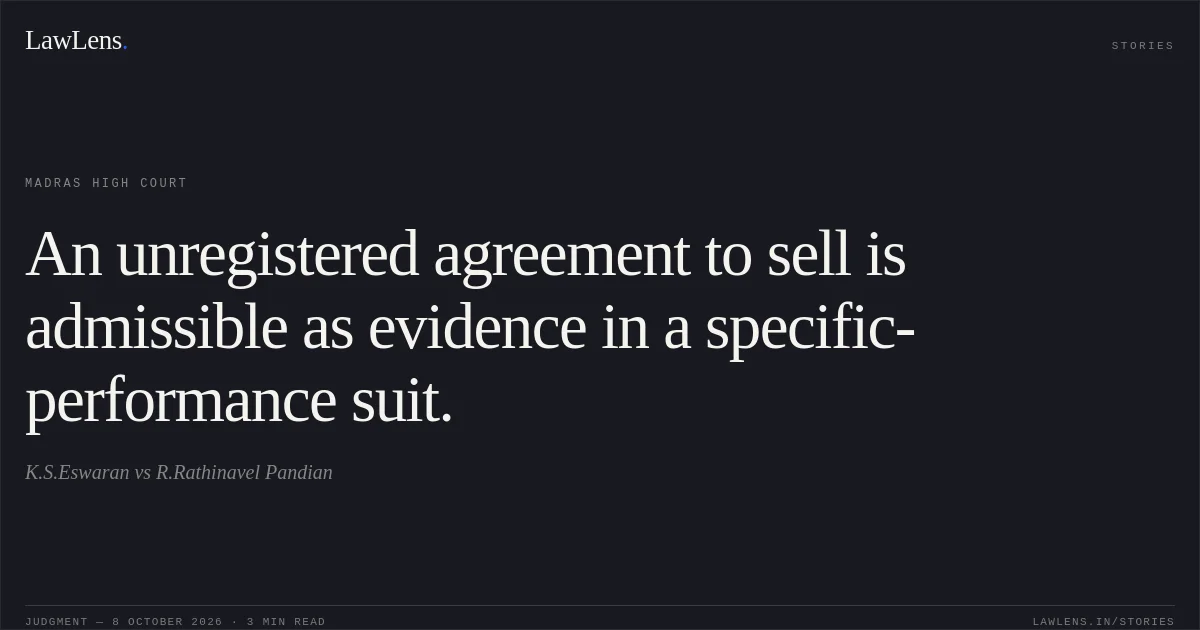
Source reference: para. 174. Whether the unregistered resale agreement was admissible in evidence in the specific-performance suit.
Source reference: para. 175. Whether the suit was barred by limitation.
Source reference: para. 176. Whether the trial court’s decree was sustainable and the appeal should be allowed.
Source reference: para. 17Law Applied
Under Section 49 of the Registration Act, an unregistered instrument may be received as evidence of a contract in a suit for specific performance, although it cannot operate as a completed conveyance; the Court relied on S. Kaladevi v. V.R. Somasundaram, R. Hemalatha v. Kashthuri, and Muruganandam v. Muniyandi.
Source reference: paras. 24–27Section 17(1-A) of the Registration Act concerns registration of contracts relied upon for protection under Section 53-A of the Transfer of Property Act; the Court distinguished that context from admissibility in a specific-performance suit.
Source reference: paras. 24, 27Under Section 103 of the Evidence Act, the party alleging forgery bears the burden of proving it; the Court also referred to Sections 45 and 73 concerning expert opinion and comparison of signatures.
Source reference: para. 23Article 54 of the Limitation Act provides a three-year limitation period, running from the date fixed for performance or, where no date is fixed, from notice of refusal.
Source reference: para. 28The Court also applied the principle that a purchaser need not produce the purchase money to establish readiness and willingness, relying on A. Kanthamani v. Nasreen Ahmed.
Source reference: para. 30Reasoning
The Court held that Arivalagan’s non-joinder and non-examination were not fatal because the defendant did not specifically dispute his relationship to the fifth plaintiff or the parties’ connection with the society.
Source reference: para. 18It found that the defendant had not established an absolute sale or the alleged oral lease, while the circumstances and pleadings supported the plaintiffs’ account that the sale deed was security for the loan.
Source reference: paras. 19–20The Court construed the written statement as admitting the resale agreement, and found the attesting witness’s evidence supported the extension endorsement; the defendant produced no expert evidence or other material proving forgery.
Source reference: paras. 21–23Applying Section 49’s proviso, it held the unregistered agreement and endorsement admissible as evidence of the contract, rather than as instruments effecting a transfer.
Source reference: paras. 24–27Since the extension expired on 25 February 2019 and the suit was filed on 29 October 2021, the suit was within three years; the plaintiffs’ notice and deposit of the balance consideration also supported readiness and willingness.
Source reference: paras. 29–30Holding
The Court answered the issues against the defendant, held that the resale agreement and extension endorsement were proved and admissible, and found the suit within limitation.
It dismissed the appeal and confirmed the trial court’s decree for specific performance; there was no order as to costs, and the connected civil miscellaneous petition was closed.
Source reference: paras. 31–32Acts & Sections Cited
4 provisions across 3 statutes referred to in this judgment. Each provision opens on LawLens.
Code of Civil Procedure, 19081
Registration Act, 19082
Limitation Act, 19631
Original Court PDF
K.S.EswaranvsR.Rathinavel Pandian
Click to open original judgment
Original judgment, available to read, download and summarize on LawLens.in