Facts
The petitioner relied upon a Will executed on 4 May 2001 in proceedings concerning rights in the disputed property.
Source reference: para. 2The Naib Tehsildar, Bangarmau, rejected the petitioner’s claim by order dated 1 July 2025, treating the Will as invalid because it was unregistered.
Source reference: para. 2The Sub-Divisional Magistrate dismissed the petitioner’s appeal by order dated 11 June 2026 on the same basis, applying the registration requirement under Section 107(3) of the U.P. Revenue Code, 2006.
Source reference: paras. 11–12Before the High Court, the private respondent objected that the writ petition was not maintainable because a statutory revisional remedy was available and the petitioner had failed to appear before the court of first instance.
Source reference: para. 3Issues
Whether the High Court should exercise its writ jurisdiction despite the availability of an alternative statutory remedy, where the controversy involves a pure question of law and no disputed question of fact requires determination?
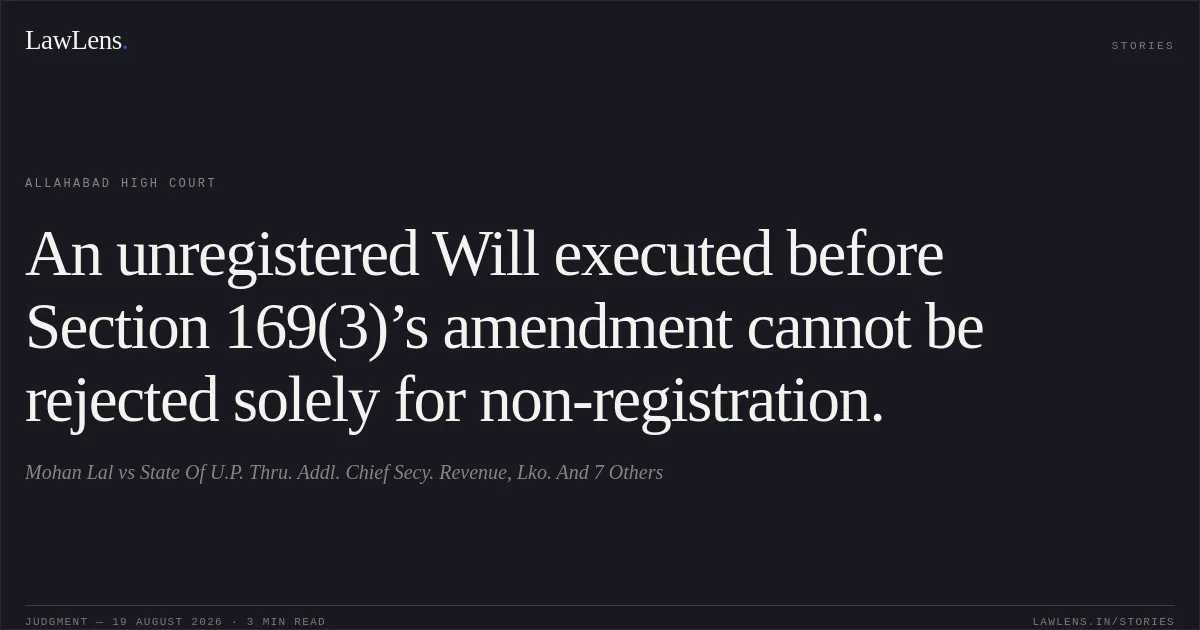
Source reference: paras. 9–12Whether an unregistered Will executed on 4 May 2001 could be rejected solely because it did not satisfy the subsequently introduced registration requirement under Section 169(3) of the U.P. Zamindari Abolition and Land Reforms Act, 1950 or Section 107(3) of the U.P. Revenue Code, 2006?
Source reference: paras. 11–15Whether the authorities were entitled to treat registration as mandatory in view of the Full Bench decision in Pramila Tiwari v. Anil Kumar Mishra?
Source reference: paras. 16–18Law Applied
The Court applied the principle that the existence of an alternative statutory remedy does not bar exercise of jurisdiction under Article 226 where the case involves a pure question of law and does not require adjudication of disputed facts, as recognised in Godrej Sara Lee Ltd. v. E, (2023) 109 GSTR 402.
Source reference: para. 10Under Section 169(3) of the U.P. Zamindari Abolition and Land Reforms Act, 1950, as it stood before the amendment by U.P. Act No. 27 of 2004, a Will was required to be in writing and attested by two persons, but registration was not mandatory.
Source reference: paras. 14–15The amendment introducing the words “and registered” came into force on 23 August 2004 and could not retrospectively invalidate a Will executed before that date.
Source reference: para. 15The Full Bench in Pramila Tiwari v. Anil Kumar Mishra, 2024 SCC OnLine All 1588, further held that Section 169(3) was void to the extent that it mandated registration of a Will; therefore, a Will in Uttar Pradesh is not required to be registered merely by virtue of that provision.
Source reference: para. 16Reasoning
The High Court held that the controversy was essentially legal because both authorities had rejected the petitioner’s claim solely on the ground that the Will was unregistered; no substantial disputed factual issue required determination.
Source reference: paras. 11–12Consequently, the alternative-remedy objection did not prevent the Court from exercising writ jurisdiction under Article 226 in accordance with Godrej Sara Lee.
Source reference: para. 10Since the Will was executed in 2001, its validity had to be assessed under the statutory regime then in force.
Source reference: paras. 13–15At that time, Section 169(3) did not require registration, and the 2004 amendment could not be applied retrospectively.
Source reference: paras. 13–15Independently, the Full Bench decision in Pramila Tiwari made clear that registration was not a valid mandatory requirement under Section 169(3).
Source reference: paras. 16–18The authorities therefore proceeded on an erroneous legal premise by rejecting the Will solely because it was unregistered.
Source reference: paras. 16–18Holding
The Court answered the principal legal issue in favour of the petitioner and held that an unregistered Will executed on 4 May 2001 could not be rejected solely for want of registration.
The orders dated 11 June 2026 passed by the Sub-Divisional Magistrate and 1 July 2025 passed by the Naib Tehsildar were quashed.
Source reference: para. 19The matter was remitted to the Naib Tehsildar for fresh consideration after providing due opportunity of hearing to all concerned parties and passing a reasoned and speaking order in accordance with law, without expressing any opinion on the merits of the rival claims.
Source reference: para. 20Pending final decision, the parties were directed to maintain status quo and not alienate, transfer, or create any third-party interest in the disputed property.
Source reference: para. 21Acts & Sections Cited
2 provisions across 2 statutes referred to in this judgment. Linked provisions open on LawLens.
U.P. Revenue Code, 20061
U.P. Zamindari Abolition and Land Reforms Act, 19501
Original Court PDF
Mohan LalvsState Of U.P. Thru. Addl. Chief Secy. Revenue, Lko. And 7 Others
Click to open original judgment
Original judgment, available to read, download and summarize on LawLens.in