Facts
The plaintiff sued to recover ₹80,000 with interest under a promissory note dated 30 June 1995.
Source reference: pp. 2–5The defendant denied borrowing that amount but admitted borrowing ₹10,000, signing an unfilled promissory note, and alleged that he had repaid the principal, leaving only interest unpaid.
Source reference: pp. 2–5He relied on statements in related criminal proceedings concerning a dispute between the parties.
Source reference: pp. 2–5The trial court decreed the suit, finding the promissory note and consideration proved and the alleged repayment unproved.
Source reference: pp. 2–5The first appellate court reversed, relying on the criminal proceedings.
Source reference: pp. 2–5The plaintiff appealed under Section 100 CPC.
Source reference: pp. 8–9Issues
1. Whether a reference to repayment in criminal proceedings, without identifying the suit transaction, discharged the defendant’s liability under the suit promissory note
Source reference: pp. 5, 14–152. Whether the first appellate court could reverse the decree by relying on the criminal proceedings rather than assessing the evidence relating to the promissory note in the civil suit
Source reference: pp. 11–12Law Applied
Under Section 118 of the Negotiable Instruments Act, execution of a promissory note attracts a presumption of consideration, which the defendant may rebut with evidence.
Source reference: pp. 10–14A party asserting repayment must establish that defence.
Source reference: pp. 10–14A criminal judgment is not, merely by virtue of its findings, binding in a civil proceeding; the civil court must decide the suit on the evidence before it.
Source reference: pp. 10–14Sections 40–43 of the Evidence Act govern when prior judgments may be relevant, and such judgments are not generally conclusive except as provided by law.
Source reference: pp. 10–14The Court relied on M.S. Sheriff v. State of Madras, Syed Askari Hadi Ali Augustine Imam v. State (Delhi Administration) and Vishnu Dutt Sharma v. Daya Sapra on the distinct assessment of civil and criminal proceedings.
Source reference: pp. 10–14Reasoning
The defendant admitted signing an unfilled promissory note, while the plaintiff’s evidence was accepted as proving execution and consideration.
Source reference: pp. 9–12The defendant’s account of the ₹10,000 loan and repayment was vague and unsupported by sufficient evidence; he did not establish that the suit note related to that separate transaction or that its principal had been repaid.
Source reference: pp. 9–12The criminal proceedings concerned a quarrel over money but did not identify the suit promissory note or establish that the alleged statement about principal and interest related to it.
Source reference: pp. 14–15The first appellate court therefore erred in treating those proceedings as sufficient to probabilise the defence and in failing to decide the civil claim on its own evidence.
Source reference: pp. 9–12, 14–15Holding
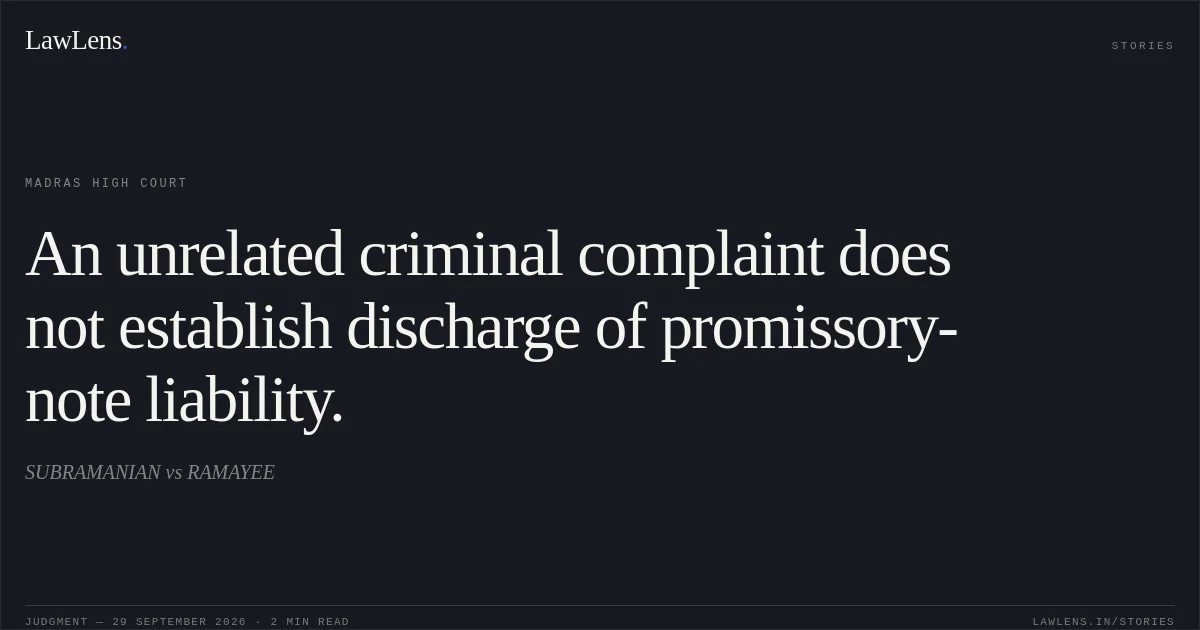
The Court answered the substantial question of law in the plaintiff’s favour: a reference to repayment in a criminal complaint, without a demonstrated connection to the suit transaction, did not discharge the defendant’s liability.
The second appeal was allowed; the first appellate court’s decree was set aside and the trial court’s decree restored.
Source reference: p. 15No order as to costs.
Source reference: p. 15Acts & Sections Cited
8 provisions across 3 statutes referred to in this judgment. Each provision opens on LawLens.
Code of Civil Procedure, 19081
Indian Penal Code, 18606
Negotiable Instruments Act, 18811
Original Court PDF
SUBRAMANIANvsRAMAYEE
Click to open original judgment
Original judgment, available to read, download and summarize on LawLens.in