Facts
The respondent was accused of selling adulterated packaged water.
Source reference: para. 2, 5A Food Inspector collected a sample on 30.10.2004.
Source reference: para. 2, 5The sample was analyzed between 22.11.2004 and 02.12.2004, which resulted in a report declaring the water adulterated.
Source reference: para. 2, 5A complaint was subsequently filed under Sections 2(1-A)(A), 2(1-A)(M), 7(1), 7(3), and 7(5) of the Food Adulteration Act ("the Act").
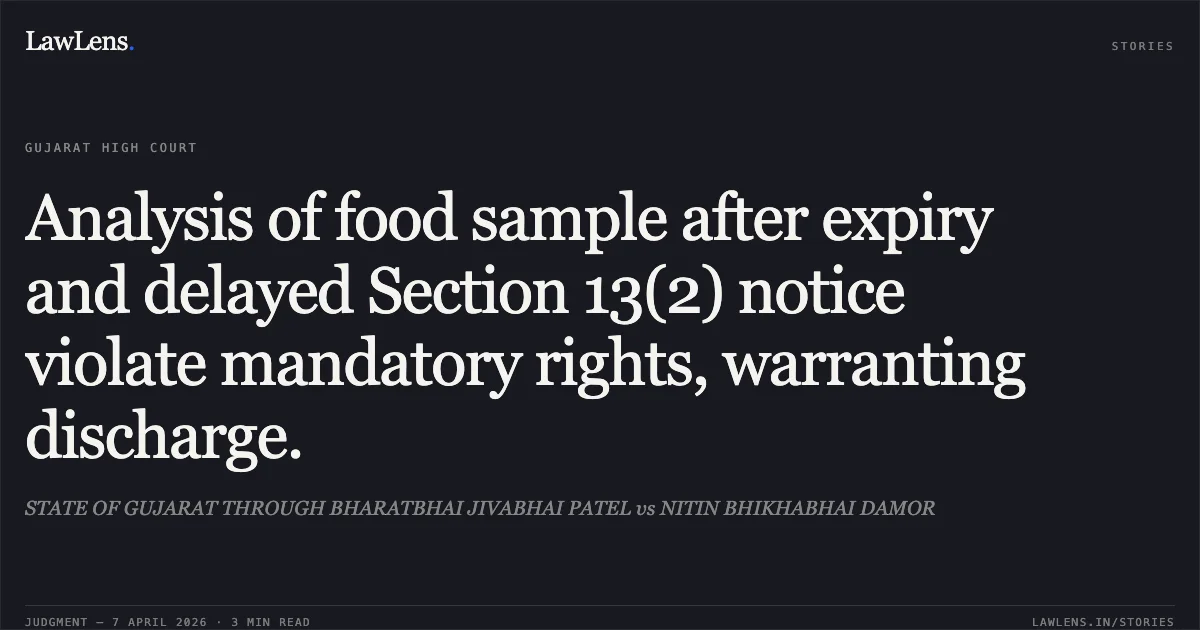
Source reference: para. 2Crucially, the manufacturing date of the sample was 16.10.2004, with a "best before" duration of one month (expiring 16.11.2004); however, the analysis was conducted after the expiry date.
Source reference: para. 5The mandatory notice under Section 13(2) of the Act, allowing the accused to seek re-analysis, was issued more than one year later.
Source reference: para. 5The learned Chief Judicial Magistrate, Tapi, discharged the accused under Section 245(1) of the CrPC on 05.01.2017.
Source reference: para. 1, 2The State of Gujarat filed this revision application challenging that discharge.
Source reference: para. 1Issues
1. Whether the trial court erred in discharging the accused on the grounds of non-compliance with the mandatory provisions of Section 13(2) of the Food Adulteration Act.
Source reference: para. 52. Whether the analysis of a food sample conducted after its expiry date constitutes a valid basis for prosecution.
Source reference: para. 53. Whether the High Court should exercise its limited revisional jurisdiction under Section 401 of the CrPC to interfere with the trial court's order of discharge.
Source reference: para. 6Law Applied
The Court applied Section 13(2) of the Food Adulteration Act, which provides the accused with a mandatory right to have a sample re-analyzed by the Central Food Laboratory to challenge the Food Analyst's report.
Source reference: para. 5It further applied Sections 397 and 401 of the Code of Criminal Procedure (CrPC), defining the scope of revisional jurisdiction as discretionary and limited to correcting manifest errors of law or glaring procedural defects.
Source reference: para. 1, 6The Court relied on Raj Kumar vs. State of Uttar Pradesh (2019) 9 SCC 427 regarding discharge.
Source reference: para. 6The Court relied on Amit Kapoor vs. Ramesh Chander (2012) 9 SCC 460 regarding the restricted scope of interference in revision.
Source reference: para. 6Several High Court and Supreme Court precedents were cited to establish that inordinate delay and analysis post-expiry violate the mandatory rights of the accused.
Source reference: para. 5Reasoning
The Court observed that the sample was analyzed between 22.11.2004 and 02.12.2004, whereas the product’s shelf life had already expired on 16.11.2004.
Source reference: para. 5This delay in analysis, coupled with the fact that the Section 13(2) notice was issued a full year after the sample was taken, effectively deprived the respondent of his statutory right to seek a second opinion from the Central Food Laboratory while the sample was still fit for analysis.
Source reference: para. 5The Court reasoned that such a breach of mandatory procedure is fatal to the prosecution.
Source reference: para. 5Regarding the State's challenge, the Court emphasized that revisional jurisdiction does not permit a re-appreciation of evidence or acting as an Appellate Court.
Source reference: para. 6Since the trial court’s findings were based on admitted facts regarding the timeline and expiry, the High Court found no perversity, illegality, or miscarriage of justice in the discharge order.
Source reference: para. 6Holding
The High Court held that the trial court did not commit any error in discharging the accused due to the clear breach of Section 13(2) of the Act and the fact that the analysis was conducted after the sample’s expiry.
The Court affirmed that the mandatory procedural safeguards must be strictly followed in food adulteration cases.
Source reference: para. 5, 6Consequently, the Criminal Revision Application was dismissed, and the trial court's order of discharge was upheld.
Source reference: para. 7Acts & Sections Cited
3 provisions across 1 statute referred to in this judgment. Each provision opens on LawLens.
Code of Criminal Procedure, 19733
Original Court PDF
STATE OF GUJARAT THROUGH BHARATBHAI JIVABHAI PATELvsNITIN BHIKHABHAI DAMOR
Click to open original judgment
Original judgment, available to read, download and summarize on LawLens.in