Facts
The plaintiffs, daughters of defendant No.1, sued for partition and separate possession, claiming that the suit properties were joint-family properties.
Source reference: no citationDefendant No.2, a son of defendant No.1 through another woman, maintained that all properties except Item No.7 were defendant No.1’s self-acquired properties, later gifted to him.
Source reference: no citationThe Trial Court decreed the suit only in respect of Item No.7; the First Appellate Court modified the decree and awarded the plaintiffs’ branch and the other plaintiffs shares in all the suit properties.
Source reference: no citationDefendant No.2 appealed under Section 100 CPC. The High Court admitted the appeal on whether Items 1–6 and 8 could be treated as ancestral properties without proof of ancestral lands or sufficient surplus income.
Source reference: para. 8–12, 23Issues
1. Whether the First Appellate Court’s finding that Items 1–6 and 8 were ancestral or joint-family properties was perverse and contrary to the evidence, given the absence of proof of ancestral lands or sufficient family income?
Source reference: para. 232. Whether the plaintiffs established a joint-family nucleus sufficient to support the inference that Items 1–6 and 8 were acquired with joint-family funds?
Source reference: para. 35–40Law Applied
Under Section 100 CPC, a second appeal lies for consideration of a substantial question of law.
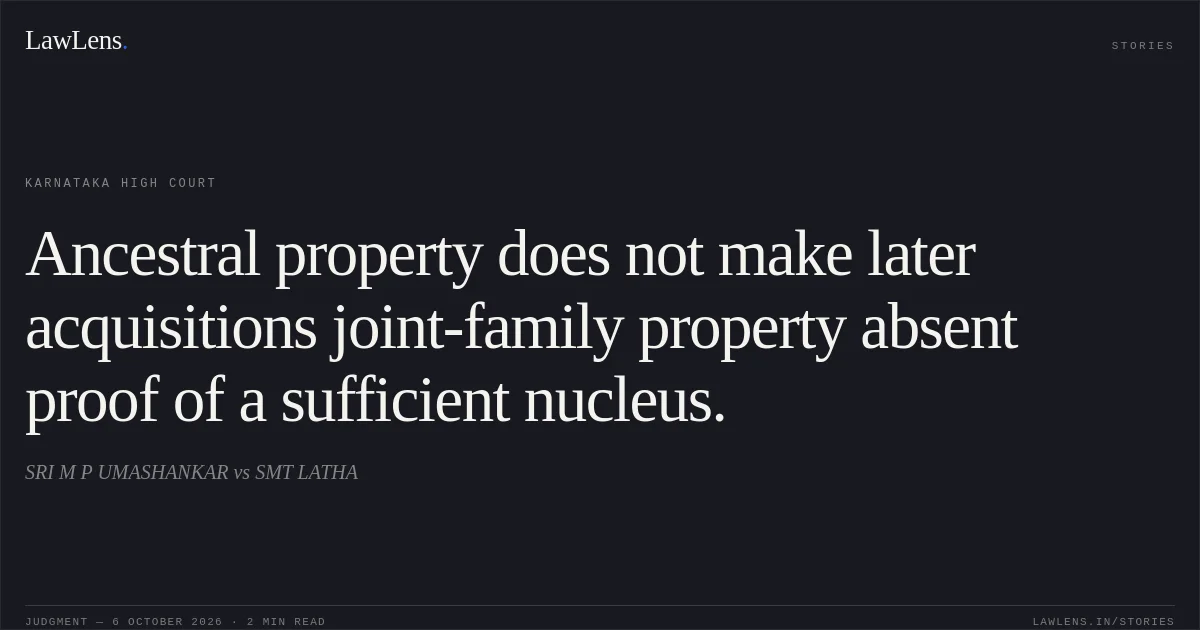
Source reference: no citationThe existence of a Hindu joint family does not, by itself, raise a presumption that property held by a family member is joint-family property; the person asserting that character must prove it.
Source reference: para. 38–43If that person establishes a sufficient joint-family nucleus from which the property could have been acquired, the evidential burden shifts to the person claiming self-acquisition to show that the purchase was made from separate funds (*D.S. Lakshmaiah v. L. Balasubramanyam*; *Appasaheb Peerappa Chandgade v. Devendra Peerappa Chandgade*).
Source reference: para. 38–43The Court also referred to *Bhimappa Yallappa Sheregar v. Krishanavva Gangappa Kalal* and *Ramappa Basappa Palled v. Smt. Basava* on assessing the family’s assets, funds, and circumstances when determining whether an acquisition was joint-family property.
Source reference: para. 44, 51It applied *Angadi Chandranna v. Shankar* for the proposition that property inherited by a person from his father becomes that person’s self-acquired property.
Source reference: para. 41–42Reasoning
The plaintiffs did not produce evidence of the income generated by Item No.7 or of savings from that property sufficient to fund the acquisition of Items 1–6 and 8.
Source reference: para. 32, 36–40, 52–57By contrast, defendant No.1 produced grant and acquisition documents, and the evidence showed that he was a salaried police employee.
Source reference: para. 32, 36–40, 52–57The Court therefore held that the plaintiffs had not established the necessary joint-family nucleus and that the First Appellate Court had erred in treating the disputed properties as joint-family acquisitions.
Source reference: para. 32, 36–40, 52–57It found no basis to infer that Item No.7 funded their purchase, particularly as it was a residential house and no income from it was shown.
Source reference: para. 32, 36–40, 52–57Holding
The High Court answered the substantial question of law in the affirmative.
The High Court allowed the second appeal, and set aside the First Appellate Court’s judgment.
Source reference: para. 57–58It restored the Trial Court’s decree, which granted partition and separate possession only in respect of Item No.7 and dismissed the claim concerning the other properties.
Source reference: para. 57–58Acts & Sections Cited
1 provisions across 1 statute referred to in this judgment. Each provision opens on LawLens.
Code of Civil Procedure, 19081
Original Court PDF
SRI M P UMASHANKARvsSMT LATHA
Click to open original judgment
Original judgment, available to read, download and summarize on LawLens.in