Facts
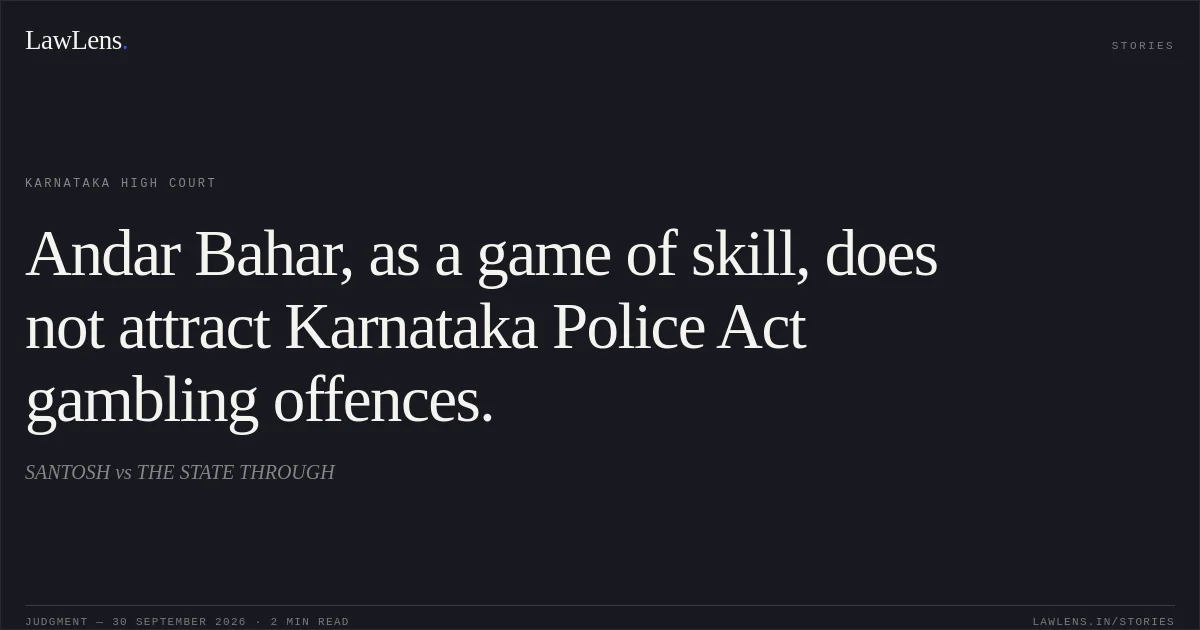
The petitioners, arrayed as accused Nos. 1, 2 and 6, sought to quash proceedings in C.C. No. 12773/2024 under Sections 79 and 80 of the Karnataka Police Act, 1963 (“KP Act”).
Source reference: para. 2The prosecution alleged that, following information about gambling, police raided a house at Kataranka Heights Apartment at about 1:05 a.m. on 23 September 2024 and found eight persons playing “Andar Bahar” with playing cards and placing monetary bets. Police seized ₹5,110 and 52 cards, among other items, and filed a charge sheet.
Source reference: para. 4The petitioners argued that “Andar Bahar” is a game of skill, not chance, and that the alleged offences were not made out.
Source reference: paras. 5–6The prosecution opposed quashing, relying on the charge sheet and asserting a prima facie case.
Source reference: para. 3Issues
Whether the alleged playing of “Andar Bahar” attracted Sections 79 and 80 of the KP Act, in light of the cited decisions treating it as a game of skill.
Source reference: paras. 5–6Whether the prosecution materials disclosed the ingredients of those offences, including the existence of a “common gaming house”.
Source reference: para. 8Whether the proceedings against the petitioners should be quashed under Section 528 of the Bharatiya Nagarik Suraksha Sanhita, 2023 (“BNSS”).
Source reference: paras. 8–9Law Applied
Sections 79 and 80 of the KP Act were the alleged offences.
Source reference: paras. 5–6The Court applied the cited decisions in Chickrangappa v. State of Mysore (1971 (2) Mys.L.J. 187), Eranna v. State of Karnataka (1977 (1) K.L.J. 264), and K.N. Suresh v. State of Karnataka (ILR 2012 KAR 1443), which it understood to hold that “Andar Bahar” is a game of skill and that Sections 79 and 80 are not attracted on that basis.
Source reference: paras. 5–6The Court also referred to the definition of “common gaming house” in Section 2(3) of the KP Act and held that the prosecution papers did not show that the premises had been converted into such a house.
Source reference: para. 8Section 528 BNSS provides the basis for the High Court’s inherent power to quash proceedings to prevent abuse of process.
Source reference: paras. 2, 8The police had obtained the Magistrate’s permission to investigate the non-cognizable offences under Section 155(2) of the Cr.P.C. / Section 174 of the BNSS.
Source reference: para. 7Reasoning
The Court accepted the petitioners’ reliance on the cited Karnataka decisions that classify “Andar Bahar” as a game of skill and found them applicable to the allegations.
Source reference: paras. 5–6, 9Although the police alleged that the petitioners were gambling and seized cash and cards, the prosecution papers did not establish that the house was a “common gaming house” within Section 2(3) of the KP Act; the Court therefore found no sufficient material disclosing the alleged offences.
Source reference: paras. 4, 8–9The Magistrate’s prior permission to investigate addressed the non-cognizable nature of the offences, but did not cure the absence of material supporting the offences’ substantive ingredients.
Source reference: paras. 7–8Holding
The Court held that the petitioners had made out sufficient grounds for quashing and allowed the petition.
It quashed the proceedings in C.C. No. 12773/2024, arising from Crime No. 231/2024, under Sections 79 and 80 of the KP Act, insofar as they related to accused Nos. 1, 2 and 6.
Source reference: para. 10Acts & Sections Cited
6 provisions across 3 statutes referred to in this judgment. Each provision opens on LawLens.
Bharatiya Nagarik Suraksha Sanhita, 20232
KARNATAKA POLICE ACT, 1963.3
Code of Criminal Procedure, 19731
Original Court PDF
SANTOSHvsTHE STATE THROUGH
Click to open original judgment
Original judgment, available to read, download and summarize on LawLens.in