Facts
The petitioner, the paternal aunt of three children alleged to be in conflict with law, sought habeas corpus, alleging that after the children were produced before the Juvenile Justice Board (JJB) on 3 August 2026, they were kept at institutions under police arrangement without a specific JJB custody order.
Source reference: para. 2–8, 25–29The State said the children were placed at a women’s safety centre and a recognised children’s home because their guardians were unavailable and no boys’ observation home existed in Guntur; they were subsequently produced before the JJB and, by order dated 6 August 2026, sent to government observation homes.
Source reference: para. 2–8, 25–29The petitioner confined the challenge to the interim period before that order.
Source reference: para. 9–10, 29Issues
1. Whether the children’s placement in institutions from 3 August until the JJB’s order of 6 August 2026, without a specific JJB order directing that placement, amounted to illegal detention warranting habeas corpus relief.
Source reference: para. 8–10, 29, 40–472. Whether the children’s apprehension and production before the JJB were unlawful because the officer concerned was not a designated Child Welfare Police Officer (CWPO).
Source reference: para. 12, 20–24Law Applied
Section 10 of the Juvenile Justice (Care and Protection of Children) Act, 2015 (JJ Act) requires a child alleged to be in conflict with law to be placed under the charge of the Special Juvenile Police Unit or designated CWPO and produced before the JJB within 24 hours; a child cannot be kept in a police lock-up or jail.
Source reference: para. 15Under Section 12, release on bail is the rule, subject to the statutory exceptions; if the child is not released, the child must be kept in an observation home or place of safety pending inquiry.
Source reference: para. 16, 31–32Sections 2(18), 2(46), 2(47) and 107 address the CWPO, place of safety, observation home, and child-welfare police arrangements.
Source reference: para. 18–19, 36–38The Court relied on Re Exploitation of Children in Orphanages in the State of Tamil Nadu v. Union of India, which emphasised the statutory safeguards and the duty to ensure a child is released or placed in an observation home or place of safety.
Source reference: para. 33–34The Court relied on Pooja Gagan Jain v. State of Maharashtra on the permissible custodial arrangements under the Act.
Source reference: para. 35It also considered Smt. Durga v. State of Rajasthan on the statutory role of the Special Juvenile Police Unit.
Source reference: para. 20Andhra Pradesh G.O.Ms. No. 12 dated 11 February 2016 designated Station House Officers/Sub-Inspectors as CWPOs.
Source reference: para. 21–22Reasoning
The Court found that the children had been produced before the JJB within 24 hours and that the officer producing them, as an SHO, fell within the designation of CWPO under the State Government’s notification.
Source reference: para. 24–25, 42Although the JJB’s orders of 3 and 5 August did not expressly direct placement in an observation home or place of safety, the children had been “returned” for further production, bail had not been granted, and their guardians were unavailable.
Source reference: para. 41–47The Court held that the police could not simply release them in those circumstances and, given the statutory requirement for safe placement and the absence of a boys’ observation home in Guntur, found no illegality in placing them in the identified institutions pending their next production.
Source reference: para. 41–47Holding
The Court rejected the habeas corpus claim and dismissed the writ petition, finding no illegal detention on the facts presented.
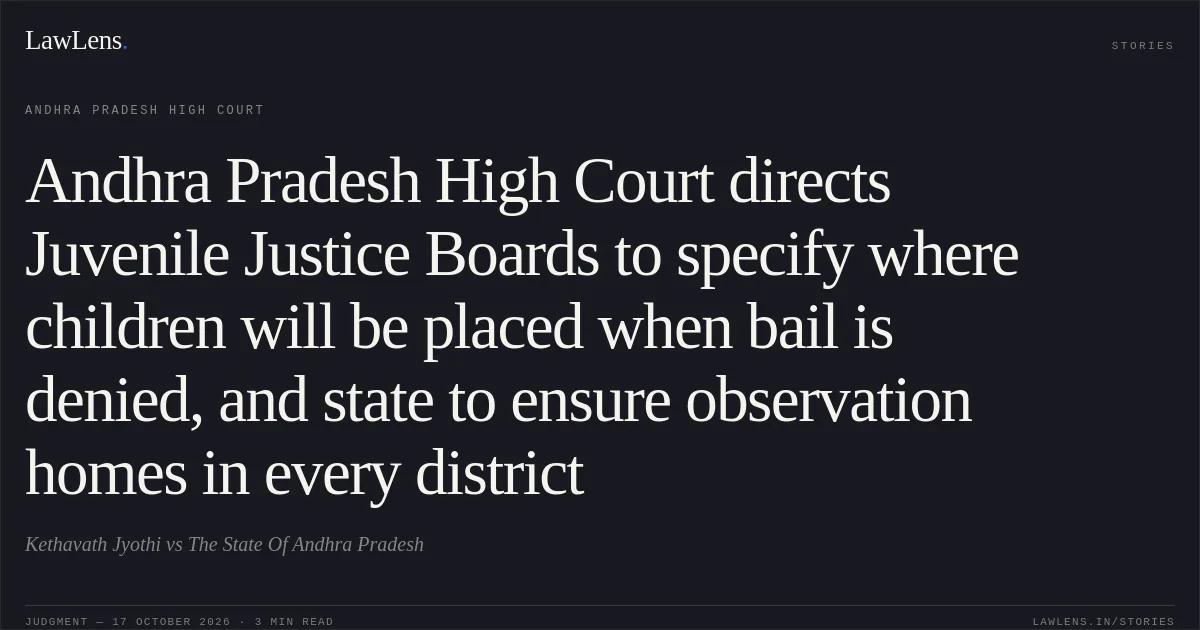
It directed all JJBs in Andhra Pradesh to make specific orders for placement in an observation home or place of safety whenever bail is denied, rather than merely returning a child to police custody; it also directed the Principal Secretary of the concerned Department to ensure sufficient observation homes, preferably at least one in each district.
Source reference: para. 48No order as to costs was made.
Source reference: para. 49Acts & Sections Cited
12 provisions across 3 statutes referred to in this judgment. Each provision opens on LawLens.
Bharatiya Nagarik Suraksha Sanhita, 20232
Bharatiya Nyaya Sanhita, 20234
Juvenile Justice (Care and Protection of Children) Act, 2015.6
Original Court PDF
Kethavath JyothivsThe State Of Andhra Pradesh
Click to open original judgment
Original judgment, available to read, download and summarize on LawLens.in