Facts
The petitioners were engaged as Anganwadi Workers (AWWs) and Anganwadi Helpers (AWHs) in five centers at Khakchang Para Bru Camp under the Damcherra ICDS Project between 2007 and 2010
Source reference: para. 6In November 2022, the Bru people were shifted to a new camp at Khahamthai Para, leading to the closure of the existing centers. Consequently, the CDPO issued a memorandum on 28.12.2022 stopping the petitioners' honorarium indefinitely without formally terminating their services
Source reference: para. 7-8The petitioners challenged this in the High Court, asserting they had a right to serve until the age of 60
Source reference: para. 9A Single Judge initially granted 50% honorarium and directed the State to decide on their fate
Source reference: para. 14Both the State and the petitioners appealed the decision
Source reference: para. 15Issues
1. What is the legal nature of the engagement of petitioners as AWWs and AWHs, and can they be termed "contingent" employees?
Source reference: para. 20(i)-(ii)2. Whether the "No Work, No Pay" principle is applicable when the State prevents employees from performing their duties?
Source reference: para. 20(iii)3. Whether the shifting of an ICDS project location justifies the arbitrary cessation of honorarium and service?
Source reference: para. 44-45Law Applied
The court primarily applied the National Food Security Act, 2013, which transitioned the status of Anganwadi centers from a mere "welfare" scheme to a "rights-based" statutory obligation of the State under Article 47 of the Constitution
Source reference: para. 23-24It relied heavily on the precedent of Maniben Maganbhai Bhariya v. Distt. Development Officer, Dahod (2022) 16 SCC 343, which established that AWWs and AWHs hold "statutory posts" and what they receive is effectively a "wage"
Source reference: para. 28-30The court applied the principle from Central Inland Water Transport Corpn. v. Brojo Nath Ganguly (1986) 3 SCC 156, ruling that unconscionable contract clauses allowing termination without reason are void against parties with unequal bargaining power
Source reference: para. 42Reasoning
The court reasoned that since the enactment of the National Food Security Act, 2013, AWWs and AWHs are no longer temporary/contingent staff but an "extended arm of the Government"
Source reference: para. 28It rejected the State’s reliance on engagement letters that suggested employment was purely temporary or tied only to the existence of a specific migrant camp, noting such clauses are arbitrary and violative of Article 14
Source reference: para. 42-47The court observed that the shifting of the Bru camp to a new location (Khahamthai Para) did not dissolve the State’s statutory obligation under the ICDS scheme
Source reference: para. 44Since the petitioners were ready to work but were prevented by the State’s failure to re-engage them at the new site, the "No Work, No Pay" doctrine was held inapplicable
Source reference: para. 49-50The court also noted that the State had already framed superannuation rules for AWWs at age 60, creating a legitimate expectation of service continuity
Source reference: para. 48Holding
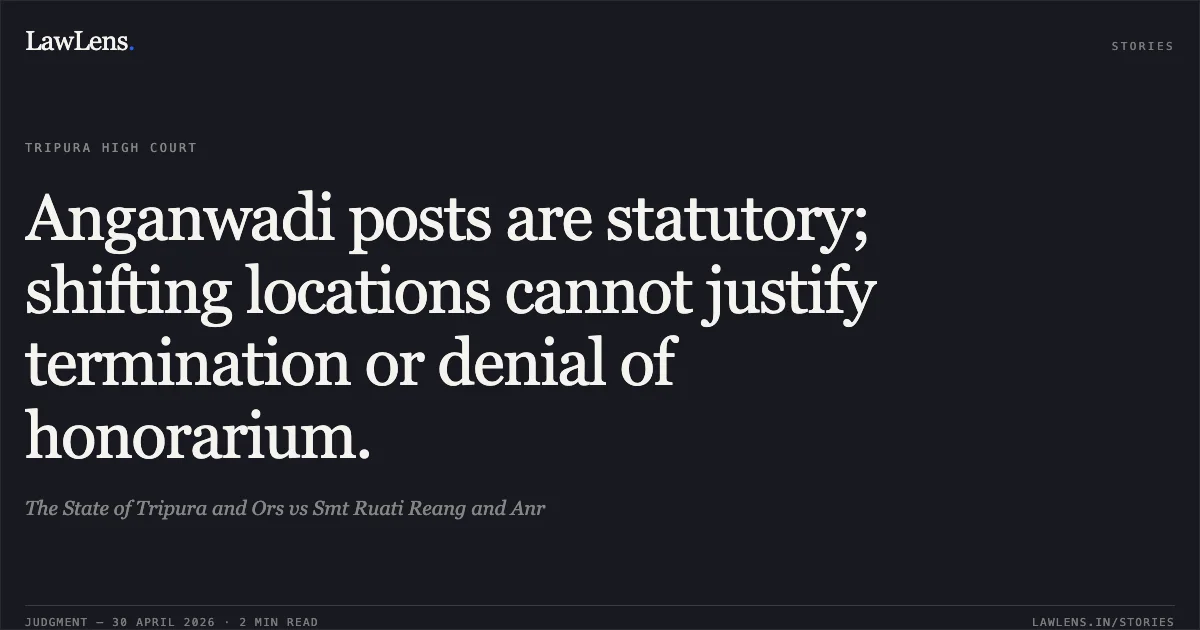
The Court held that AWWs/AWHs hold statutory posts and cannot be summarily disengaged due to relocation
The Court directed the State to (i) re-engage the petitioners at the Khahamthai Para Bru Camp or any other Anganwadi center within the Damcherra Project within four weeks, and (ii) pay full back-honorarium/wages from December 2022 until the date of re-engagement within eight weeks
Source reference: para. 51Acts & Sections Cited
4 provisions across 2 statutes referred to in this judgment. Each provision opens on LawLens.
Right of Children to Free and Compulsory Education Act, 20091
Original Court PDF
The State of Tripura and OrsvsSmt Ruati Reang and Anr
Click to open original judgment
Original judgment, available to read, download and summarize on LawLens.in