Facts
The petitioner was engaged as an Anganwadi Worker at 201 No. Batua Anganwadi Center on an honorary basis in 2007.
Source reference: p. 3On 25.07.2012, she was allegedly assaulted by her husband and remained absent from duty, claiming she submitted leave applications.
Source reference: p. 3-4Following her husband's murder on 19.09.2012, she was arrested as an accused and remained in detention until 05.12.2012.
Source reference: p. 4Upon being enlarged on bail, the petitioner alleged she was barred from resuming duties due to the pending criminal case.
Source reference: p. 4On 30.04.2013, the Child Development Project Officer (CDPO) removed her from service due to unauthorized absence effective from 19.09.2012.
Source reference: p. 4, 8The petitioner was acquitted of the criminal charges on 15.10.2015 and subsequently filed this writ petition challenging her removal.
Source reference: p. 5-6Issues
1. Whether the removal of an honorary Anganwadi Worker for unauthorized absence requires a formal disciplinary enquiry under Article 311(2) of the Constitution of India and the Assam Services (Discipline & Appeal) Rules, 1964.
Source reference: p. 5, 112. Whether the petitioner’s absence was willful and justified the termination of her engagement.
Source reference: p. 9, 10Law Applied
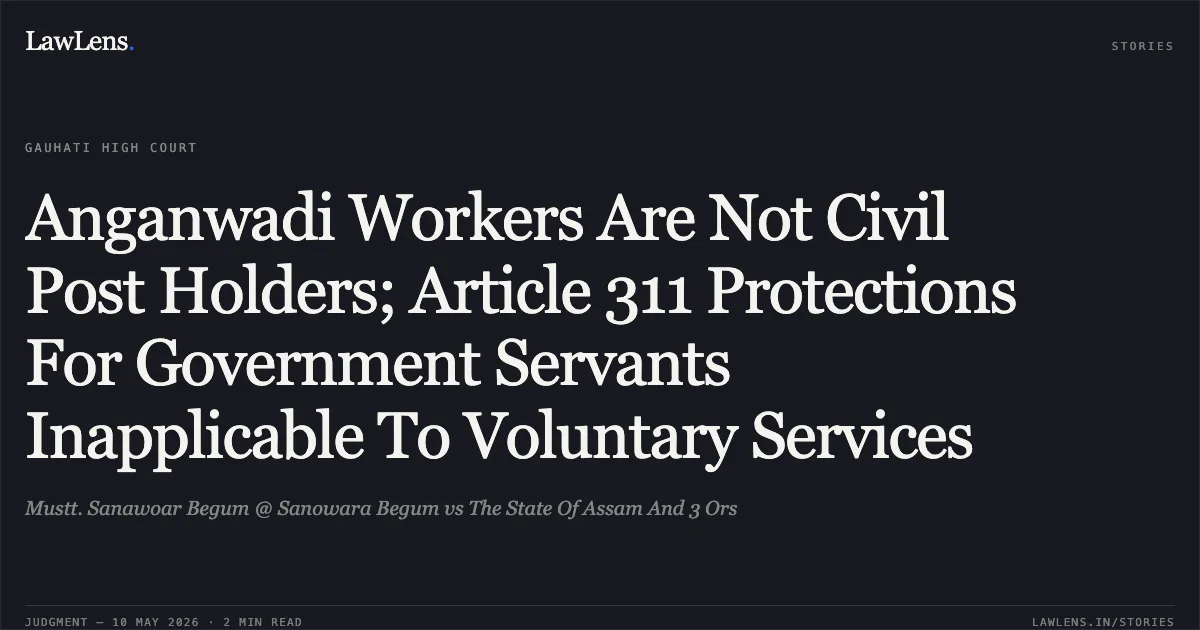
Anganwadi Workers are engaged on a voluntary/honorary basis and do not hold a "civil post", therefore the protection of Article 311(2) of the Constitution of India does not apply to them.
Source reference: p. 11The Assam Services (Discipline & Appeal) Rules, 1964, which govern the disciplinary procedures for government servants, are inapplicable to such honorary workers.
Source reference: p. 11An appointee currently holding a post must be impleaded if their appointment is effectively challenged (procedural principle regarding the non-joinder of necessary parties).
Source reference: p. 11-12Reasoning
The Court found that the petitioner failed to provide documentary evidence of her medical injuries or the leave applications allegedly submitted prior to her removal.
Source reference: p. 8-9While the petitioner claimed she attempted to resume duties on 18.12.2012 but was blocked by authorities, the Court noted that her subsequent representation dated 29.07.2013 made no mention of such an attempt or refusal; therefore, the Court concluded her absence was deliberate and willful.
Source reference: p. 9-10The court rejected the petitioner's argument for a formal enquiry, clarifying that as an honorary worker, she is not a government servant and cannot claim the constitutional or statutory protections reserved for holders of civil posts.
Source reference: p. 11Holding
The Court held that the petitioner’s removal for unauthorized absence was justified and legally sound, ruling that Article 311(2) does not apply to honorary workers and that the absence was willfully unauthorized.
The Court noted that since the post is no longer vacant and the current incumbent was not made a party, no adverse order could be passed; the writ petition was dismissed as devoid of merit with no order as to costs.
Source reference: p. 11-12Acts & Sections Cited
1 provisions across 1 statute referred to in this judgment. Linked provisions open on LawLens.
Indian Penal Code, 18601
Original Court PDF
Mustt. Sanawoar Begum @ Sanowara BegumvsThe State Of Assam And 3 Ors
Click to open original judgment
Original judgment, available to read, download and summarize on LawLens.in