Facts
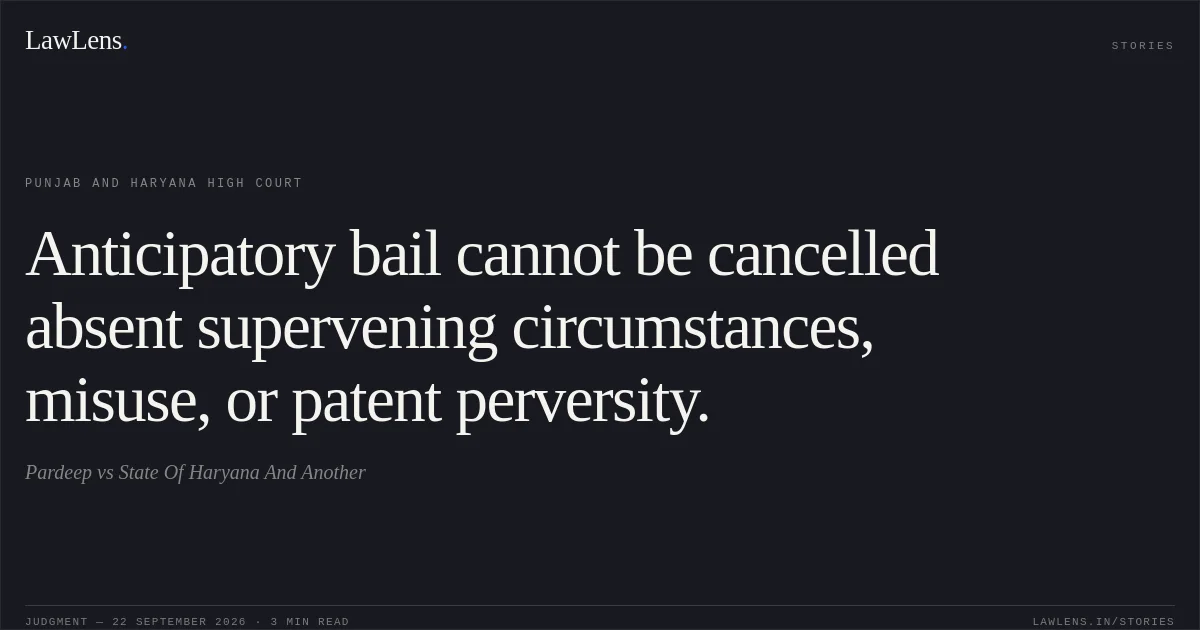
The petitioner sought cancellation of the anticipatory bail granted to respondent No. 2 in FIR No. 197 dated 12 July 2026, registered at Police Station Israna, District Panipat, under Section 318(4) read with Section 61(2), Bharatiya Nyaya Sanhita, 2023, corresponding to Sections 420 and 120-B IPC.
Source reference: para. 1The prosecution arose from a failed property transaction in which the complainant had allegedly paid ₹1.75 crore as earnest money to respondent No. 2 and ₹2.68 crore to co-accused Wazir, who was stated to be the original owner of the property.
Source reference: para. 5The petitioner alleged that respondent No. 2 and her husband had induced him to make the payments, retained or facilitated retention of the money, and were implicated through call recordings, transcripts, and the financial trail. It was also alleged that a cheque issued towards repayment had been dishonoured.
Source reference: para. 2The Additional Sessions Judge granted respondent No. 2 anticipatory bail after observing that the dispute essentially arose from a civil transaction, that Wazir had failed to execute the sale deed and had transferred the land to his wife and son, and that respondent No. 2’s intention to defraud could not prima facie be inferred at the time of entering into the agreement.
Source reference: para. 5The petitioner consequently invoked Section 483(3) read with Section 528 BNSS, corresponding to Sections 439(2) and 482 Cr.P.C., seeking cancellation of that bail and custodial interrogation of respondent No. 2.
Source reference: para. 1Issues
1. Whether the anticipatory bail granted to respondent No. 2 suffered from patent illegality, perversity, arbitrariness, or non-consideration of material circumstances warranting its cancellation?
Source reference: paras. 6–92. Whether the allegations regarding the disputed monetary and property transaction, including the alleged financial trail, dishonoured cheque, and call recordings, constituted sufficient grounds for cancellation of anticipatory bail and custodial interrogation?
Source reference: paras. 2, 8–93. Whether any supervening circumstance, such as misuse of bail, interference with investigation or trial, witness intimidation, evidence tampering, evasion of law, or breach of bail conditions, had been established?
Source reference: paras. 7–8Law Applied
The Court applied Section 483(3) read with Section 528 of the BNSS, 2023, corresponding to Sections 439(2) and 482 Cr.P.C., governing cancellation of bail and inherent jurisdiction.
Source reference: para. 1It held that cancellation of bail stands on a qualitatively different footing from refusal of bail at the initial stage and must ordinarily be exercised sparingly. Bail may be cancelled where the accused subsequently misuses the concession, interferes with the administration of justice, tampers with evidence, intimidates or influences witnesses, evades the process of law, violates bail conditions, or where the original bail order is patently perverse, arbitrary, or legally infirm.
Source reference: para. 7Relying on Dolat Ram v. State of Haryana, 1995 (1) SCC 349, the Court reiterated that very cogent, compelling, and overwhelming circumstances are required to displace an order granting bail.
Source reference: para. 7The Court also relied on the principle that a criminal proceeding should not be converted into a mechanism for recovery of money arising from a disputed commercial or contractual transaction where appropriate civil remedies are available.
Source reference: para. 5Reasoning
The Court found that the Additional Sessions Judge had considered the material circumstances and had reasonably concluded that the dispute arose from a failed property transaction.
Source reference: para. 5The alleged payments, dishonoured cheque, call recordings, and financial trail related primarily to the underlying transaction and did not, by themselves, demonstrate post-bail misconduct or misuse of the concession.
Source reference: paras. 5, 8The Court distinguished Kurban v. State of Haryana and Another, 2020 (4) RCR (Criminal) 696, observing that the present proceedings concerned cancellation of bail rather than the initial consideration of an anticipatory-bail application; therefore, the Court was not required to undertake a fresh assessment of the accusation on merits.
Source reference: para. 6No material established that respondent No. 2 had interfered with the investigation or trial, tampered with evidence, intimidated witnesses, evaded the process of law, or violated any bail condition.
Source reference: para. 8Consequently, the stringent threshold for cancellation under Section 439(2) Cr.P.C. was not met.
Source reference: paras. 8–9Holding
The Court held that the petitioner failed to establish any supervening circumstance, misuse of anticipatory bail, patent perversity in the bail order, or other compelling ground warranting cancellation.
The petition seeking cancellation of respondent No. 2’s anticipatory bail and her custodial interrogation was accordingly dismissed, without expressing any opinion on the merits of the underlying criminal allegations or the defence of the parties.
Source reference: para. 9All pending miscellaneous and ancillary applications were disposed of as infructuous.
Source reference: para. 10Acts & Sections Cited
7 provisions across 4 statutes referred to in this judgment. Each provision opens on LawLens.
Bharatiya Nagarik Suraksha Sanhita, 20232
Bharatiya Nyaya Sanhita, 20232
Code of Criminal Procedure, 19732
Indian Penal Code, 18601
Original Court PDF
PardeepvsState Of Haryana And Another
Click to open original judgment
Original judgment, available to read, download and summarize on LawLens.in