Facts
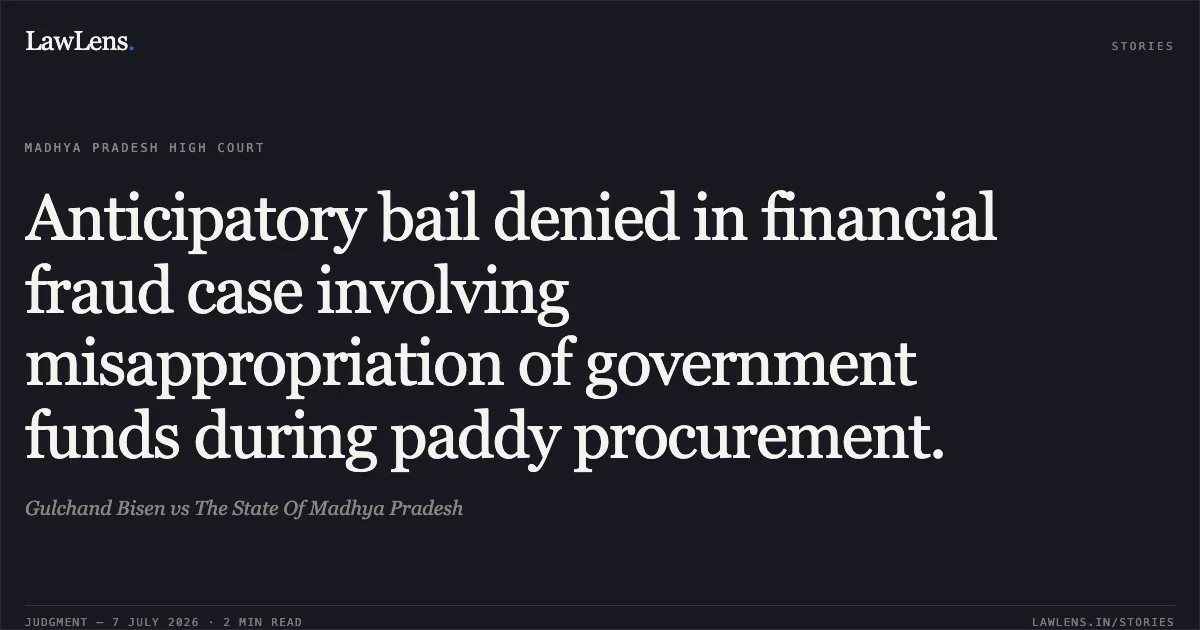
The applicant, Gulchand Bisen, filed his first anticipatory bail application under Section 482 of the Bharatiya Nagarik Suraksha Sanhita (BNSS), 2023.
Source reference: para. 1He was implicated in Crime No. 38/2026 for allegedly conspiring with other society managers to procure 257.87 quintals of substandard paddy to cover a shortage in government procurement targets, thereby causing financial loss to the State.
Source reference: para. 2The applicant contended he was the In-charge of the Katedara and Nandi centers, not the Mehkepar center where the irregularities occurred.
Source reference: para. 3He further argued that according to Supreme Court precedents, grounds of arrest must be communicated in writing, and as a 56-year-old government servant, he was not a flight risk.
Source reference: para. 3The State opposed the bail, citing the gravity of the economic offense and the need for custodial interrogation.
Source reference: para. 4Issues
1. Whether the applicant is entitled to the protection of anticipatory bail despite the prima facie evidence of his involvement in a conspiratorial economic offense.
Source reference: para. 72. Whether the strict requirement to furnish written grounds of arrest prior to or at the time of arrest is absolute in cases involving financial fraud and ongoing investigations.
Source reference: para. 7Law Applied
The Court considered Section 482 of the BNSS regarding anticipatory bail and Sections 316(5) and 3(5) of the Bharatiya Nyaya Sanhita (BNS), 2023, relating to criminal breach of trust and common intention.
Source reference: para. 1It examined the principles regarding the communication of grounds of arrest under Article 22(1) of the Constitution and Section 47 of the BNSS, as interpreted in Mihir Rajesh Shah v. State of Maharashtra (2025) and Vihaan Kumar v. State of Haryana (2025).
Source reference: para. 3These precedents establish that while written grounds are generally mandatory, certain exceptional circumstances—including financial offenses and the risk of evidence tampering—may justify arrest to secure the presence of the accused or protect the integrity of the investigation.
Source reference: para. 7Reasoning
The Court found that the case diary revealed a common design among the accused to misappropriate government funds by procuring inferior quality paddy.
Source reference: para. 6It distinguished the precedents cited by the applicant, noting that the gravity of the economic offense and the ongoing nature of the investigation created a reasonable apprehension that the applicant might tamper with evidence or influence witnesses if granted bail.
Source reference: para. 7The Court specifically categorized five circumstances where the immediate requirement to inform/protect the applicant from arrest is relaxed, notably including "financial offences, misappropriation, [or] fraud" where there is credible evidence of potential obstruction to the investigation.
Source reference: para. 7, point 4Because the applicant's complicity was supported by prima facie material, the Court held that custodial oversight was necessary.
Source reference: para. 7-8Holding
The Court answered the issues in the negative, holding that the seriousness of the fraud and the risk to the investigation outweighed the applicant's personal liberty interests.
The High Court of Madhya Pradesh dismissed the application for anticipatory bail.
Source reference: para. 9Acts & Sections Cited
7 provisions across 3 statutes referred to in this judgment. Each provision opens on LawLens.
Bharatiya Nagarik Suraksha Sanhita, 20233
Code of Criminal Procedure, 19732
Bharatiya Nyaya Sanhita, 20232
Original Court PDF
Gulchand BisenvsThe State Of Madhya Pradesh
Click to open original judgment
Original judgment, available to read, download and summarize on LawLens.in