01Facts
The petitioner sought anticipatory bail under Section 482 of the Bharatiya Nagarik Suraksha Sanhita, 2023 (BNSS) in FIR No. 24/2026 dated 29 January 2026, registered at PS Special Cell, Delhi, under Sections 308/318(4)/319/340 of the Bharatiya Nyaya Sanhita, 2023 (BNS).
¶ 1His earlier anticipatory bail application (BA No. 2066/2026) was dismissed by the Additional Sessions Judge-03, Patiala House Courts, on 21 August 2026.
¶ 2 · p. 2The complainant, Bhrigu Das, alleged that he and his wife were "digitally arrested" by fraudsters impersonating law enforcement officials and induced to transfer ₹1,28,10,000 into various accounts.
¶ 3.1 · p. 2The amount was traced to four first-layer accounts.
¶ 3.2One such account was a Bandhan Bank current account in the name of M/s Hari Om Traders, of which the petitioner is proprietor. It received ₹25,50,000 of the complainant's money on 27 January 2026 and the funds were then layered into nine second-layer accounts.
¶ 3.3The account was linked to 17 acknowledgements and received a total of ₹2,82,30,864.
¶ 3.4The petitioner was served notice under Section 35(3) BNSS but did not join the investigation.
¶ 3.5Non-bailable warrants (NBWs) issued against the petitioner could not be executed because his house was found locked.
¶ 3.6The petitioner contended that he is a victim, was unaware of the deposits, has deep social roots, and that his absence was due to a family circumstance communicated to the police by his wife. He also relied on the pendency of his bail plea and on the documentary nature of the evidence.
¶ 5.1–5.6 · pp. 3–4The State opposed the plea on the ground of the substantial credits, non-cooperation, and the need for custodial interrogation to uncover the wider conspiracy, identify further accounts, and trace proceeds of crime.
¶ 4.1–4.3 · pp. 2–302Issues
i.1. Whether anticipatory bail should be granted to a proprietor whose bank account received a substantial portion of the defrauded amount, where he has not joined the investigation despite notice and NBWs.
¶ 11–12 · p. 9ii.2. Whether the pendency of the petitioner's own anticipatory bail application justified his failure to cooperate with the investigation.
¶ 12 · p. 9iii.3. Whether the documentary and electronic nature of the evidence obviates the need for custodial interrogation.
¶ 13 · p. 1003Law Applied
The general principles of anticipatory bail, drawn from Siddharam Satlingappa Mhetre v. State of Maharashtra (2011) 1 SCC 694, hold that no rigid formula exists and that grant or refusal depends on the facts. Relevant factors include the nature and gravity of the accusation, the accused's exact role, the possibility of flight or repetition, tampering with witnesses, the magnitude of the offence, and the balance between a fair investigation and protection from harassment. Arrest is to be the last option.
¶ 8 · pp. 4–6P. Chidambaram v. Directorate of Enforcement (2019) 9 SCC 24 treats economic offences as a distinct class. Anticipatory bail is to be exercised sparingly in such cases, and its grant at the investigation stage may frustrate interrogation and the collection of evidence.
¶ 9 · pp. 6–8The observation in Y.S. Jagan Mohan Reddy v. CBI (2013) 7 SCC 439, quoted within Chidambaram, holds that economic offences with deep-rooted conspiracies require a different approach to bail.
¶ 9 · pp. 6–7Mohit v. State of NCT of Delhi, 2025 SCC OnLine Del 6382 recognises that digital frauds involve complex methods and that the investigating agency must be given latitude to investigate without premature pre-arrest protection.
¶ 10 · pp. 8–9Provisions in the judgment · 10 · Linked ones open on LawLens
Bharatiya Nagarik Suraksha Sanhita, 2023 Section 482Section 35Section 84
Bharatiya Nyaya Sanhita, 2023 Section 308Section 318Section 319Section 340
Code of Criminal Procedure, 1973 Section 438
Indian Penal Code, 1860 Section 34Section 149
04Reasoning
The Court treated the case as a serious economic offence because a large part of the defrauded amount passed through an account directly linked to the petitioner. Applying Chidambaram and Mohit, it held that the investigation of such digital frauds should not be curtailed by granting pre-arrest protection.
¶ 11 · p. 9On the petitioner's conduct, the Court held that pursuing a bail application did not prevent him from joining the investigation, and it did not justify his failure to appear after notice and NBWs. This non-cooperation weighed against him.
¶ 12The Court rejected the argument that documentary evidence removes the need for custody. It reasoned that the investigating agency may still need to confront the petitioner with specific documents, establish his role in the transactions, identify other accounts, and trace the balance of the funds.
¶ 13The judgment does not record a finding on the petitioner's claim that he was unaware of the deposits. The Court's reasoning rests on the investigative necessity and the petitioner's non-cooperation.
¶ 11–1405Holding
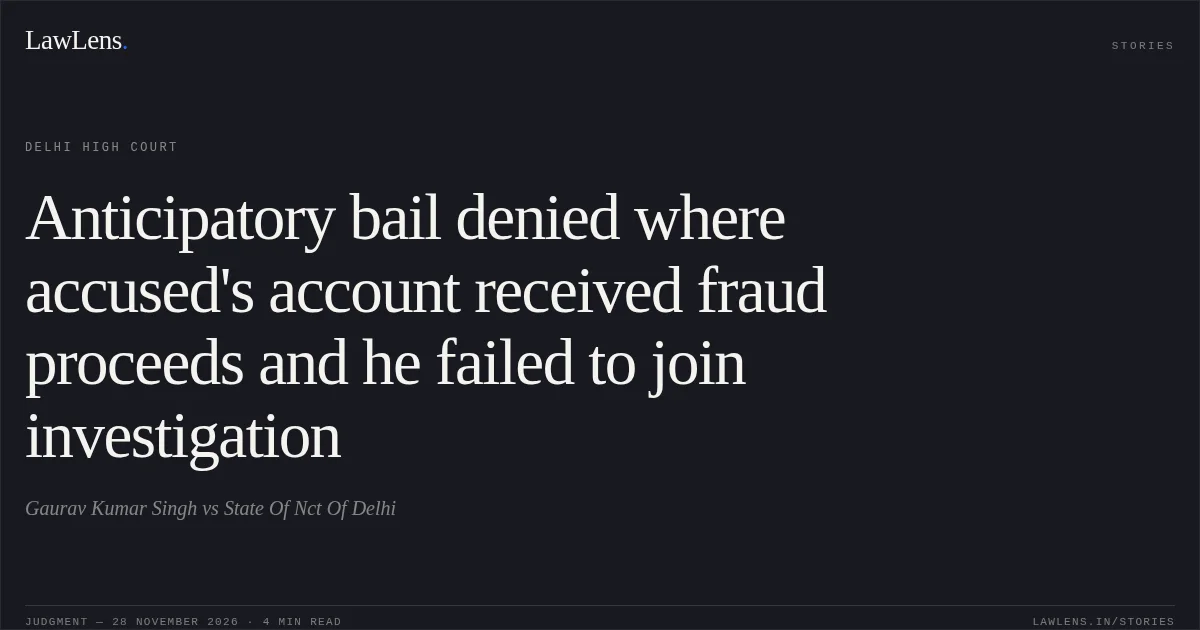
The case is not a fit one for the grant of anticipatory bail, given the seriousness of the economic offence, the substantial credits to the petitioner's account, his failure to join the investigation despite notice and NBWs, and the continuing need for custodial interrogation.
¶ 11–14 · p. 10The application (BA 4982/2026) is dismissed. The Court clarified that its observations are confined to this application and will not affect the merits of the case at trial.
¶ 15 · p. 10 · ¶ 16 · p. 10Original Court PDF
Gaurav Kumar SinghvsState Of Nct Of Delhi
Click to open original judgment
Original judgment, available to read, download and summarize on LawLens.in