Facts
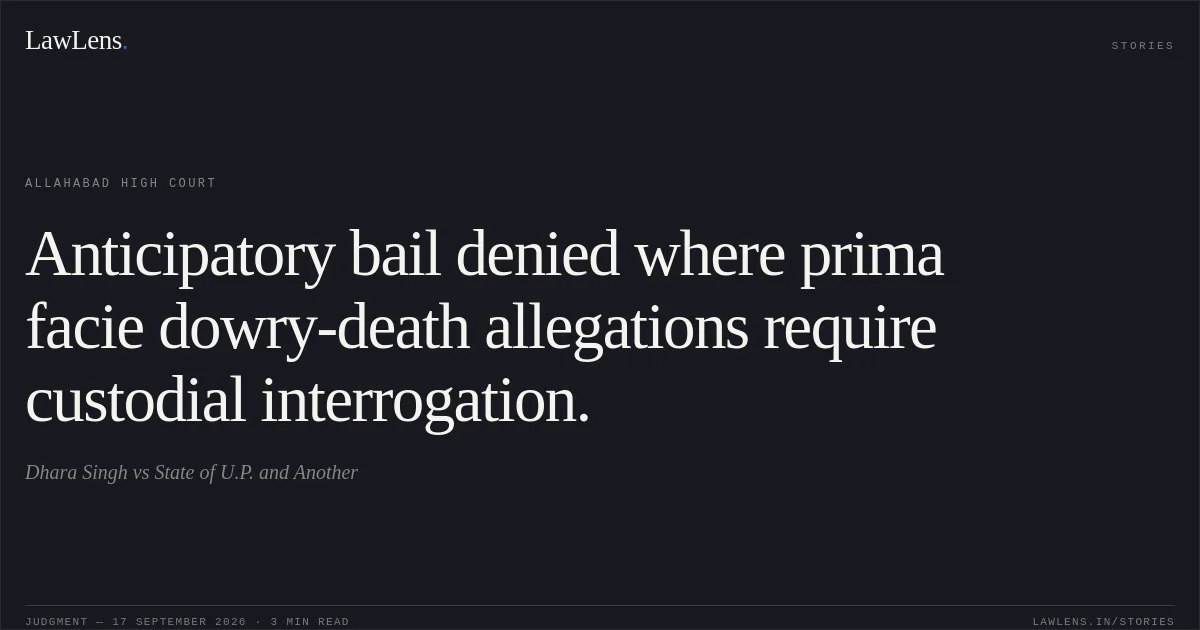
The applicant, the father-in-law of the deceased, sought anticipatory bail in Case Crime No. 366 of 2026, Police Station Aonla, District Bareilly, registered under Sections 80(2) and 85 of the Bharatiya Nyaya Sanhita, 2023 and Sections 3/4 of the Dowry Prohibition Act.
Source reference: para. 2The prosecution alleged that the deceased, who died within two years of her marriage, had been subjected to cruelty and harassment in connection with dowry demands.
Source reference: para. 4The applicant denied the allegations, asserting that he lived separately from the deceased and her husband, that only general and omnibus allegations had been made against him, and that he had been present during preparation of the inquest report.
Source reference: para. 3The State opposed anticipatory bail, contending that the applicant lived in the same village, was present at the time of the inquest, and that a prima facie case of dowry-related cruelty was made out.
Source reference: para. 4The State also questioned the maintainability of the application in light of Srikant Upadhyay v. State of Bihar.
Source reference: para. 4Issues
Whether the applicant, accused of dowry-related cruelty and harassment resulting in the death of the deceased within two years of marriage, was entitled to anticipatory bail under Section 482 BNSS?
Source reference: paras. 6, 10–12Whether the applicant had demonstrated exceptional circumstances warranting the exercise of the extraordinary power of pre-arrest bail?
Source reference: paras. 6–11Whether custodial interrogation was necessary at the preliminary stage of investigation?
Source reference: para. 10Law Applied
The Court applied Section 482 of the Bharatiya Nagarik Suraksha Sanhita, 2023, governing anticipatory bail, along with Sections 80(2) and 85 of the Bharatiya Nyaya Sanhita, 2023 and Sections 3/4 of the Dowry Prohibition Act, 1961.
Source reference: para. 2It held that anticipatory bail is an extraordinary remedy to be granted cautiously and only in exceptional cases, unlike regular bail, which generally follows the principle that bail is the rule and jail the exception.
Source reference: paras. 6, 11Relying on Srikant Upadhyay v. State of Bihar, (2024) 12 SCC 382, the Court stated that pre-arrest protection must not ordinarily be granted where it may cause miscarriage of justice, hamper investigation, or enable an accused to evade the process of law.
Source reference: para. 7Under P. Chidambaram v. Directorate of Enforcement, (2019) 9 SCC 24, the power must be exercised sparingly after considering the nature and gravity of the accusation, the possibility of the applicant fleeing justice, and the effect on investigation.
Source reference: para. 8The Court also relied on Kishor Vishwasrao Patil v. Deepak Yashwant Patil, 2022 SCC OnLine SC 2528, and Jai Prakash Singh v. State of Bihar, (2012) 4 SCC 379, for the principles that arrest may facilitate investigation and that anticipatory bail in serious offences is justified only where exceptional circumstances and apparent false implication are shown.
Source reference: para. 9Sushila Aggarwal v. State (NCT of Delhi), (2020) 5 SCC 1, was relied upon for considering the nature and gravity of the offence, the applicant’s role, and the likelihood of influencing the investigation or tampering with evidence.
Source reference: para. 9Reasoning
The Court found that the applicant was the deceased’s father-in-law and that allegations of cruelty and harassment concerning dowry demands had been specifically levelled against him.
Source reference: para. 6Although the applicant claimed to be living separately, that assertion was disputed by the State, and his presence during the inquest did not, at this stage, establish his innocence.
Source reference: para. 6Given that the deceased had died within two years of marriage and that the investigation was still at a preliminary stage, the Court held that a prima facie case existed and that custodial interrogation was necessary to ascertain the truth and advance the investigation.
Source reference: paras. 4, 6, 10The applicant failed to demonstrate that the prosecution was false or motivated by an attempt to humiliate him, or that the circumstances were sufficiently exceptional to justify pre-arrest protection.
Source reference: paras. 10–12The Court accordingly distinguished the considerations applicable to regular bail from those governing anticipatory bail.
Source reference: para. 11Holding
The Court held that the applicant was not entitled to anticipatory bail, as a prima facie case was made out, the allegations were serious, the investigation was at an early stage, and custodial interrogation was considered necessary.
The anticipatory bail application was therefore dismissed.
Source reference: para. 13Any interim order was vacated, and the Registrar (Compliance) was directed to transmit a copy of the order to the court concerned through the fastest mode.
Source reference: paras. 14–15Acts & Sections Cited
6 provisions across 4 statutes referred to in this judgment. Each provision opens on LawLens.
Bharatiya Nagarik Suraksha Sanhita, 20231
Bharatiya Nyaya Sanhita, 20232
Code of Criminal Procedure, 19731
Original Court PDF
Dhara SinghvsState of U.P. and Another
Click to open original judgment
Original judgment, available to read, download and summarize on LawLens.in