Facts
The applicant, Managing Director of M/s Electrical Energy Equipments India Pvt. Ltd. (EEE), sought anticipatory bail regarding FIR No. 112/2025 involving alleged economic offences.
Source reference: p. 1-2EEE entered into an MoU with the complainant, M/s Visual Technologies India Pvt. Ltd. (VTI), for project supplies, representing that payments from the client, BESCOM, would be routed through an Escrow Account.
Source reference: p. 2The complainant alleged that the applicant diverted these payments to a private account, used fabricated/ante-dated invoices, and misappropriated approximately Rs. 9.31 Crores.
Source reference: p. 2-3The State and complainant contended that the applicant submitted forged Purchase Orders to the Court and failed to operationalize the Escrow Account despite receiving full payment from BESCOM.
Source reference: p. 4, 8Issues
1. Whether the applicant is entitled to the extraordinary relief of anticipatory bail under Section 482 of the BNSS in a case involving allegations of financial fraud and document forgery?
Source reference: p. 5-72. Whether the existence of a civil remedy or the applicant's participation in the investigation precludes the necessity of custodial interrogation in economic offences?
Source reference: p. 6-8Law Applied
The Court applied Section 482 of the Bharatiya Nagarik Suraksha Sanhita (BNSS) regarding anticipatory bail.
Source reference: p. 2The Court relied on Srikant Upadhyay v. State of Bihar, establishing that anticipatory bail is an exceptional remedy, not a rule, and must be granted cautiously to avoid hampering investigations.
Source reference: p. 5The Court applied Saurabh Agarwal v. State of Uttar Pradesh, which held that the existence of a civil remedy does not dilute criminal allegations of fraud and that economic offences involving substantial sums require stricter scrutiny regarding the exercise of judicial discretion.
Source reference: p. 6, 7Reasoning
The Court observed that the applicant failed to maintain "clean hands," a prerequisite for discretionary relief. Specifically, the Court noted a significant discrepancy between the three-page Purchase Order claimed by the complainant and the six-page version filed by the applicant, which contained a conflicting jurisdiction clause (Bengaluru vs. Delhi).
Source reference: p. 3-4, 8On the merits, the Court found that despite the applicant's claim of intending to use an Escrow Account, evidence from BESCOM revealed that the applicant failed to complete the necessary formalities to operationalize it.
Source reference: p. 8The investigation showed that the applicant suppressed the fact that substantial payments had already been released by BESCOM prior to the MoU.
Source reference: p. 4, 8The Court reasoned that the gravity of the economic offence, the prima facie evidence of diverted funds, and the disputed authenticity of documents necessitated a denial of protection.
Source reference: p. 9Holding
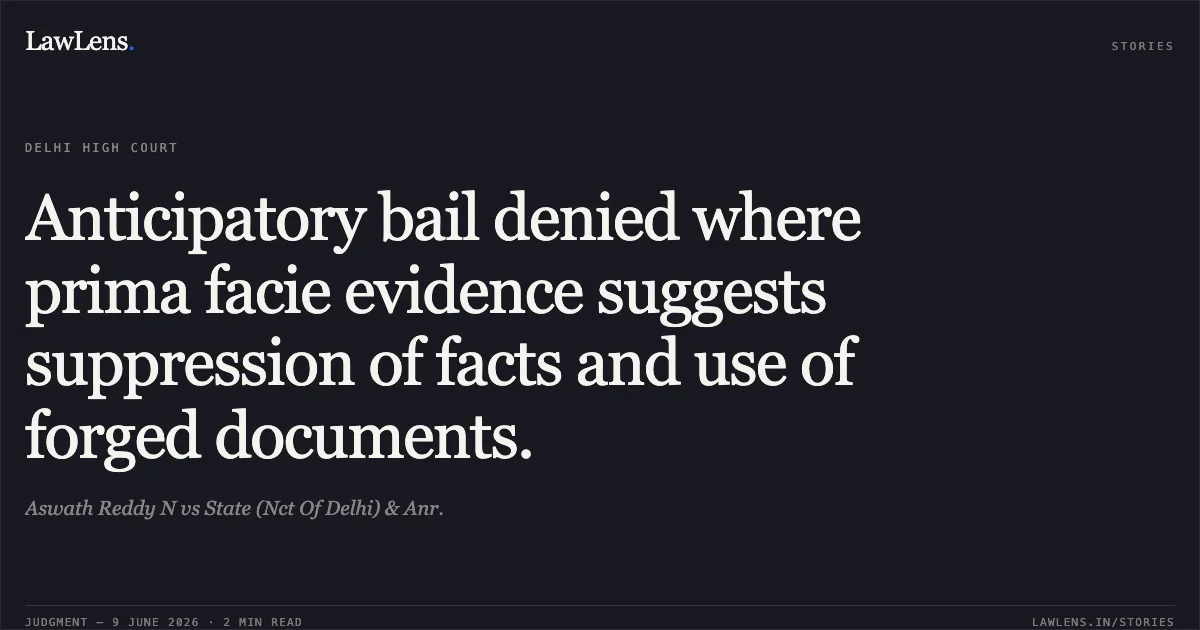
The Court dismissed the application for anticipatory bail.
The Court held that the nature and gravity of the allegations, the discrepancies in the documents relied upon by the applicant, and the findings of the Investigating Officer regarding the financial trail made the applicant ineligible for the discretionary relief under Section 482 of the BNSS.
Source reference: p. 9All pending applications were disposed of accordingly.
Source reference: p. 9Acts & Sections Cited
4 provisions across 1 statute referred to in this judgment. Each provision opens on LawLens.
Bharatiya Nagarik Suraksha Sanhita, 20234
Original Court PDF
Aswath Reddy NvsState (Nct Of Delhi) & Anr.
Click to open original judgment
Original judgment, available to read, download and summarize on LawLens.in