Facts
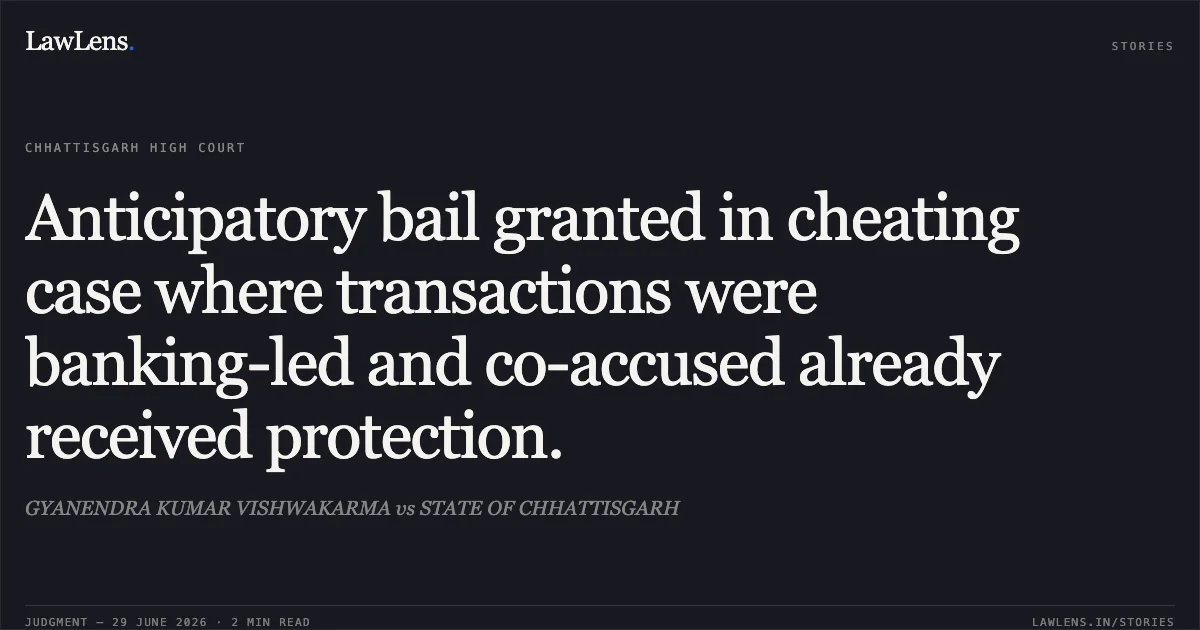
The applicant, Gyanendra Kumar Vishwakarma, sought anticipatory bail regarding Crime No. 220/2023.
Source reference: p.1Complainants Suresh Tiwari and Mukesh Verma alleged that in April 2022, the applicant and another individual, posing as employees of "Kisan Agro Bazaar Company," induced them to deposit membership fees and security amounts.
Source reference: para. 2Despite these payments made via cheque and RTGS, no goods were supplied, the accused allegedly collected more money under false pretexts, and then switched off their phones.
Source reference: para. 2The applicant contended he was merely a salesman/field employee with no control over financial affairs and that the transactions were documented via banking channels.
Source reference: para. 3The applicant had previously been granted anticipatory bail in a similar case (Crime No. 255/2022) by the same High Court.
Source reference: para. 3Issues
1. Whether the applicant is entitled to the protection of anticipatory bail under the Bhartiya Nagarik Suraksha Sanhita, 2023, considering the nature of the fraud allegations and his role in the company?
Source reference: para. 1, 6Law Applied
The court primarily applied Section 482 of the Bhartiya Nagarik Suraksha Sanhita (BNSS), 2023, which governs the grant of anticipatory bail (replacing Section 438 of the CrPC).
Source reference: para. 1The court also considered the substantive offences defined under Section 420 (cheating) and Section 34 (common intention) of the Indian Penal Code (IPC).
Source reference: para. 1, 2The court relied on the principle that bail is a matter of judicial discretion based on the facts and circumstances of the case, the nature of the allegations, and the likelihood of the trial's duration.
Source reference: para. 6Reasoning
The Court evaluated the applicant's submission that he was a subordinate employee without decision-making power and that custodial interrogation was unnecessary as the case against him relied on documentary evidence.
Source reference: para. 3While the State opposed the bail based on the existence of two registered cases, the Court placed significant weight on the fact that the applicant had already been granted anticipatory bail in the other related matter (MCRCA No. 923/2026) on June 22, 2026.
Source reference: para. 3, 4, 6The Court reasoned that since the investigation and trial would likely be time-consuming and the applicant had established permanent residency, the risk of absconding was low.
Source reference: para. 3, 6Consequently, without commenting on the merits of the allegations, the Court found it fit to grant protection from arrest subject to stringent conditions.
Source reference: para. 6, 7Holding
The Court allowed the anticipatory bail application.
It directed that in the event of arrest, the applicant be released upon executing a personal bond with one local surety. The holding is subject to conditions including: non-interference with witnesses, regular appearances before the trial court, submission of Aadhaar verification with a postcard-sized photo, and a prohibition against committing similar offences in the future.
Source reference: para. 7Acts & Sections Cited
3 provisions across 2 statutes referred to in this judgment. Each provision opens on LawLens.
Bharatiya Nagarik Suraksha Sanhita, 20231
Indian Penal Code, 18602
Original Court PDF
GYANENDRA KUMAR VISHWAKARMAvsSTATE OF CHHATTISGARH
Click to open original judgment
Original judgment, available to read, download and summarize on LawLens.in