01Facts
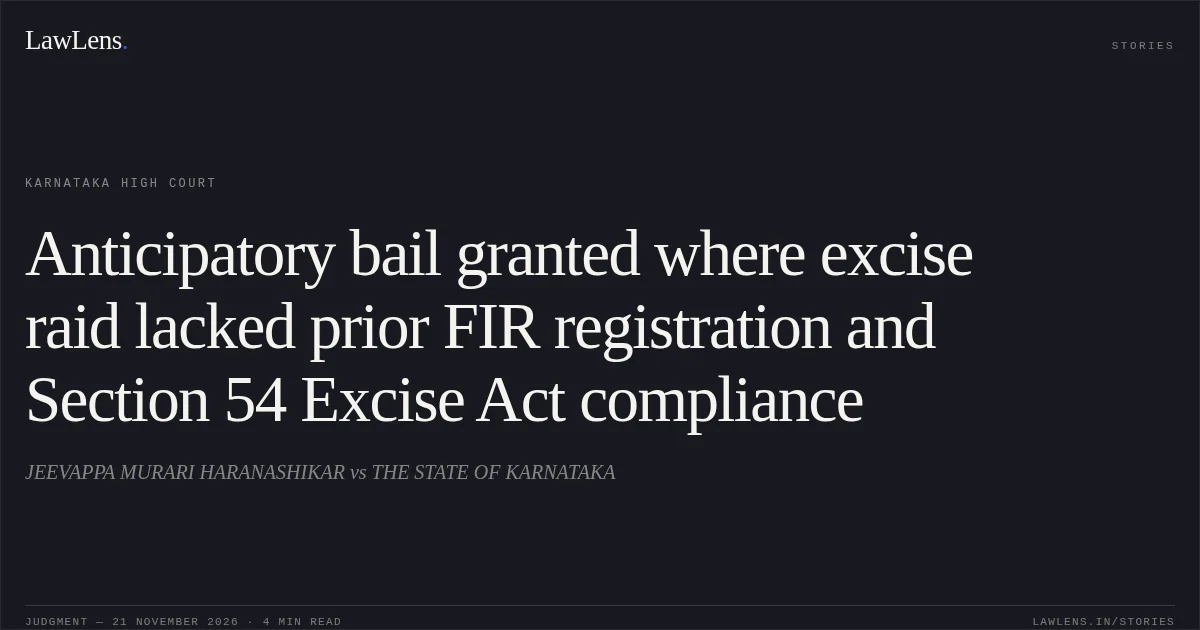
On 18.08.2026, the PSI, on patrol in the rural area of Hubballi (Ingalahalli Village), received information that the petitioner was selling illicit liquor. He conducted a raid with his sub-staff and panchas and seized 13.77 litres of illicit liquor from the petitioner under a seizure panchanama
¶ 3 · pp. 2–3The complaint was lodged before the SHO, leading to registration of an FIR (Crime No. 004/2026-27) for offences under Sections 14, 15, 32(1) and 38(A) of the Karnataka Excise Act, 1965
¶ 3 · p. 3 · ¶ 2 · p. 2The petitioner, apprehending arrest, sought anticipatory bail under Section 438 CrPC (Section 482 BNSS)
¶ 4 · p. 3The petitioner contended he was falsely implicated, the offences are not punishable with death or life imprisonment, he is the sole breadwinner, and the mandatory procedure under Section 54 of the Karnataka Excise Act was not complied with
¶ 5 · pp. 3–4The HCGP opposed the petition, citing serious allegations and a prima facie case
¶ 6 · p. 402Issues
i.1. Whether the search and seizure conducted by the Excise Officer without a search warrant, and without recording reasons for dispensing with one, complied with Section 54 of the Karnataka Excise Act
¶ 7 · pp. 4–5 · ¶ 8 · p. 5ii.2. Whether the commencement of investigation without prior registration of an FIR under Section 154 CrPC is sustainable, and whether such irregularity bars the petitioner from being granted anticipatory bail
¶ 7 · p. 5 · ¶ 9 · pp. 5–6iii.3. Whether, weighing the nature of allegations, gravity and punishment, risk of absconding, antecedents, and possibility of witness tampering, the petitioner is entitled to anticipatory bail and on what conditions
¶ 10 · p. 603Law Applied
Section 438 CrPC (Section 482 BNSS), under which anticipatory bail is granted in the court's discretion, guided by the nature and gravity of the accusation, the likelihood of absconding, antecedents, and the risk of tampering with witnesses
¶ 10 · p. 6Section 54 of the Karnataka Excise Act, which permits an officer in charge of a police station to conduct a search without a warrant only where a warrant cannot be obtained without affording the offender an opportunity to escape or destroy evidence, and only after recording the grounds of belief
¶ 7 · pp. 4–5 · ¶ 8 · p. 5Lalita Kumari v. Government of U.P., (2014) 2 SCC 1, which mandates registration of an FIR under Section 154 CrPC where information discloses a cognizable offence, before investigation commences
¶ 7 · p. 5G. Puttaraju v. State of Karnataka, W.P. No. 20816/2023 (dated 31.01.2024), holding that investigation commenced without an FIR violates the CrPC and renders proceedings unsustainable against the accused
¶ 9 · pp. 5–6Provisions in the judgment · 3 · Linked ones open on LawLens
Code of Criminal Procedure, 1973 Section 438Section 154
Bharatiya Nagarik Suraksha Sanhita, 2023 Section 482
04Reasoning
The Court found that the seizure of 13.77 litres of liquor from the petitioner was effected without a search warrant and without recorded reasons justifying dispensation with one, which the Court held impermissible under Section 54 of the Excise Act. It further found that the Excise Officer proceeded with search and seizure before an FIR was registered, contrary to Lalita Kumari
¶ 7 · p. 5 · ¶ 8 · p. 5The Court held that FIR registration in these circumstances violated Section 54, since the offences are cognizable. Relying on Puttaraju, it treated the investigation as defective and the proceedings against the petitioner as unsustainable. It also noted that the alleged offences are not punishable with death or life imprisonment
¶ 8 · p. 5 · ¶ 9 · pp. 5–6Having regard to these infirmities and the statutory factors in Section 438, the Court concluded the petitioner was entitled to anticipatory bail subject to conditions. The Court's reasoning on the defects is largely framed as a basis for the bail determination rather than a final adjudication on the merits of the seizure or the prosecution case
¶ 10 · p. 6 · p. 805Holding
The Court held that the search and seizure without warrant or recorded reasons under Section 54 of the Karnataka Excise Act, and the investigation commenced without a prior FIR, rendered the petitioner entitled to anticipatory bail
¶ 7–9 · pp. 5–6 · ¶ 10 · p. 6The petition was allowed. The petitioner was ordered to be enlarged on anticipatory bail in the event of arrest in Crime No. 004/2026-27 for offences under Sections 14, 15, 32(1) and 38(A) of the Karnataka Excise Act, subject to the following conditions: (i) personal bond of ₹1,00,000 with a surety for the like sum; (ii) surrender before the SHO/IO within 15 days; (iii) attendance before the IO/SHO on the first Sunday of every month (10:00 a.m. to 5:00 p.m.) for six months or until filing of the final report, whichever is earlier; (iv) no tampering with or threatening of prosecution witnesses; (v) regular appearance before the Court; (vi) no involvement in any offence. Any violation permits the prosecution to seek cancellation of bail. The observations are limited to the disposal of the present petition
¶ 10 · pp. 6–7 · p. 7 · p. 8Original Court PDF
JEEVAPPA MURARI HARANASHIKARvsTHE STATE OF KARNATAKA
Click to open original judgment
Original judgment, available to read, download and summarize on LawLens.in