01Facts
The informant, a cashew nut businessman, alleged that Sumit and Amit bought cashew nuts from him on three occasions. On 24.10.2018 they purchased 2,960 kg valued at Rs. 24,91,230 and issued a cheque, which was dishonoured on presentation because the signature differed.
¶ 3 · pp. 2–3The informant alleged cheating and lodged a complaint, and Belagavi Rural Police registered Crime No. 200/2018 under Sections 420, 406 and 34 IPC.
¶ 3 · pp. 2–3The accused were arrested, remanded, and later granted bail by the trial court on 09.08.2019.
¶ 3 · p. 3The order records the trial commencing on "27.08.2018," which is likely a typographical error, since the bail order is dated 2019.
¶ 3 · p. 3Summons could not be served on the petitioner (accused No. 3), and a Non-Bailable Warrant was issued.
¶ 3 · p. 3The petitioner then jumped bail and, apprehending arrest, sought anticipatory bail in C.C. No. 744/2020 before the JMFC-II Court, Belagavi.
¶ 2, 6The petitioner argued innocence and that the charge sheet had been filed, so custodial interrogation was unnecessary.
¶ 4 · p. 4The State opposed, citing the 2018 case, the earlier grant of bail, and the subsequent absconding.
¶ 5 · p. 4The petitioner's counsel stated that the petitioner was ready to deposit the earlier bond amount.
¶ 10 · p. 702Issues
i.1. Whether an accused who has jumped bail, and whose earlier bond is liable to forfeiture, can be granted fresh bail or anticipatory bail in the same proceedings.
¶ 6, 9 · p. 5 · p. 7ii.2. Whether a separate order is required for forfeiture of the bond when bail is jumped.
¶ 7 · pp. 5–6iii.3. Whether the recovery or deposit of the earlier bond amount may be imposed as a condition for grant of bail after the accused has jumped bail.
¶ 8 · pp. 6–703Law Applied
Section 482 of the BNSS, 2023 (corresponding to Section 438 CrPC, anticipatory bail), vests discretionary and special powers in the High Court to grant bail, though such relief is not a right in cases of bail jumping.
¶ 2, 9Sadananda v. State of Karnataka, ILR 1985 KAR 2813, holds that jumping bail automatically results in forfeiture of the bond, and no separate forfeiture order is required.
¶ 7 · pp. 5–6Section 446(2) CrPC permits remission of part of the bond amount only for a surety who has done his best to secure the accused's presence, and provides no equivalent relief for the accused. An accused's bond is an unequivocal undertaking to the State to secure his presence, so its breach attributable to the accused's own conduct cannot be excused.
¶ 8 · p. 6The discretionary factors governing bail are the gravity of the offence, likelihood of flight, risk of repetition, witness tampering, and antecedents.
¶ 11 · p. 7The substantive offences are Sections 420, 406 and 34 IPC.
¶ 2 · p. 2Provisions in the judgment · 6 · Linked ones open on LawLens
Bharatiya Nagarik Suraksha Sanhita, 2023 Section 482
Indian Penal Code, 1860 Section 420Section 406Section 34
Code of Criminal Procedure, 1973 Section 438Section 446
04Reasoning
The Court accepted that the petitioner was not entitled to bail as of right, given that he had jumped the bail granted in 2019.
¶ 6, 9Under Sadananda, the earlier bond stood forfeited automatically, and the petitioner could not claim any remission because his default was attributable to his own conduct.
¶ 7–8 · pp. 5–6Despite this, the Court exercised its discretion to allow the petition, giving the petitioner "one more opportunity" to participate in the trial while on bail. Relevant considerations were that the petitioner had not filed any similar petition elsewhere, and that the petitioner volunteered to deposit the earlier bond amount.
¶ 9–10Weighing the gravity of the offences, the petitioner's status, the risk of flight and repetition, the risk of witness tampering, and his antecedents, the Court held the case fit for bail only on stringent conditions.
¶ 11 · pp. 6–7Recovery of the earlier bond amount was made a necessary condition, following the State's submission that such recovery was required.
¶ 8 · p. 605Holding
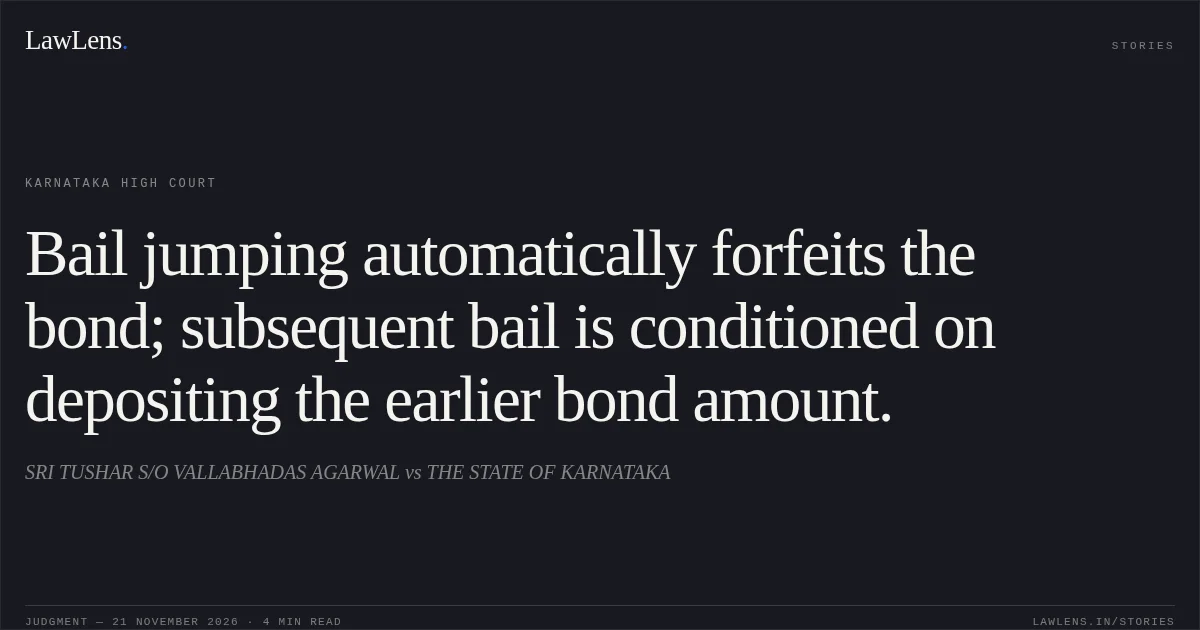
Bail jumping automatically forfeits the bond without a separate order, and the accused cannot seek remission of the forfeited amount.
¶ 7–8 · pp. 5–6Although fresh bail was not a matter of right, the petition was allowed in the interest of justice, subject to the petitioner's deposit of the earlier bond amount.
¶ 9–10 · p. 7The respondent police are directed to release the petitioner (accused No. 3) in the event of arrest in C.C. No. 744/2020, subject to the following conditions: (i) execution of a personal bond of Rs. 1,00,000 with one surety to the satisfaction of the IO/SHO; (ii) surrender before the IO/SHO within fifteen days of receipt of a certified copy of the order; (iii) appearance before the jurisdictional court on all hearing dates; (iv) no direct or indirect tampering with prosecution witnesses; (v) no commission of any offence in future. Violation of these conditions permits the prosecution to seek cancellation of bail.
pp. 7–8The trial court is directed to issue release intimation or warrants to the prison authorities, subject to the petitioner depositing the previously directed bond amount. The order states that its observations are limited to the disposal of the present petition.
p. 8, NoteOriginal Court PDF
SRI TUSHAR S/O VALLABHADAS AGARWALvsTHE STATE OF KARNATAKA
Click to open original judgment
Original judgment, available to read, download and summarize on LawLens.in