Facts
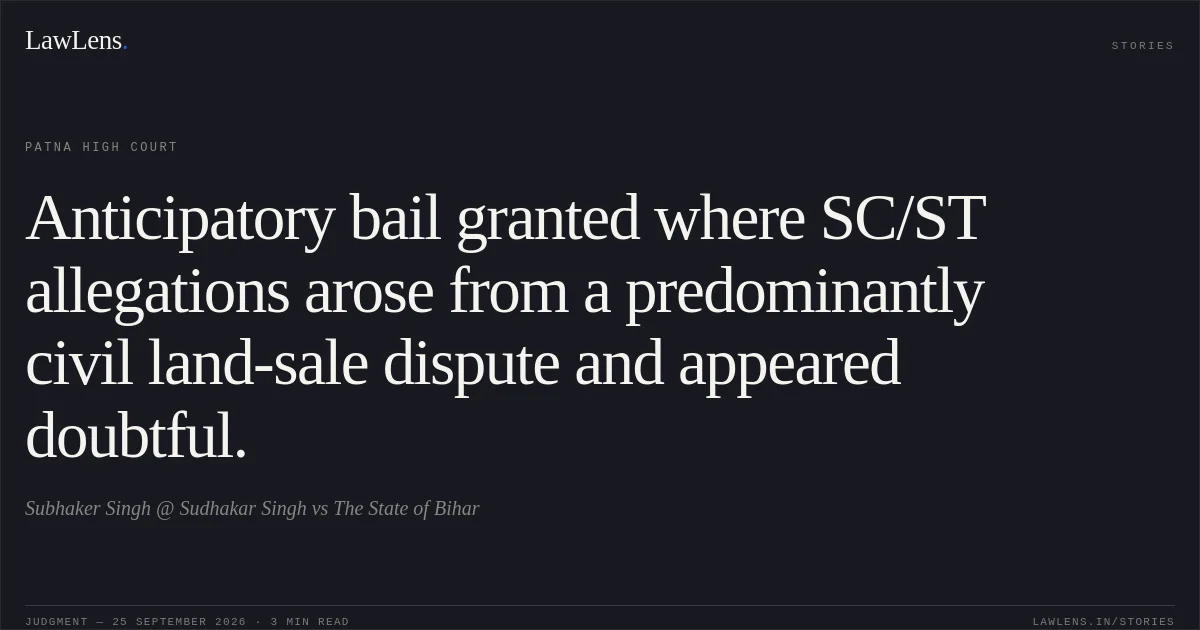
The appellant challenged the order dated 27 January 2026 by which the Special Judge, SC/ST (PoA) Act, Gopalganj, rejected his anticipatory-bail application in connection with Mohammadpur P.S. Case No. 151 of 2025.
Source reference: p. 1The case was registered under Sections 318(4) and 308(2) of the Bharatiya Nyaya Sanhita, 2023 and Sections 3(1)(r) and 3(1)(s) of the Scheduled Castes and Scheduled Tribes (Prevention of Atrocities) Act, 1989.
Source reference: p. 2According to the prosecution, the appellant and his co-accused brother agreed to sell land to the informant for ₹8,50,000. The informant later discovered that the land did not belong to them.
Source reference: p. 2Following a panchayati in which the co-accused allegedly agreed to refund the money, the informant issued a legal notice. It was thereafter alleged that the appellant and his co-accused surrounded the informant at Devkuli market and abused and threatened him by using caste-related insults.
Source reference: p. 2The appellant denied involvement, contending that the dispute was essentially civil, that the allegations against him were false, and that he had been implicated merely because he was the co-accused’s younger brother.
Source reference: p. 2He also relied on the regular bail granted to his co-accused brother by a coordinate Bench of the High Court.
Source reference: pp. 2–3Issues
Whether the appellant was entitled to anticipatory bail in a case involving alleged offences under Sections 318(4) and 308(2) of the BNS and Sections 3(1)(r) and 3(1)(s) of the SC/ST (PoA) Act.
Source reference: pp. 1–4Whether the allegations against the appellant, viewed in the context of the predominantly civil dispute, were sufficiently doubtful and potentially false to justify protection from arrest.
Source reference: p. 4Law Applied
The appeal was maintainable under Section 14(A)(2) of the Scheduled Castes and Scheduled Tribes (Prevention of Atrocities) Act, 1989, which provides an appellate remedy against orders of a Special Court concerning bail.
Source reference: p. 1The alleged substantive offences were Sections 318(4) and 308(2) of the Bharatiya Nyaya Sanhita, 2023, along with Sections 3(1)(r) and 3(1)(s) of the SC/ST (PoA) Act concerning intentional insult or intimidation and abuse by caste name in circumstances covered by the statute.
Source reference: p. 2The Court applied the anticipatory-bail principle by assessing the overall circumstances, including the nature of the dispute, the credibility of the accusation, and the possibility of false implication.
Source reference: p. 4Bail was directed to be subject to Section 482(2) of the Bharatiya Nagarik Suraksha Sanhita, 2023, and additional conditions imposed by the Court.
Source reference: p. 4Reasoning
The Court considered the underlying transaction and the demand for refund to indicate that the dispute was predominantly civil in nature.
Source reference: p. 4It also found the allegation of caste-based abuse and intimidation against the appellant to be doubtful, particularly in light of his contention that he had no direct role in the land transaction and had been implicated because of his relationship with the principal accused.
Source reference: pp. 2–3The Court further took into account the probability of false accusation and the fact that the co-accused brother had already been granted regular bail.
Source reference: pp. 3–4Although the prosecution and respondent no. 2 argued that the alleged abuse occurred in a market place and therefore attracted the SC/ST Act, the Court ultimately held that the circumstances justified granting anticipatory bail.
Source reference: p. 3–4Holding
The High Court allowed the appeal and set aside the order dated 27 January 2026 rejecting anticipatory bail.
It directed that, in the event of arrest or surrender within eight weeks, the appellant be released on bail upon furnishing a bond of ₹10,000 with two sureties of the like amount to the satisfaction of the Special Judge, SC/ST (PoA) Act, Gopalganj.
Source reference: p. 4The relief was made subject to Section 482(2) of the BNSS and the additional conditions that one bailor be a close relative of the appellant and that the appellant remain present on every date fixed by the trial court, if so required.
Source reference: p. 4Acts & Sections Cited
4 provisions across 3 statutes referred to in this judgment. Each provision opens on LawLens.
Scheduled Castes and the Scheduled Tribes (Prevention of Atrocities) Act, 19891
Bharatiya Nyaya Sanhita, 20232
Bharatiya Nagarik Suraksha Sanhita, 20231
Original Court PDF
Subhaker Singh @ Sudhakar SinghvsThe State of Bihar
Click to open original judgment
Original judgment, available to read, download and summarize on LawLens.in