Facts
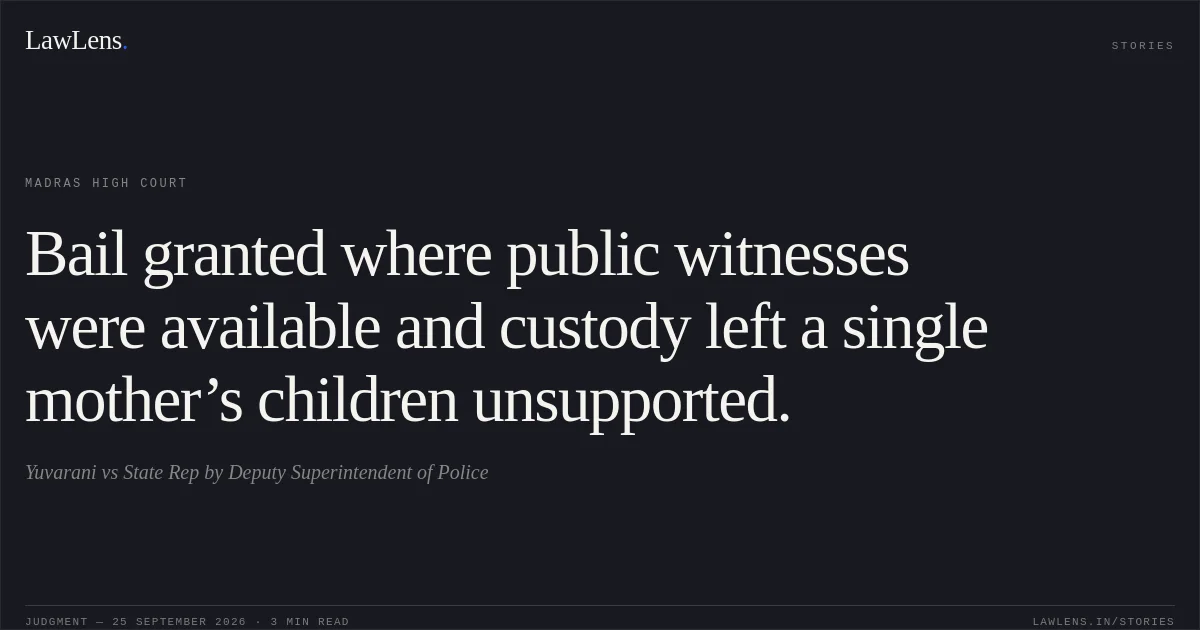
The appellant, Yuvarani, a saleswoman in a cooperative society, was arrested on 4 September 2026 in Crime No. 422 of 2026 for offences under Sections 296(b), 115(2) and 133 of the Bharatiya Nyaya Sanhita, 2023, and Sections 3(1)(r), 3(1)(s) and 3(2)(va) of the Scheduled Castes and Scheduled Tribes (Prevention of Atrocities) Act, 1989.
Source reference: p.2, para.2The prosecution alleged that, following a dispute concerning contributions and gift articles at a farewell function, the appellant used caste-based derogatory remarks against the de facto complainant and assaulted him with footwear at the Uthukuli Tahsildar Office.
Source reference: p.4, para.3The appellant alleged that the de facto complainant had previously made sexually coloured remarks and abusive WhatsApp-group comments against her, assaulted her at a review meeting on 8 August 2026, and that the complaint against her was an afterthought filed after she had complained against him.
Source reference: pp.2–3, para.3The Special Court for SC/ST (PoA) Act cases, Tiruppur, rejected her bail application in Crl. M.P. No. 146 of 2026 on 11 September 2026. She challenged that order under Section 14 of the SC/ST (PoA) Amendment Act, 2015.
Source reference: p.1; p.2, para.1Issues
Whether the appellant should be enlarged on bail pending investigation despite the offences alleged under the BNS and the SC/ST (Prevention of Atrocities) Act, 1989?
Source reference: pp.1–2, paras.1–2Whether the appellant’s release on bail was likely to prejudice the ongoing investigation by enabling her to tamper with evidence or influence witnesses?
Source reference: pp.4–5, paras.3–4Whether the circumstances of the appellant, including her status as a woman with dependent children, and the availability of witnesses justified interference with the Special Court’s order refusing bail?
Source reference: p.5, para.6Law Applied
The Court exercised appellate jurisdiction under Section 14 of the Scheduled Castes and Scheduled Tribes (Prevention of Atrocities) Amendment Act, 2015, to examine the order refusing bail.
Source reference: p.1The alleged offences included Sections 296(b), 115(2) and 133 of the Bharatiya Nyaya Sanhita, 2023, and Sections 3(1)(r), 3(1)(s) and 3(2)(va) of the SC/ST (Prevention of Atrocities) Act, 1989.
Source reference: p.2, para.2The governing bail principle required the Court to balance the seriousness of the allegations and the need to protect the investigation against the accused’s liberty, while assessing the likelihood of witness intimidation, evidence tampering or abscondence.
Source reference: pp.4–5, paras.3–6The Court also referred to P.K. Shaji v. State of Kerala, (2005) AIR SCW 5560, for the proposition that breach of bail conditions may invite appropriate action by the trial court.
Source reference: p.6, para.7(vii)Reasoning
The Court noted that the dispute arose between two employees of different cooperative societies following a farewell function and subsequent exchanges in a WhatsApp group.
Source reference: p.5, para.5Although the investigation was still pending and electronic records had allegedly been collected, the Court found that the material witnesses were identifiable colleagues and that the relevant incidents occurred at a public office, making their details readily available.
Source reference: pp.4–5, paras.3, 6Consequently, the Court held that releasing the appellant would not materially prejudice the investigation, provided stringent conditions were imposed.
Source reference: pp.4–5, paras.3, 6The Court also considered that the appellant was a single woman with children who had been left without support following her arrest.
Source reference: p.5, para.6The concerns regarding witness influence and evidence tampering were addressed through conditions prohibiting contact with witnesses, interference with evidence and commission of similar offences.
Source reference: p.6, para.7Holding
The High Court allowed the criminal appeal and set aside the Special Court’s order dated 11 September 2026 refusing bail.
The appellant was directed to be released on bail upon executing a bond of Rs.10,000 with two sureties for the like sum.
Source reference: p.5, para.7(i)She was required to appear before the investigating officer daily at 10:30 a.m. for two weeks and thereafter as required, not contact or influence witnesses, not tamper with evidence, not commit similar offences, and not abscond.
Source reference: pp.5–6, para.7The Court further recorded that breach of the conditions could result in appropriate action by the trial court, and that abscondence could attract registration of a fresh FIR under Section 229A IPC.
Source reference: p.6, para.7(vii)–(viii)Acts & Sections Cited
4 provisions across 2 statutes referred to in this judgment. Each provision opens on LawLens.
Bharatiya Nyaya Sanhita, 20233
Scheduled Castes and the Scheduled Tribes (Prevention of Atrocities) Act, 19891
Original Court PDF
YuvaranivsState Rep by Deputy Superintendent of Police
Click to open original judgment
Original judgment, available to read, download and summarize on LawLens.in