Facts
The petitioner, a Halqa Patwari (Revenue Department employee), allegedly demanded an illegal gratification of ₹30,000 (later reduced to ₹17,000) from a complainant to permit house construction on land held under an Agreement to Sell
Source reference: para 02Following a discreet verification that corroborated the allegations, the Anti-Corruption Bureau (ACB) registered FIR No. 0001/2026 under Section 7 of the Prevention of Corruption Act, 1988
Source reference: para 04During a trap operation, the petitioner allegedly accepted the bribe but escaped from the spot, though the money was recovered from a nearby pantry
Source reference: para 05The petitioner’s prior application for anticipatory bail was rejected by the Special Judge Anti-corruption, Udhampur, on March 3, 2026
Source reference: para 07The petitioner now moves the High Court for anticipatory bail, claiming the money was planted and that he did not accept it
Source reference: para 06Issues
1. Whether the petitioner is entitled to the concession of anticipatory bail in light of the gravity of corruption charges and the requirements of custodial interrogation
Source reference: para 11-122. Whether the personal liberty of the accused outweighs the public interest and the integrity of the investigation in a corruption case
Source reference: para 15-16Law Applied
The court primarily applied Section 482 of the Bharatiya Nagarik Suraksha Sanhita (BNSS) (formerly Section 438 CrPC) governing anticipatory bail
Source reference: para 15It relied on the principles from Gurbaksh Singh Sibbia v. State of Punjab, which emphasize balancing individual liberty against the risk of fleeing or tampering with justice
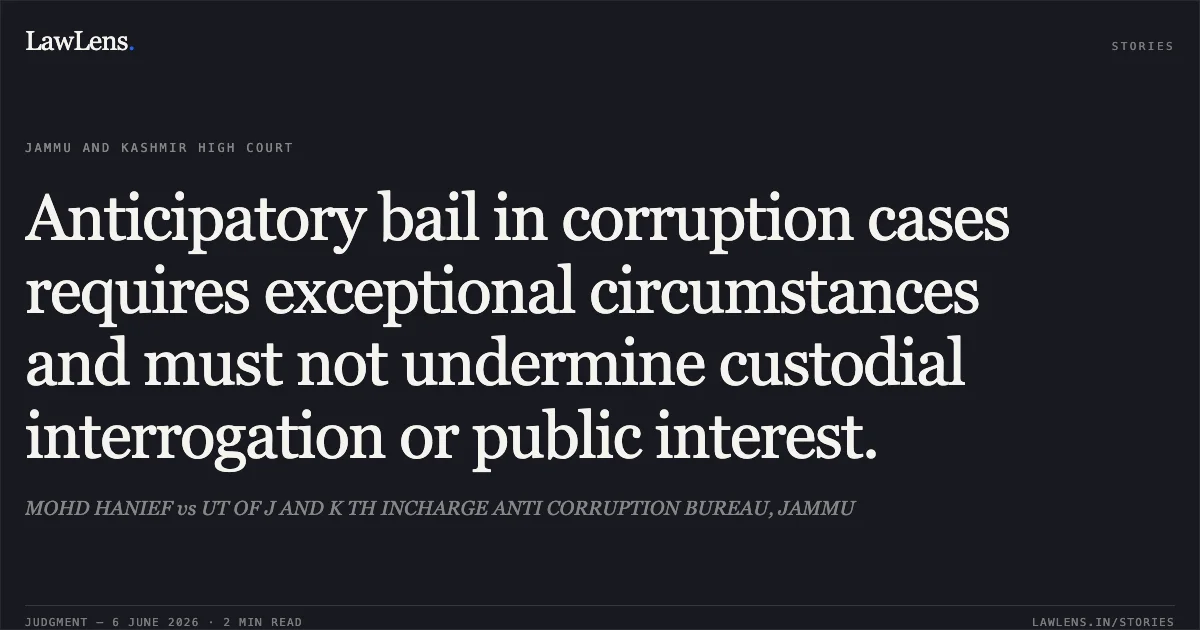
Source reference: para 10It extensively applied Devinder Kumar Bansal v. State of Punjab (2025), which establishes that anticipatory bail in corruption cases should only be granted in "exceptional circumstances" where allegations are prima facie frivolous or politically motivated
Source reference: para 13Finally, it cited Subramanian Swamy v. Manmohan Singh regarding the grave threat corruption poses to democracy and the Rule of Law
Source reference: para 14Reasoning
The Court reasoned that anticipatory bail is an extraordinary remedy that must be balanced against the societal interest in maintaining a corruption-free administration
Source reference: para 15Applying the facts, the Court noted that the ACB's discreet verification corroborated the demand, and the recovery of bribe money on-site established a prima facie case that cannot be discarded as frivolous at this stage
Source reference: para 04, 12The Court emphasized that the petitioner’s conduct—specifically escaping the trap and reportedly failing to cooperate with the investigating officer—indicates that custodial interrogation is necessary for a fruitful investigation
Source reference: para 11, 19It rejected the "presumption of innocence" as the sole ground for bail, holding that over-solicitousness toward an accused’s liberty can defeat the cause of public justice in serious corruption matters
Source reference: para 13Holding
The Court answered the issues in the negative and dismissed the bail application
It held that the petitioner failed to demonstrate any exceptional circumstances or mala fides in the prosecution to warrant protection under Section 482 BNSS
Source reference: para 11, 13Given the gravity of the offense, the reported non-cooperation of the petitioner, and the risk of tampering with evidence, the Court concluded that the petitioner does not deserve the concession of bail in anticipation of arrest
Source reference: para 18-19The Case Diary (C/D) was ordered to be returned to the Investigating Officer
Source reference: para 19Acts & Sections Cited
3 provisions across 3 statutes referred to in this judgment. Each provision opens on LawLens.
Prevention of Corruption Act, 19881
Code of Criminal Procedure, 19731
Bharatiya Nagarik Suraksha Sanhita, 20231
Original Court PDF
MOHD HANIEFvsUT OF J AND K TH INCHARGE ANTI CORRUPTION BUREAU, JAMMU
Click to open original judgment
Original judgment, available to read, download and summarize on LawLens.in