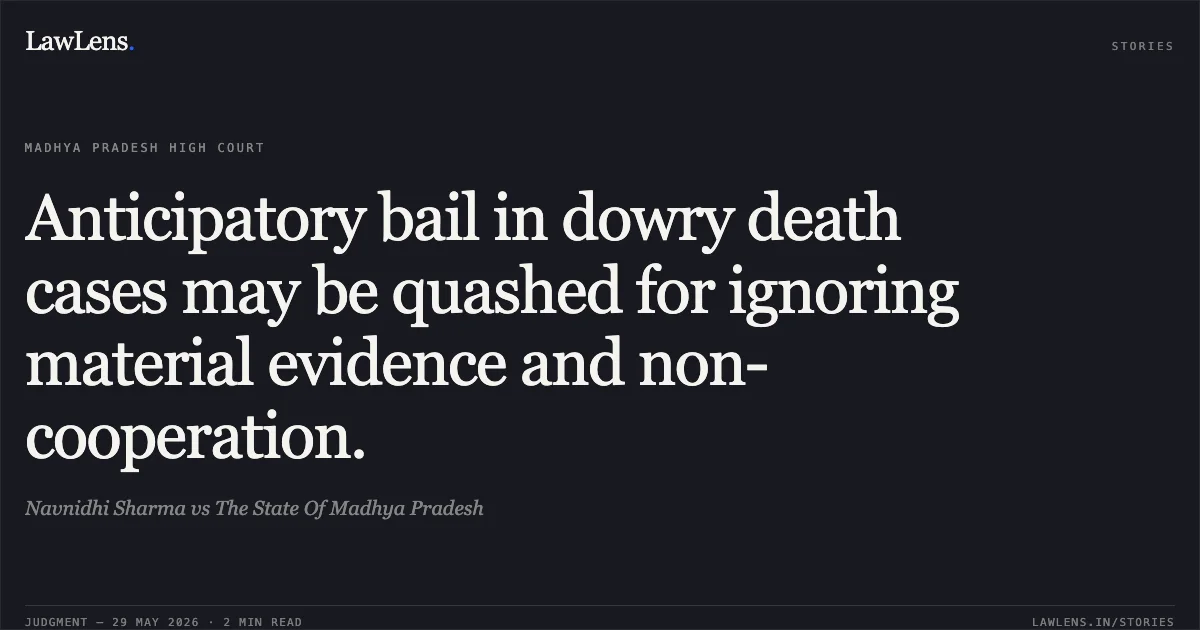
Facts
The deceased, Twisha Sharma, married Samarth Singh (son of the respondent, a retired Judicial Officer) on 09.12.2025.
Source reference: para. 12On 12.05.2026, Twisha died by hanging in her matrimonial home under mysterious circumstances; a postmortem revealed six additional blunt-force injuries.
Source reference: para. 12, 26FIR No. 133/2026 was registered for offenses under Sections 80(2), 85, and 3(5) of the Bharatiya Nyaya Sanhita (BNS), 2023, and the Dowry Prohibition Act.
Source reference: para. 11On 15.05.2026, the 10th Additional Sessions Judge, Bhopal, granted anticipatory bail to the respondent (mother-in-law) on the day the FIR was lodged.
Source reference: para. 12, 14The State and the father of the deceased moved the High Court seeking quashment of said bail, alleging non-cooperation, tampering with evidence via press conferences, and the existence of incriminating WhatsApp chats regarding dowry demands and forced abortion.
Source reference: para. 14, 18-21Issues
1. Whether the trial court exercised its discretion perversely by ignoring material evidence on record while granting anticipatory bail.
Source reference: para. 15, 212. Whether the respondent’s conduct post-bail, including non-cooperation with the investigation and public statements, warrants the quashment of the bail order.
Source reference: para. 19, 21Law Applied
The court primarily applied Section 438 of the CrPC/Section 482 of BNSS regarding anticipatory bail.
Source reference: no citationThe court relied on Puran v. Rambilas and Dr. Naresh Kumar Mangla v. Anita Agarwal, establishing that bail may be cancelled if the order ignores material evidence or is perverse.
Source reference: para. 15The court cited Siddharam Satlingappa Mhetre v. State of Maharashtra for factors governing bail, including the gravity of the offense and the likelihood of tampering.
Source reference: para. 15It further referenced Samunder Singh v. State of Rajasthan, which mandates extreme caution in granting anticipatory bail in dowry death cases.
Source reference: para. 16It cited Vipin Kumar Dhir v. State of Punjab, which permits revocation if the order is legally untenable or ignores societal impact at the threshold of investigation.
Source reference: para. 30Reasoning
The High Court found that the trial court's order suffered from patent perversity as it failed to consider the "antemortem" injuries found on the deceased's body which were unrelated to hanging.
Source reference: para. 26The court noted that the trial court erroneously characterized the allegations as "formal" and prematurely relied on defense documents (e.g., medical prescriptions and bank transfers) as "gospel truth" while ignoring the statutory presumption under Section 118 of the Bhartiya Saksha Adhiniyam.
Source reference: para. 18, 25, 29The analysis highlighted that the respondent, despite being a retired Judicial Officer, failed to cooperate with investigative notices and attempted to malign the deceased's character through selective media leaks of CCTV footage.
Source reference: para. 19, 21The court determined that the WhatsApp chats provided prima facie evidence of harassment and coercion regarding pregnancy termination, which the trial court overlooked.
Source reference: para. 28Holding
The Court answered the issues in the affirmative, holding that the trial court failed to use its discretion in a proper manner by ignoring relevant materials indicating the respondent's involvement.
The High Court held that custodial interrogation was necessary given the serious nature of the "dowry death" and the respondent's influential status and non-cooperation.
Source reference: para. 19, 29Consequently, the anticipatory bail order dated 15.05.2026 was quashed, and the petitions filed by the State and the father of the deceased were allowed.
Source reference: para. 31-32Acts & Sections Cited
10 provisions across 5 statutes referred to in this judgment. Each provision opens on LawLens.
Bharatiya Nyaya Sanhita, 20234
Indian Penal Code, 18602
Code of Criminal Procedure, 19731
Bharatiya Sakshya Adhiniyam, 20231
Original Court PDF
Navnidhi SharmavsThe State Of Madhya Pradesh
Click to open original judgment
Original judgment, available to read, download and summarize on LawLens.in


