Facts
The applicants, the mother-in-law and father-in-law of the deceased, sought anticipatory bail in Case Crime No. 120 of 2026, registered at Police Station Civil Lines, District Etawah, under Sections 80(2) and 85 of the Bharatiya Nyaya Sanhita, 2023 and Section 4 of the Dowry Prohibition Act.
Source reference: para. 2The prosecution alleged dowry-related cruelty and harassment, physical assault, and the deceased’s death by ante-mortem hanging within four years of marriage.
Source reference: para. 6The post-mortem recorded eight injuries and opined the cause of death as asphyxia due to ante-mortem hanging.
Source reference: para. 6The applicants claimed that they lived separately in District Etah, that the allegations were general and omnibus, and that the deceased’s brother had admitted their separate residence.
Source reference: para. 3The prosecution opposed bail, relying on an earlier FIR lodged by the deceased on 9 October 2025 against her husband and applicant no. 2 for dowry-related cruelty and other offences.
Source reference: para. 4A charge-sheet had been filed in that case, and non-bailable warrants were issued against applicant no. 2 on 27 August 2026.
Source reference: para. 6Issues
Whether the applicants were entitled to anticipatory bail under Section 482 of the Bharatiya Nagarik Suraksha Sanhita, 2023, in a case involving the unnatural death of the deceased within four years of marriage and allegations of dowry-related cruelty.
Source reference: paras. 2, 6, 10–12Whether applicant no. 2 could invoke the extraordinary jurisdiction for anticipatory bail after issuance of non-bailable warrants in the earlier criminal case.
Source reference: paras. 6–7Whether the facts disclosed exceptional circumstances warranting protection from arrest despite the general rule that anticipatory bail is an extraordinary remedy.
Source reference: paras. 7–12Law Applied
The Court applied Sections 80(2) and 85 of the Bharatiya Nyaya Sanhita, 2023, and Section 4 of the Dowry Prohibition Act, which formed the statutory basis of the alleged dowry-related offences.
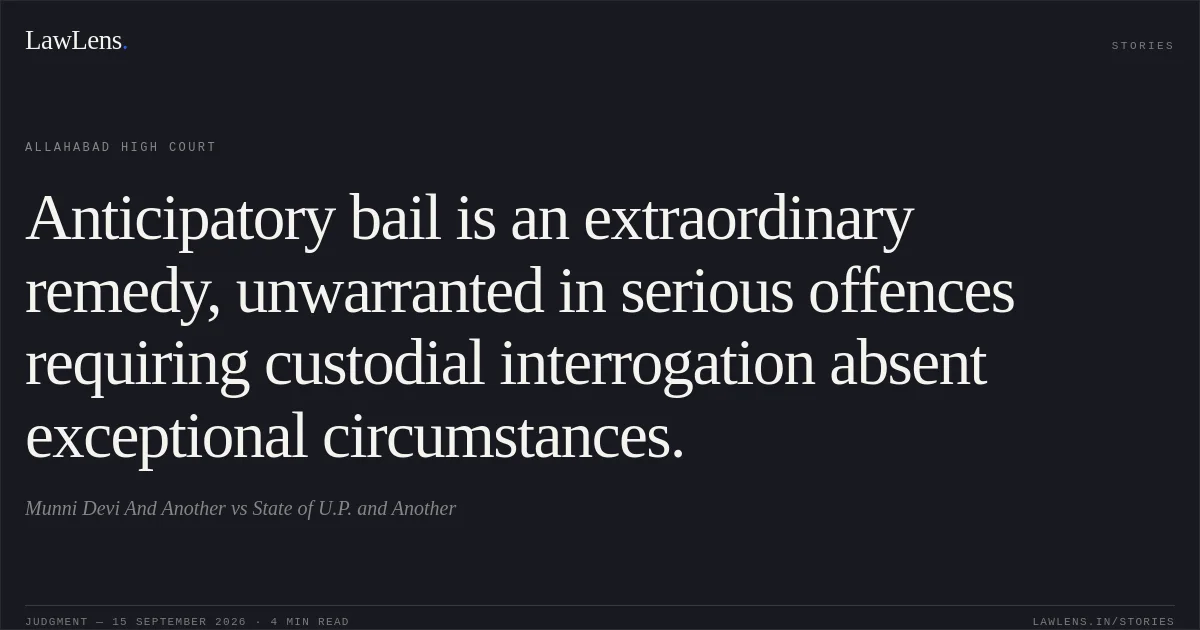
Source reference: para. 2It treated anticipatory bail under Section 482 BNSS as an extraordinary and discretionary remedy to be exercised sparingly and only in exceptional cases.
Source reference: no citationRelying on Srikant Upadhyay v. State of Bihar, (2024) 12 SCC 382, the Court held that a person against whom a warrant of arrest or proclamation has been issued is ordinarily not entitled to invoke anticipatory bail, except in extreme and exceptional circumstances.
Source reference: para. 7Under P. Chidambaram v. Directorate of Enforcement, (2019) 9 SCC 24, arrest may serve legitimate investigative purposes and pre-arrest bail should be granted only after considering the gravity of the accusation, flight risk, and the potential effect on investigation.
Source reference: para. 8The Court also relied on Kishor Vishwasrao Patil v. Deepak Yashwant Patil, 2022 SCC OnLine SC 2528, and Sushila Aggarwal v. State (NCT of Delhi), (2020) 5 SCC 1, for the principles that the Court must consider the nature and gravity of the offence, the accused’s role, the possibility of witness influence or evidence tampering, and the likelihood of fleeing justice.
Source reference: para. 9Gurbaksh Singh Sibbia v. State of Punjab, (1980) 2 SCC 565, was relied upon for the principle that anticipatory bail cannot be granted routinely merely because bail is generally regarded as the rule.
Source reference: para. 11Reasoning
The Court found that the applicants were named in the FIR, the deceased had suffered eight injuries, and her death had occurred unnaturally within four years of marriage.
Source reference: para. 6The earlier FIR lodged by the deceased against applicant no. 2 for dowry-related harassment provided additional incriminating context, while the issuance of non-bailable warrants against him indicated his failure to submit to the process of law.
Source reference: para. 6Applying Srikant Upadhyay, the Court held that applicant no. 2 could not ordinarily seek the extraordinary protection of anticipatory bail in the face of the warrants, and no extreme or exceptional circumstance was established.
Source reference: para. 7The Court further observed that the investigation was at a preliminary stage, custodial interrogation was necessary to uncover the truth, and the applicants had not demonstrated that the prosecution was false or that no prima facie case existed.
Source reference: para. 10The asserted separate residence and general nature of the allegations were insufficient, at the anticipatory-bail stage, to outweigh the seriousness of the accusations and the investigative requirements.
Source reference: paras. 3, 6, 10–12Holding
The Court answered the issues against the applicants and held that they were not entitled to anticipatory bail.
The application was dismissed because the accusations were serious, a prima facie case was disclosed, the investigation was at an initial stage requiring custodial interrogation, and applicant no. 2 was subject to non-bailable warrants in the earlier case.
Source reference: paras. 10–13Any interim protection was vacated, and the Registrar (Compliance) was directed to transmit a copy of the order to the concerned court through the fastest mode.
Source reference: paras. 14–15Acts & Sections Cited
7 provisions across 4 statutes referred to in this judgment. Each provision opens on LawLens.
Bharatiya Nagarik Suraksha Sanhita, 20231
Bharatiya Nyaya Sanhita, 20234
Dowry Prohibition Act, 19611
Code of Criminal Procedure, 19731
Original Court PDF
Munni Devi And AnothervsState of U.P. and Another
Click to open original judgment
Original judgment, available to read, download and summarize on LawLens.in


