Facts
The applicant sought anticipatory bail under Section 482 of the Bharatiya Nagarik Suraksha Sanhita, 2023 (“BNSS”)/Section 438 of the Code of Criminal Procedure, 1973 (“CrPC”) in FIR No. 226/2025, registered at Police Station Hazrat Nizamuddin, Delhi, for offences under Sections 109(1), 332(B), 189(4), 191 and 3(5) of the Bharatiya Nyaya Sanhita, 2023, and Sections 25, 54 and 59 of the Arms Act, 1959.
Source reference: p. 2, para. 1The FIR alleged that, on 1 August 2025, the principal accused and several others entered the complainant’s shop, assaulted him, and fired multiple pistol rounds, one of which struck the complainant’s brother.
Source reference: p. 2, para. 4The applicant contended that he was neither named in the FIR nor implicated during the initial investigation, and that the original chargesheet did not mention him, including in column 12.
Source reference: p. 3, paras. 5–7The State submitted that the applicant was identified during further investigation through CCTV footage, could not be found at his residence or in Bulandshahr, and had failed to join the investigation.
Source reference: p. 4, paras. 11–13A non-bailable warrant was issued against him on 4 August 2026, and proceedings under Section 84 BNSS for declaring him absconding were initiated on 20 August 2026.
Source reference: p. 4, para. 14The applicant’s anticipatory bail application had earlier been rejected by the Sessions Court on 18 September 2026.
Source reference: p. 2, para. 2Issues
Whether the applicant was entitled to anticipatory bail in connection with FIR No. 226/2025, considering the allegations of his active participation in a violent incident involving assault and firearm use?
Source reference: p. 5, para. 20; p. 6, paras. 23–25Whether anticipatory bail should be granted when the applicant had allegedly failed to join the investigation, could not be traced, and proceedings for declaring him absconding had been initiated?
Source reference: p. 4, para. 14; p. 6, paras. 22–23Law Applied
The Court applied the principles governing anticipatory bail under Section 482 BNSS/Section 438 CrPC, along with the Court’s inherent jurisdiction under Section 528 BNSS/Section 482 CrPC.
Source reference: p. 2, para. 1It relied principally on Srikant Upadhyay v. State of Bihar, (2024) 12 SCC 382, which holds that anticipatory bail is an extraordinary remedy to be exercised cautiously and judiciously; that its grant is not an ordinary rule; and that interim or pre-arrest protection may be refused where it could hamper investigation, facilitate evidence tampering, or result in miscarriage of justice.
Source reference: pp. 5–6, para. 22The Supreme Court further held that a person against whom a warrant of arrest or proclamation has been issued is ordinarily not entitled to invoke the extraordinary power, although relief may be granted in extreme and exceptional cases in the interests of justice.
Source reference: pp. 5–6, para. 22The Court also considered the need for custodial interrogation where the accused had not joined the investigation.
Source reference: p. 6, para. 23Reasoning
The Court found that the allegations were grave and that the material placed by the complainant, including photographs and video footage, allegedly depicted the applicant as an active participant rather than a passive bystander.
Source reference: pp. 4–5, paras. 18–19His alleged role in throwing a large plant pot, his relationship with the principal accused who had allegedly fired multiple shots, and the collective nature of the assault weighed against granting protection.
Source reference: p. 5, paras. 20–21; p. 6, para. 24The Court further noted that the applicant had not joined the investigation, could not be located at his present or original residence, and was subject to a non-bailable warrant and proceedings under Section 84 BNSS.
Source reference: p. 4, para. 14Applying the restrictive principles governing anticipatory bail, particularly where the accused is evading investigation and custodial interrogation is considered necessary, the Court held that the case did not warrant the exercise of its extraordinary jurisdiction.
Source reference: p. 6, paras. 22–25Holding
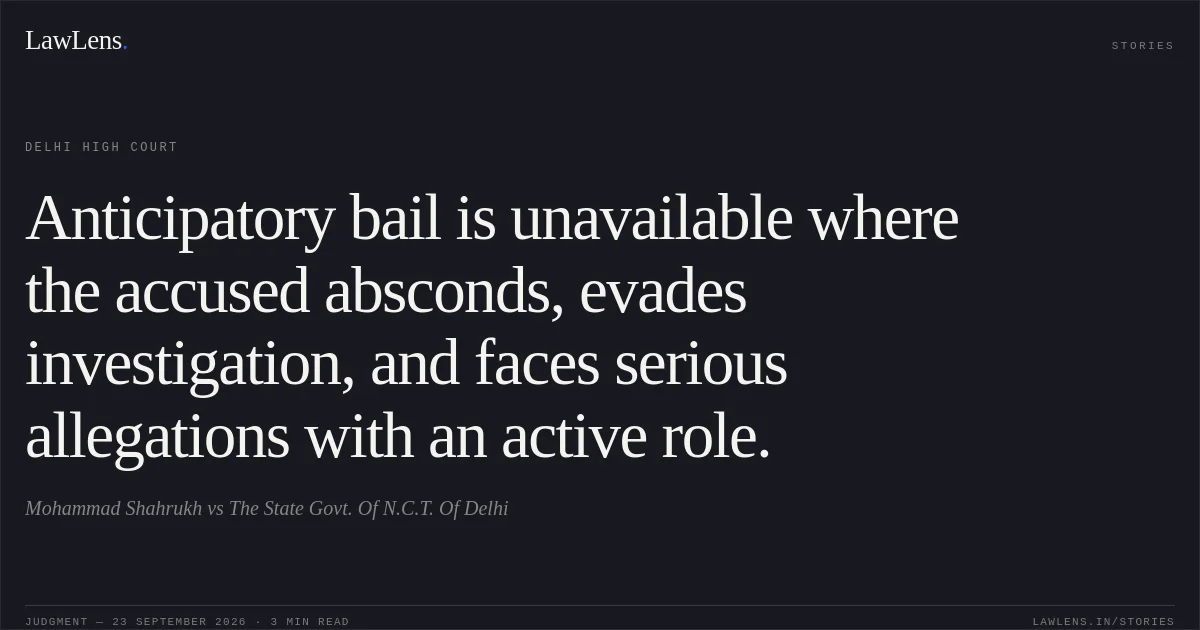
The High Court dismissed the anticipatory bail application and the connected miscellaneous application, holding that the seriousness of the allegations, the applicant’s specific and active role, his failure to join the investigation, and the initiation of proceedings concerning his abscondence justified denial of pre-arrest protection.
The Court clarified that its observations were confined to the adjudication of the bail proceedings and would not prejudice the parties on the merits at any subsequent stage.
Source reference: p. 7, para. 27Acts & Sections Cited
13 provisions across 4 statutes referred to in this judgment. Each provision opens on LawLens.
Bharatiya Nagarik Suraksha Sanhita, 20233
Code of Criminal Procedure, 19732
Bharatiya Nyaya Sanhita, 20235
Arms Act, 19593
Original Court PDF
Mohammad ShahrukhvsThe State Govt. Of N.C.T. Of Delhi
Click to open original judgment
Original judgment, available to read, download and summarize on LawLens.in