Facts
The applicant sought anticipatory bail in Case Crime No. 129 of 2026, registered at Police Station Jasrana, District Firozabad, under Sections 115(2), 191(2), 191(3), 109, 352 and 351(2) of the Bharatiya Nyaya Sanhita (BNS).
Source reference: para. 3He asserted that he was innocent and falsely implicated, that the injuries were simple and did not support an offence under Section 109 BNS, and undertook to cooperate with the investigation and trial.
Source reference: para. 4The State and informant opposed bail, relying on the injured Foturam’s depressed skull fracture, the opinion that the injuries were grievous and dangerous to life, and the applicant’s two allegedly unexplained criminal antecedents; they also argued that the application was not maintainable in light of *Srikant Upadhyay v. State of Bihar*.
Source reference: para. 5The Court considered the injury reports, the FIR and witness statements before dismissing the application.
Source reference: paras. 6–7, 11–14Issues
1. Whether, in light of the allegations, injury evidence and other circumstances on record, the applicant was entitled to anticipatory bail.
Source reference: paras. 7, 11–142. Whether the principles governing anticipatory bail, including those discussed in *Srikant Upadhyay*, warranted refusal of the application.
Source reference: paras. 8–9, 11–14Law Applied
The application was considered under Section 482 of the Bharatiya Nagarik Suraksha Sanhita (BNSS), the provision identified by the Court for anticipatory bail.
Source reference: paras. 3, 9The Court applied the principle that anticipatory bail is an extraordinary, discretionary remedy, not a rule, and should be exercised cautiously and sparingly after considering the nature and gravity of the accusation, the applicant’s role, the possibility of flight, and the potential for interference with investigation or evidence.
Source reference: para. 8It relied on *Srikant Upadhyay v. State of Bihar*, (2024) 12 SCC 382, concerning cautious exercise of the power and the position of applicants who defy court orders or abscond.
Source reference: para. 8*P. Chidambaram v. Directorate of Enforcement*, (2019) 9 SCC 24, on the exceptional nature of pre-arrest bail and the relevance of the accusation’s gravity and other circumstances.
Source reference: para. 9*Kishor Vishwasrao Patil v. Deepak Yashwant Patil*, 2022 SCC OnLine SC 2528, on balancing personal liberty against the investigating agency’s need to question the accused and pursue investigation.
Source reference: para. 10The Court also referred to *Sushila Aggarwal v. State (NCT of Delhi)*, (2020) 5 SCC 1, on considering the offence, the applicant’s role, and risks to investigation, evidence or the administration of justice, and *Gurbaksh Singh Sibbia v. State of Punjab*, (1980) 2 SCC 565, in support of the proposition that anticipatory bail is not to be granted routinely.
Source reference: paras. 10, 12Reasoning
The Court found that the injury report recorded a depressed fracture to Foturam’s head and classified the injuries as grievous; it also noted that three persons on the informant’s side had sustained injuries.
Source reference: para. 7Considering the FIR, witness statements and injury reports together, the Court held that a prima facie case, including under Section 109 BNS, was made out and that the applicant had not shown that the case was false.
Source reference: paras. 7, 11Against the seriousness of the allegations and the material on record, the applicant’s claim that the injuries were simple and his undertaking to cooperate did not establish that this was a fit case for the exceptional relief of anticipatory bail.
Source reference: paras. 4, 11–13The Court applied the distinction between regular bail and anticipatory bail, concluding that grounds sufficient for regular bail do not necessarily justify pre-arrest protection.
Source reference: para. 12Holding
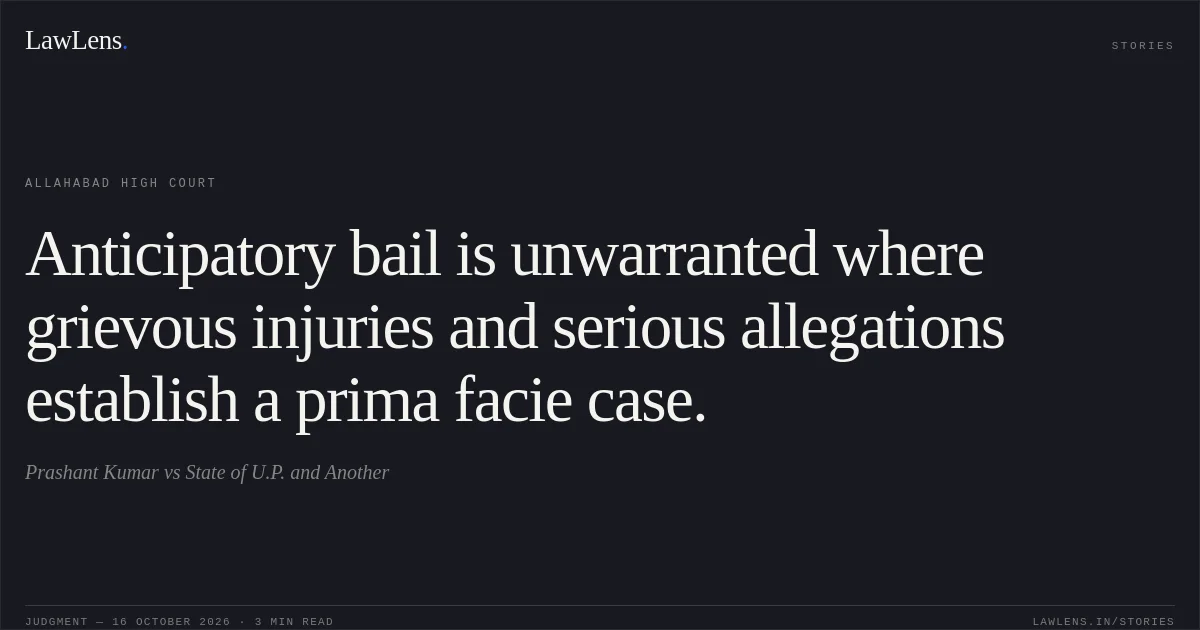
The Court held that the applicant was not entitled to anticipatory bail and dismissed the application.
Any interim order was vacated, and the Registrar (Compliance) was directed to send the order to the court concerned, which was to proceed in accordance with law.
Source reference: paras. 15–16Acts & Sections Cited
7 provisions across 3 statutes referred to in this judgment. Each provision opens on LawLens.
Bharatiya Nyaya Sanhita, 20235
Bharatiya Nagarik Suraksha Sanhita, 20231
Code of Criminal Procedure, 19731
Original Court PDF
Prashant KumarvsState of U.P. and Another
Click to open original judgment
Original judgment, available to read, download and summarize on LawLens.in