Facts
The applicant sought anticipatory bail in Case Crime No. 410 of 2025, alleging offences under Sections 419, 420, 467, 468, 471, 506 and 120-B IPC.
Source reference: p.1, para. 3The FIR was lodged on 12 December 2025 pursuant to an order under Section 175(3) BNSS, concerning alleged acts beginning on 1 June 2021.
Source reference: p.1, para. 3The informant alleged that his father had executed a registered power of attorney in favour of the applicant on 4 September 2019 and died on 3 May 2021.
Source reference: p.1, para. 3Despite the consequent cessation of authority, the applicant allegedly executed more than twenty sale deeds between 1 June 2021 and 31 August 2022, although he knew of the deceased’s death.
Source reference: p.1, para. 3The applicant relied on the delay in lodging the FIR, denied knowledge of the death, asserted that the dispute was civil in nature, and relied on an alleged notarised sale deed dated 25 July 2016 and compromise dated 15 October 2024.
Source reference: pp.1–2, paras. 4–5The informant and the State opposed bail, submitting that handwriting-expert reports indicated that the alleged compromise and sale deed had not been signed by the informant or his deceased father.
Source reference: p.2, para. 6The prosecution also relied on witness statements showing that the applicant had attended post-death ceremonies and therefore knew of the death.
Source reference: p.2, para. 6Proceedings under Section 82 CrPC/Section 84 BNSS had also been initiated against him on 21 May 2026.
Source reference: p.2, para. 6Issues
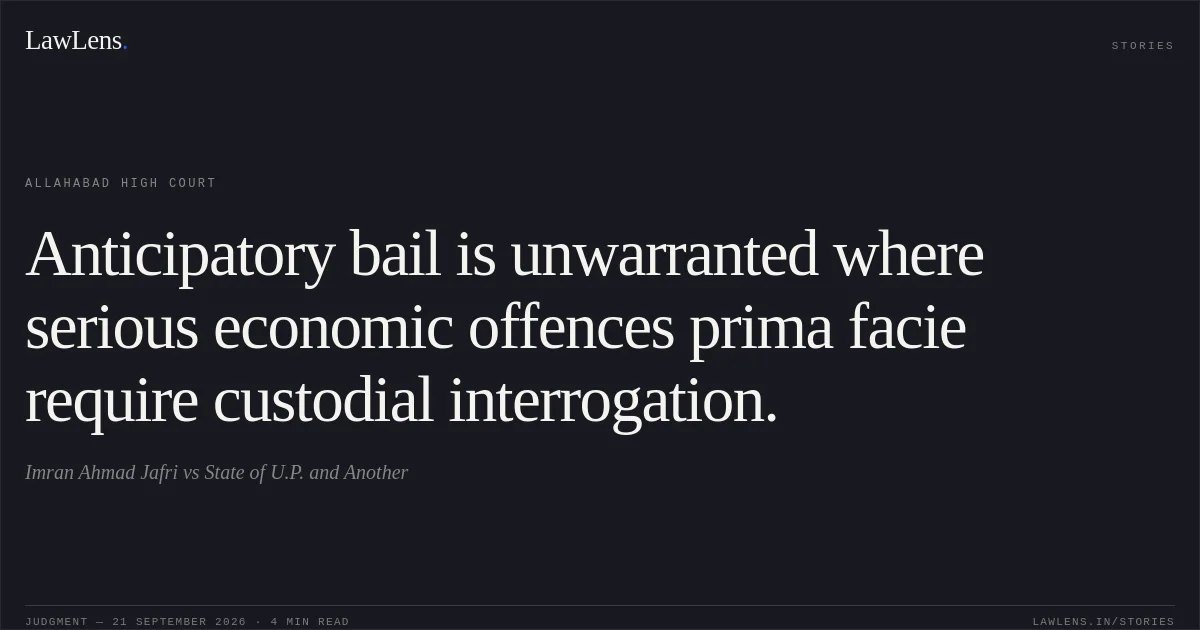
Whether the applicant had made out a case for anticipatory bail under Section 482 BNSS despite the prima facie allegations that he knowingly executed sale deeds after the death of the principal who had granted the power of attorney?
Source reference: pp.2–3, paras. 7–8Whether the delay in lodging the FIR, the alleged civil nature of the dispute, and the applicant’s asserted compromise justified grant of pre-arrest protection?
Source reference: pp.1–3, paras. 4–8Whether the gravity of the alleged economic and documentary fraud, the stage of investigation, the need for custodial interrogation, and the initiation of proclamation proceedings militated against anticipatory bail?
Source reference: pp.3–11, paras. 9–18Law Applied
The Court applied Section 482 BNSS, corresponding to the power to grant anticipatory bail, and held that pre-arrest bail is an extraordinary remedy to be exercised sparingly and only in exceptional circumstances.
Source reference: pp.6–11, paras. 14–18It considered the allegations under Sections 419, 420, 467, 468, 471, 506 and 120-B IPC concerning cheating, forgery, use of forged documents, criminal intimidation and conspiracy.
Source reference: p.1, para. 2Relying on Y.S. Jagan Mohan Reddy v. CBI, (2013) 7 SCC 439, State of Bihar v. Amit Kumar, (2017) 13 SCC 751, and Rohit Tandon v. Directorate of Enforcement, (2018) 11 SCC 46, the Court held that economic offences and deep-rooted fraud require a stricter approach at the bail stage.
Source reference: pp.3–6, paras. 9–13Under Srikant Upadhyay v. State of Bihar, (2024) 12 SCC 382, a person against whom a warrant or proclamation has been issued is ordinarily not entitled to anticipatory bail, absent exceptional circumstances.
Source reference: p.6, para. 14P. Chidambaram v. Directorate of Enforcement, (2019) 9 SCC 24, and Kishor Vishwasrao Patil v. Deepak Yashwant Patil, 2022 SCC OnLine SC 2528, establish that arrest may be necessary for effective investigation, including interrogation, discovery and prevention of evidence tampering.
Source reference: pp.6–10, paras. 15–16The Court also relied on Sushila Aggarwal v. State (NCT of Delhi), (2020) 5 SCC 1, which requires consideration of the nature and gravity of the offence, the applicant’s role, and the likelihood of influencing the investigation or tampering with evidence.
Source reference: p.10, para. 16Reasoning
The Court found that the execution of the power of attorney on 4 September 2019 and the principal’s death on 3 May 2021 were admitted facts.
Source reference: pp.2–3, para. 8Since the applicant executed the sale deeds after the principal’s death, and witness statements indicated that he had attended the deceased’s post-death ceremonies, the Court concluded that there was prima facie material showing knowledge of the death and the absence of continuing authority.
Source reference: pp.2–3, para. 8The alleged compromise and notarised sale deed did not assist the applicant because the handwriting-expert material suggested that both documents were fabricated or unauthorised.
Source reference: p.2, para. 6The Court accepted the informant’s explanation that the offence came to light only upon his visit to the ancestral village in September 2025, thereby rejecting the delay objection at the anticipatory-bail stage.
Source reference: p.3, para. 8Given the seriousness of the alleged forgery and property-related fraud, the preliminary stage of investigation, the need for custodial interrogation, the applicant’s alleged involvement in multiple transactions, and the initiation of proceedings under Section 82 CrPC/Section 84 BNSS, the Court held that the applicant had failed to establish exceptional circumstances warranting pre-arrest protection.
Source reference: pp.10–11, paras. 17–19Holding
The Court held that a prima facie case was made out against the applicant and that the allegations involved serious economic and documentary offences.
The applicant was not entitled to anticipatory bail because the investigation was at a preliminary stage, custodial interrogation was considered necessary, and proclamation proceedings had already been initiated.
Source reference: pp.10–11, paras. 17–19Accordingly, the anticipatory bail application was dismissed; any interim order was vacated.
Source reference: p.11, paras. 20–22The Registrar (Compliance) was directed to transmit the order to the court concerned, which was directed to ensure that the Investigating Officer proceeded in accordance with law and concluded the investigation without delay.
Source reference: p.11, paras. 20–22Acts & Sections Cited
11 provisions across 3 statutes referred to in this judgment. Each provision opens on LawLens.
Bharatiya Nagarik Suraksha Sanhita, 20233
Indian Penal Code, 18606
Code of Criminal Procedure, 19732
Original Court PDF
Imran Ahmad JafrivsState of U.P. and Another
Click to open original judgment
Original judgment, available to read, download and summarize on LawLens.in