Facts
The petitioner-complainant entered into an agreement dated 5 May 2021 with opposite party nos. 2 and 3, Uday Kumar Singh and Sobha Devi, for purchase of land and paid them ₹22,00,000 in instalments. When the sale deed was not executed, the opposite parties acknowledged the amount and agreed to refund it. They allegedly returned ₹15,00,000 but failed to pay the balance ₹7,00,000, leading to Complaint Case No. 699C of 2022, in which cognizance was taken under Sections 120B, 406 and 420 read with Section 34 IPC.
Source reference: pp. 2–3, paras. 2–3The opposite parties’ application for anticipatory bail was initially rejected. Thereafter, by order dated 18 December 2023 in Criminal Miscellaneous No. 79989 of 2023, a Co-ordinate Bench granted them provisional anticipatory bail for three months on their submission that they were ready to return ₹7,00,000. The trial court was directed to confirm the bail only after satisfying itself that the amount had been paid to the complainant.
Source reference: pp. 3–4, para. 4The complainant alleged that no amount had been paid after the bail order. In their counter-affidavit, the opposite parties claimed that the entire ₹22,00,000 had been repaid, relying on transactions which, according to the complainant and the Court, related to the earlier repayment of ₹15,00,000 made before the complaint and before the bail order. The complainant therefore sought cancellation of anticipatory bail under Section 439(2) CrPC.
Source reference: pp. 5–7, paras. 6–9Issues
Whether the opposite parties’ failure to pay ₹7,00,000, despite obtaining provisional anticipatory bail on the basis of their undertaking to do so, constituted a breach warranting cancellation of bail under Section 439(2) CrPC?
Source reference: pp. 7–10, paras. 12–15Whether the principles requiring “cogent and overwhelming circumstances” for cancellation of bail prevented cancellation in the present case, or whether breach of the condition on which bail was granted and abuse of the bail process justified such action?
Source reference: pp. 7–10, paras. 12–15Whether the opposite parties’ reliance on pre-complaint repayments, coupled with their alleged evasion of court process and false plea of compliance, justified withdrawal of the concession of anticipatory bail?
Source reference: pp. 11–19, paras. 16–25Law Applied
The Court applied Section 439(2) CrPC, under which a competent court may direct the arrest and commitment to custody of a person released on bail. It distinguished cancellation of bail for subsequent misconduct from annulment of an order that was illegal, perverse or otherwise unjustified when granted.
Source reference: paras. 12–14Under Dolat Ram v. State of Haryana, (1995) 1 SCC 349, cancellation based on subsequent conduct requires cogent and overwhelming circumstances, including misuse of liberty, evasion of justice, witness intimidation or breach of bail conditions.
Source reference: paras. 12–14, 22Puran v. Rambilas, (2001) 6 SCC 338, Neeru Yadav v. State of U.P., (2014) 16 SCC 508, Deepak Yadav v. State of U.P., (2022) 8 SCC 559, and Vipin Kumar Dhir v. State of Punjab, (2021) 15 SCC 518 recognise that an unjustified bail order, violation of its conditions or abuse of the concession may justify cancellation.
Source reference: paras. 12–15The Court further relied on Sushila Aggarwal v. State (NCT of Delhi), (2020) 5 SCC 1, holding that anticipatory bail may be subject to fact-specific conditions and may be cancelled upon breach.
Source reference: para. 23–25The Court also applied the clean-hands principle in S.P. Chengalvaraya Naidu v. Jagannath, (1994) 1 SCC 1, K.D. Sharma v. Steel Authority of India Ltd., (2008) 12 SCC 481, and Kusha Duruka v. State of Odisha, (2024) 4 SCC 432, holding that suppression or misrepresentation of material facts disentitles a litigant to discretionary relief.
Source reference: paras. 17–20Reasoning
The Court found that the anticipatory bail order itself recorded that ₹15,00,000 had already been repaid and ₹7,00,000 remained outstanding. The transactions relied upon by the opposite parties in their counter-affidavit were from 2022, preceding both the complaint and the bail order, and therefore could not constitute compliance with the subsequent condition to pay ₹7,00,000.
Source reference: para. 16The Court also noted that the annexures contradicted the plea of compliance: the counter-affidavit attributed ₹7,00,000 to an annexure which reflected ₹9,00,000, corresponding to the earlier repayment of ₹15,00,000.
Source reference: para. 17The failure to make any post-order payment, the false assertion of full repayment, and the evasion of service and court process collectively amounted to abuse of the concession of bail and supervening circumstances under the principles in Dolat Ram.
Source reference: paras. 21–22The Court rejected the argument that cancellation proceedings were being used as a recovery mechanism, holding that it was not enforcing a monetary debt but withdrawing liberty obtained on the basis of a voluntary and unperformed undertaking.
Source reference: paras. 23–25Since the bail was expressly provisional and conditional upon proof of payment, the opposite parties could not convert it into unconditional protection merely through the passage of time.
Source reference: paras. 26–28Holding
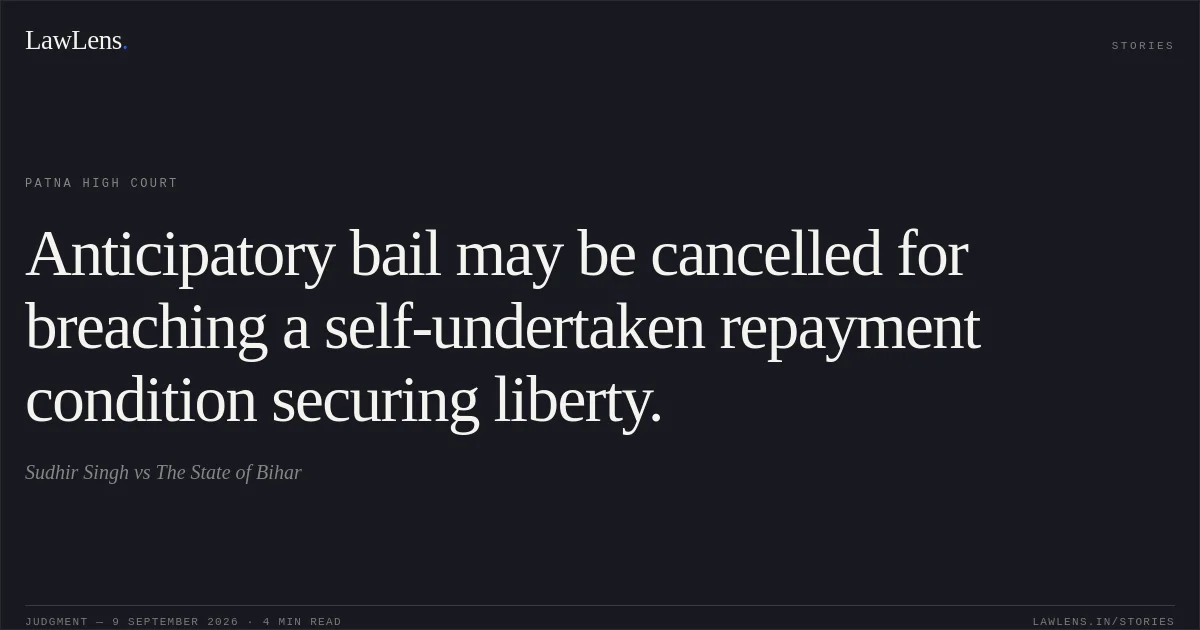
The Court held that grounds for cancellation of the anticipatory bail were made out because the opposite parties had failed to fulfil the payment condition on which they obtained bail, had relied on earlier repayments as alleged compliance, and had evaded the court process.
However, instead of cancelling bail immediately, the Court granted one final opportunity. The opposite parties were directed to pay ₹7,00,000 to the complainant, either by account-payee bank draft, electronic transfer, or deposit before the trial court, within eight weeks from the date of judgment.
Source reference: para. 31(i)Upon proof of payment, the trial court was directed to confirm the provisional bail in accordance with the earlier order.
Source reference: para. 31(ii)In default, the anticipatory bail would stand cancelled after the trial court recorded satisfaction regarding non-payment and afforded the opposite parties an opportunity to produce proof of payment.
Source reference: para. 31(iii)They were also directed to appear regularly and cooperate with the expeditious disposal of the complaint case.
Source reference: para. 31(iv)The application was accordingly disposed of with directions.
Source reference: para. 33Acts & Sections Cited
5 provisions across 2 statutes referred to in this judgment. Each provision opens on LawLens.
Code of Criminal Procedure, 19732
Indian Penal Code, 18603
Original Court PDF
Sudhir SinghvsThe State of Bihar
Click to open original judgment
Original judgment, available to read, download and summarize on LawLens.in