Facts
The applicants sought anticipatory bail in FIR No. 04/2026, registered for alleged offences under the Bharatiya Nyaya Sanhita, 2023 (BNS) and the Protection of Children from Sexual Offences Act, 2012 (POCSO Act), and challenged the Sessions Court’s rejection of their bail application.
Source reference: p. 1–3The prosecution alleged that the applicants aided the principal accused by arranging hotel accommodation and facilitating his movements with the minor victim, and that one applicant attempted to remove personal details from a hotel register.
Source reference: p. 3–5The victim’s mother stated that she had no objection to bail, subject to conditions.
Source reference: p. 5The applicants had received interim protection from the High Court; the State did not identify any breach of its conditions.
Source reference: p. 5, 9–10Issues
Whether the applicants were entitled to anticipatory bail in light of the allegations that they provided logistical assistance to the principal accused in a case involving offences against a minor.
Source reference: p. 6–8, 10–11Whether the interim anticipatory bail should be made absolute, having regard to the applicants’ compliance with its conditions and the complainant’s position.
Source reference: p. 9–11Law Applied
The application was considered under Section 482 of the Bharatiya Nagarik Suraksha Sanhita, 2023 (BNSS), which empowers the court to grant anticipatory bail.
Source reference: no citationRelying on Gurbaksh Singh Sibbia v. State of Punjab, as discussed in Bhadresh Bipinbhai Sheth v. State of Gujarat, the Court noted that anticipatory bail protects personal liberty and provides conditional immunity from arrest.
Source reference: p. 8–9It also applied the factors identified in Ajwar v. Waseem: the nature and gravity of the accusation, the accused’s alleged role and antecedents, risks of witness tampering or repetition, and the likelihood of the accused evading or obstructing justice.
Source reference: p. 9The Court further invoked the principle that bail is the rule and jail the exception.
Source reference: p. 10Reasoning
The Court considered the allegations that the applicants had provided logistical support, including arranging accommodation and facilitating the principal accused’s movements, while noting that they were not alleged to be the principal perpetrators of the main offences.
Source reference: p. 10It assessed the seriousness of the allegations alongside the applicants’ role, the fact that interim protection had been operating, and the absence of any identified breach of its conditions.
Source reference: p. 9–10The victim’s mother’s statement of no objection also weighed in the Court’s assessment.
Source reference: p. 10Without expressing any view on the merits, the Court concluded that the circumstances justified continuing protection from arrest.
Source reference: p. 10–11Holding
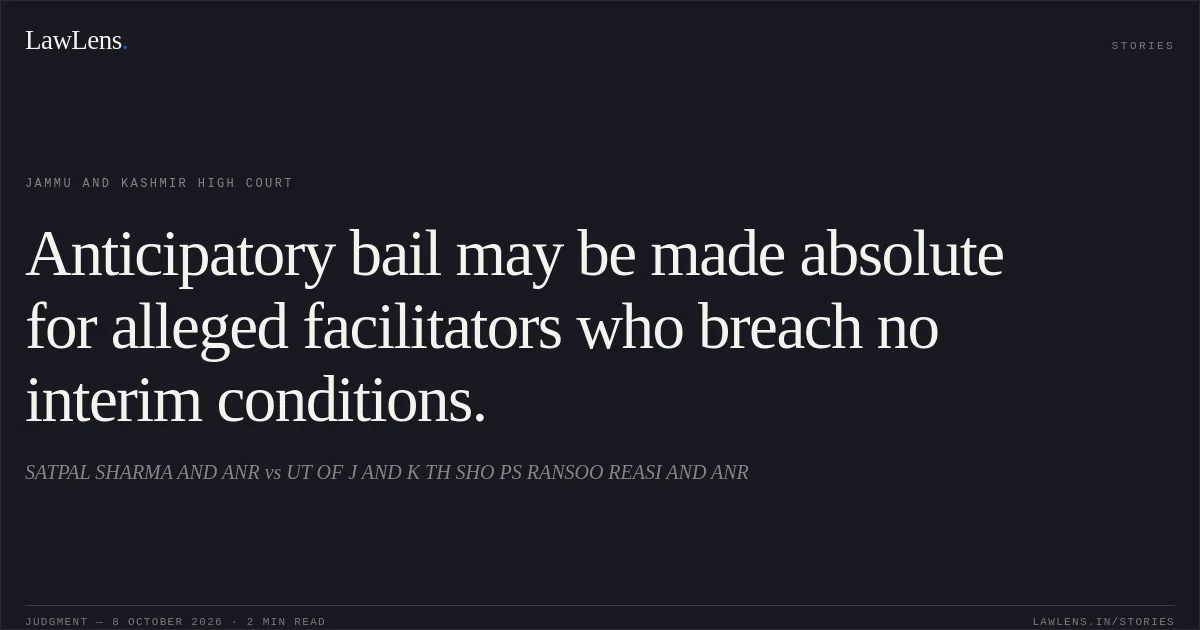
The Court allowed the application and made the interim anticipatory bail absolute.
The applicants were directed to cooperate with the investigation, not leave the Union Territory of Jammu and Kashmir without the concerned SHO’s permission, refrain from frustrating the investigation or tampering with evidence, and furnish personal and surety bonds of ₹50,000 each to the satisfaction of the concerned SHO.
Source reference: p. 11Acts & Sections Cited
15 provisions across 5 statutes referred to in this judgment. Each provision opens on LawLens.
Bharatiya Nyaya Sanhita, 20236
Protection of Children from Sexual Offences Act, 20124
Bharatiya Nagarik Suraksha Sanhita, 20231
Code of Criminal Procedure, 19733
Indian Penal Code, 18601
Original Court PDF
SATPAL SHARMA AND ANRvsUT OF J AND K TH SHO PS RANSOO REASI AND ANR
Click to open original judgment
Original judgment, available to read, download and summarize on LawLens.in