Facts
The petitioner sought anticipatory bail under Section 482 of the Bharatiya Nagarik Suraksha Sanhita, 2023, in FIR No. 139/2026, registered under Sections 309(4), 309(6), 311 and 3(5) of the Bharatiya Nyaya Sanhita, 2023
Source reference: p. 1, para. 1The FIR arose from an allegation that four armed men entered a senior citizen’s home at around 3:30 a.m., assaulted and restrained the complainant and his wife, and robbed them of jewellery, cash and other valuables
Source reference: p. 2, paras. 4.1–4.3The petitioner’s earlier anticipatory-bail application was dismissed by the Sessions Court
Source reference: p. 2, para. 4.4The State opposed relief, submitting that co-accused had disclosed the petitioner’s involvement, that a co-accused had identified him in CCTV footage, and that only 11 criminal antecedents were disclosed in the petitioner’s affidavit although the State alleged 25
Source reference: pp. 2–3, paras. 9–12The State further submitted that investigation was ongoing, substantial property remained unrecovered, and custodial interrogation was required
Source reference: pp. 4–5, paras. 15–20Issues
Whether the petitioner was entitled to anticipatory bail under Section 482 BNSS in light of the gravity and circumstances of the alleged armed house robbery
Source reference: p. 1, para. 1; pp. 5–7, paras. 18, 24Whether the need for custodial interrogation and the ongoing recovery of stolen property weighed against granting anticipatory bail
Source reference: pp. 4–5, paras. 15–20Law Applied
Section 482 BNSS provides for anticipatory bail.
Source reference: no citationThe Court relied on State v. Anil Sharma, (1997) 7 SCC 187, for the principle that custodial interrogation may be more effective than questioning a suspect protected by a pre-arrest bail order, particularly where information or concealed material is sought
Source reference: pp. 5–6, paras. 21–22It also relied on Srikant Upadhyay v. State of Bihar, (2024) 12 SCC 382, which holds that anticipatory bail is an extraordinary, discretionary remedy to be exercised cautiously; protection in serious cases may hamper investigation or risk interference with evidence
Source reference: pp. 6–7, para. 23The FIR invoked Sections 309(4), 309(6), 311 and 3(5) BNS
Source reference: p. 1, para. 1Reasoning
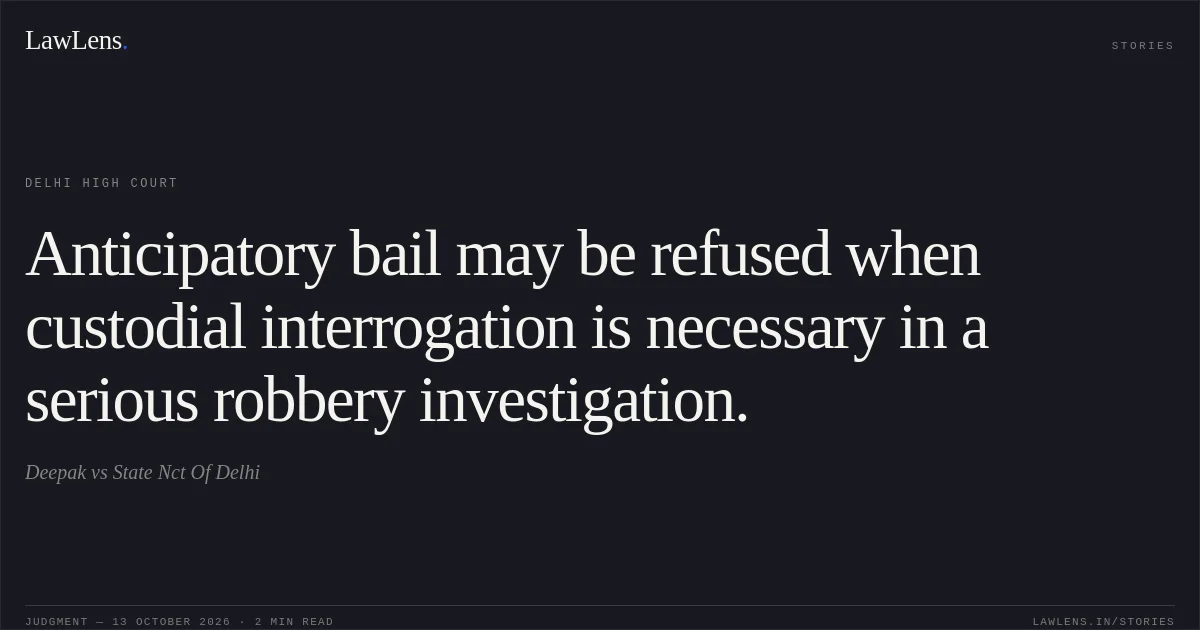
The Court considered the alleged offence to be a serious, organised armed robbery against elderly victims in their home, allegedly carried out pursuant to a pre-arranged plan
Source reference: p. 5, paras. 16–18It noted the State’s case that the petitioner’s involvement emerged from co-accused disclosures and CCTV identification, and that substantial stolen property remained unrecovered
Source reference: pp. 3–5, paras. 9, 15–20Applying the principles in Anil Sharma and Srikant Upadhyay, the Court accepted the State’s submission that custodial interrogation was required to investigate the alleged conspiracy, the movements and roles of the accused, and the concealment or disposal of the remaining property
Source reference: pp. 5–7, paras. 17–23In these circumstances, it found anticipatory bail inappropriate
Source reference: p. 7, para. 24Holding
The Delhi High Court dismissed the anticipatory-bail application and the pending application, declining to grant the petitioner pre-arrest protection
It clarified that its observations were confined to the bail application and would not prejudice the parties or be treated as an opinion on the merits
Source reference: p. 7, para. 26Acts & Sections Cited
5 provisions across 3 statutes referred to in this judgment. Each provision opens on LawLens.
Bharatiya Nagarik Suraksha Sanhita, 20231
Bharatiya Nyaya Sanhita, 20233
Code of Criminal Procedure, 19731
Original Court PDF
DeepakvsState Nct Of Delhi
Click to open original judgment
Original judgment, available to read, download and summarize on LawLens.in
![Pension must be recalculated on the Passenger Attendant Grade-I scale, not merely the Group-C Porter scale.. DINESHWAR PRASAD TIWARI vs NORTH CENTRAL RAILWAY. CAT - ['Allahabad']. LawLens](/stories/thumbnails/pension-must-be-recalculated-on-the-passenger-attendant-grade-i-scale-not-merely-the-group-97c58c85243d433bb520084af94a02bd.webp)
![Delayed IPR filing cannot independently disqualify an employee from promotion absent an applicable rule.. Bhupendra Kumar vs DELHI DEVELOPMENT AUTHORITY. CAT - ['Delhi']. LawLens](/stories/thumbnails/delayed-ipr-filing-cannot-independently-disqualify-an-employee-from-promotion-absent-an-ap-da80816741284e10afeaa1e45c382f9b.webp)
![Selection creates no indefeasible right to appointment after a recruitment process is lawfully cancelled.. Harish Kumar vs D/o Post. CAT - ['Delhi']. LawLens](/stories/thumbnails/selection-creates-no-indefeasible-right-to-appointment-after-a-recruitment-process-is-lawf-70891953705b49a7aaa5c5f32080304a.webp)