Facts
The appellants, accused Nos. 1–4, challenged the Sessions Court’s rejection of their application for anticipatory bail in a case alleging offences under Sections 115(2), 351(2), 352, 133, 54 and 76 read with Section 3(5) of the Bharatiya Nyaya Sanhita, 2023, and Sections 3(1)(r), 3(1)(s) and 3(2)(va) of the SC/ST Act.
Source reference: paras. 1–2, 5The complaint alleged that, during a dispute over construction on Gram Panchayat land, the appellants abused and assaulted the complainant and her family by referring to their caste; it also alleged that three appellants dragged the complainant by her sari with intent to outrage her modesty.
Source reference: paras. 3–4, 19The appellants denied the allegations and contended that the complaint arose from the land dispute.
Source reference: paras. 10–12The High Court noted the submission that the investigation was complete and the charge-sheet had been filed.
Source reference: para. 22Issues
Whether the appellants had grounds to interfere with the Sessions Court’s rejection of anticipatory bail.
Source reference: para. 15Whether the complaint, taken at face value, disclosed a prima facie offence under the SC/ST Act so as to attract the bar on anticipatory bail under Sections 18 and 18-A.
Source reference: paras. 16–18Law Applied
Section 14-A(2) of the SC/ST Act provides for an appeal against specified orders of a Special Court or Exclusive Special Court.
Source reference: para. 1Sections 18 and 18-A of the SC/ST Act bar the application of the anticipatory-bail provision in cases under that Act.
Source reference: para. 16However, relying on Prathvi Raj Chauhan v. Union of India, (2020) 4 SCC 727, the Court stated that the bar does not operate where the complaint does not make out a prima facie case under the Act; pre-arrest bail may be considered in such exceptional circumstances.
Source reference: para. 17The Court’s inquiry at this stage was limited to whether the allegations, taken at face value, disclosed the ingredients attracting the statutory bar, not to conducting a mini-trial.
Source reference: paras. 18, 20Reasoning
The Court identified the land dispute as the genesis of the incident and noted that the complaint also alleged caste-based abuse and assault.
Source reference: para. 19It observed that the allegations of caste-based abuse required consideration of the material collected during investigation and could not be conclusively accepted on the basis of the rival submissions alone.
Source reference: para. 21In granting relief, the Court also relied on the stated completion of the investigation and filing of the charge-sheet, the absence of a demonstrated need for custodial interrogation, and the appellants’ undertaking to cooperate.
Source reference: paras. 22–23It did not undertake a detailed assessment of the evidence, instead concluding that the appellants could be protected by stringent conditions.
Source reference: paras. 20, 23Holding
The Court allowed the appeal and set aside the Sessions Court’s order rejecting anticipatory bail.
It directed that, in the event of arrest, each appellant be released on bail on executing a personal bond of ₹2,00,000 with two sureties for the like sum, subject to conditions including cooperation with the investigation and trial, non-interference with witnesses or evidence, and regular appearance before the jurisdictional court.
Source reference: pp. 11–13The Court stated that its observations were confined to the bail appeal and would not affect the trial court’s assessment on the merits.
Source reference: p. 13Acts & Sections Cited
11 provisions across 4 statutes referred to in this judgment. Each provision opens on LawLens.
Scheduled Castes and the Scheduled Tribes (Prevention of Atrocities) Act, 19892
Bharatiya Nagarik Suraksha Sanhita, 20231
Bharatiya Nyaya Sanhita, 20237
Code of Criminal Procedure, 19731
Original Court PDF
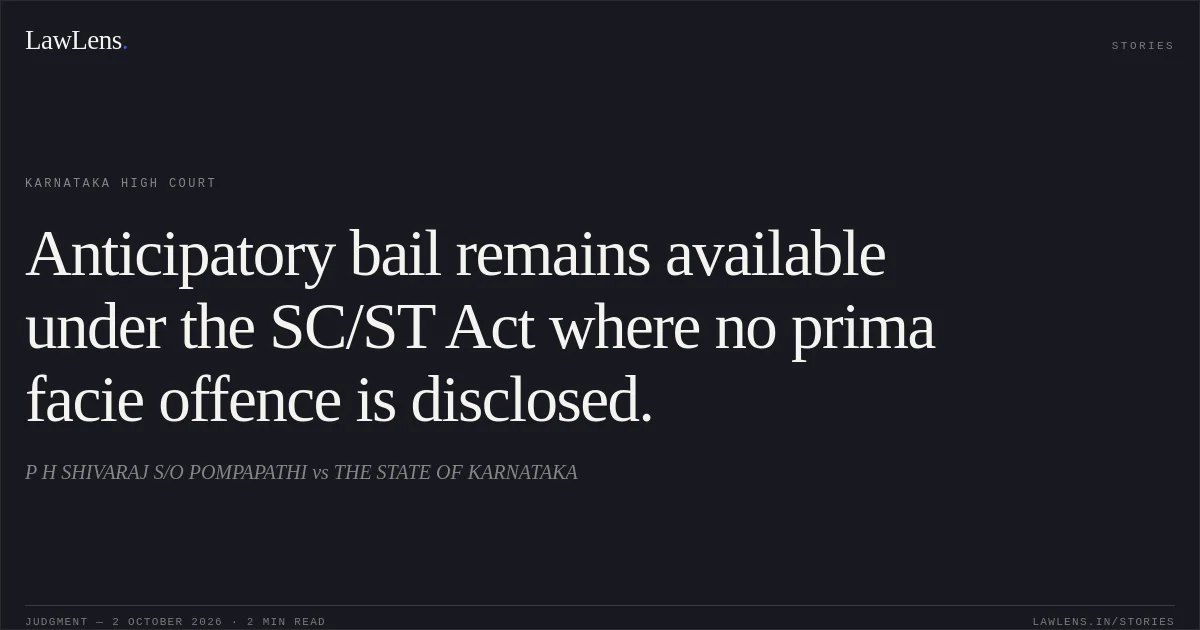
P H SHIVARAJ S/O POMPAPATHIvsTHE STATE OF KARNATAKA
Click to open original judgment
Original judgment, available to read, download and summarize on LawLens.in