Facts
The petitioner filed a review petition against a judgment dated 21-02-2019 passed in S.A. No. 129/2002, which had allowed the respondents' (plaintiffs') appeal and restored the trial court's decree
Source reference: p. 2, para 1During the pendency of the second appeal, Plaintiff No. 1 (Pratap Singh Rathiya) died on 24-09-2009, and Defendant No. 1 (Madhusudan) died on 06-11-2013
Source reference: p. 2-3, para 3Despite these deaths, the respective counsels failed to inform the Court as required under Order 22 Rule 10A of the CPC
Source reference: p. 3, para 3The petitioner (wife of Defendant No. 1) contended that since both parties died prior to the judgment, the appeal had abated, and the resulting decree was a nullity
Source reference: p. 3, para 4Issues
1. Whether the failure of counsel to inform the Court of a party's death under Order 22 Rule 10A of the CPC results in the automatic abatement of the proceedings
Source reference: p. 5, para 102. Whether the second appeal abated and the decree became a nullity when the estates of the deceased parties were represented by their surviving brothers (Class II heirs) who were already parties to the suit
Source reference: p. 5, para 11; p. 8, para 14Law Applied
The Court applied Order 22 Rule 10A of the CPC, noting that the duty of a lawyer to inform the court of a client's death is directory, as no penalty for non-compliance is contemplated
Source reference: p. 5, para 10It further applied Section 8 of the Hindu Succession Act, 1956, recognizing brothers as Class II heirs
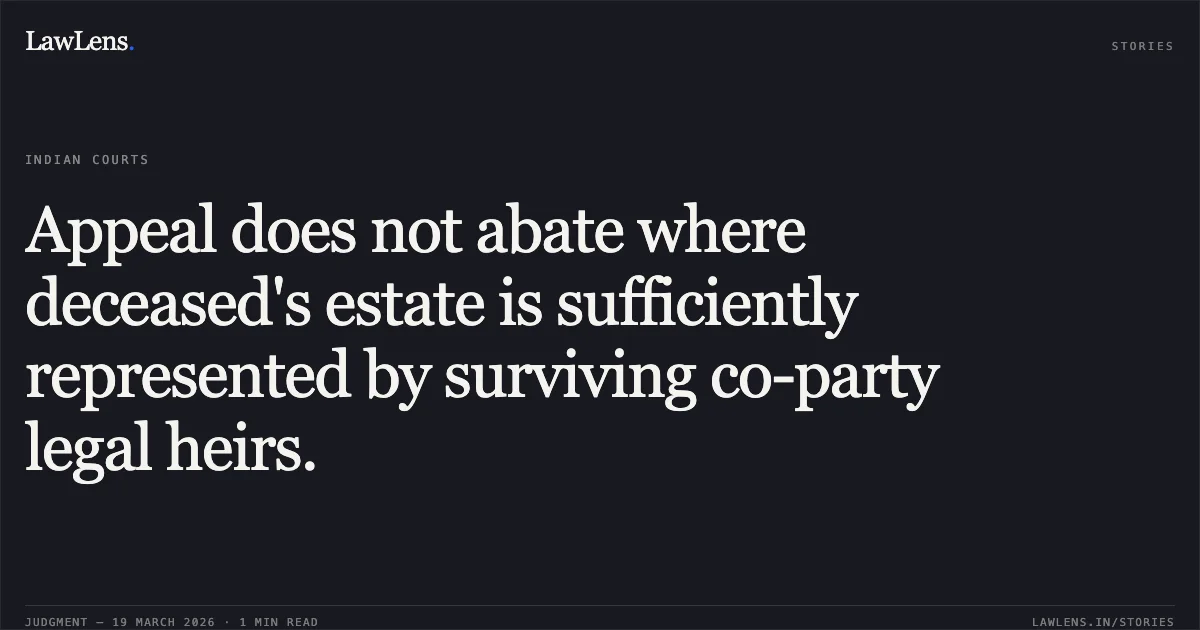
Source reference: p. 3-4, para 7The primary legal principle relied upon was the doctrine of "substantial representation," as established by the Supreme Court in Collector of 24 Parganas v. Lalith Mohan Mullick, which holds that an appeal does not abate if the estate of the deceased is sufficiently represented by other heirs already on record
Source reference: p. 5, para 12This was reinforced by Shivshankara v. H.P. Vedavyasa Char, which clarified that non-substitution of legal representatives does not abate a suit if the interest is fully and substantially represented by other defendants jointly defending the suit
Source reference: p. 6, para 13Reasoning
The Court reasoned that although there was a procedural lapse under Order 22 Rule 10A, the second appeal did not abate because the legal interests of the deceased were effectively protected
Source reference: p. 5, para 11Regarding Defendant No. 1, his brothers (Defendants No. 2 and 3) were already on record; since they were Class II heirs under the Hindu Succession Act and were jointly defending a common interest, they "effectively represented" his estate
Source reference: p. 3, para 7; p. 8, para 14Similarly, the estate of Plaintiff No. 1 was sufficiently represented by his three brothers (Plaintiffs No. 2 to 4), who were also Class II heirs and parties to the appeal
Source reference: p. 4, para 7; p. 8, para 14Applying the precedents of the Supreme Court, the Court found that when surviving co-parties share the same interest and legal status as the deceased, the "estate is fully and substantially represented," preventing abatement
Source reference: p. 8-9, para 14Consequently, there was no error apparent on the face of the record
Source reference: p. 9, para 14Holding
The Court held that the second appeal had not abated on the date of judgment because the estates of the deceased parties were sufficiently represented by their surviving brothers who were already parties to the litigation
Therefore, the decree passed was not a nullity
Source reference: p. 9, para 14The Court dismissed the review petition and directed the petitioner to pay costs of ₹2,000 to the High Court Legal Services Authority
Source reference: p. 9, para 14Acts & Sections Cited
2 provisions across 2 statutes referred to in this judgment. Each provision opens on LawLens.
Code of Civil Procedure, 19081
Hindu Succession Act, 19561
Original Court PDF
MADHUSUDAN S/O SUNDAR SAI (DEAD) THROUGH LEGAL HEIRvsPRATAP SINGH RATHIYA (DEAD) THROUGH LEGAL HEIRS
Click to open original judgment
Original judgment, available to read, download and summarize on LawLens.in


