Facts
The plaintiffs (respondents) filed a suit for declaration of title and possession regarding "A" schedule property, asserting that Jamaluddin purchased the property in 1951
Source reference: p.5Jamaluddin’s younger brother, Abdul Wahab (ancestor of the appellants), was permitted to reside there as a licensee from 1959-60 due to familial affection
Source reference: p.6-7After the deaths of Abdul Wahab (1989) and Jamaluddin (1990), the plaintiffs sought possession, but the defendants refused, claiming the property was purchased Benami by Abdul Wahab in Jamaluddin's name and that they had acquired title via adverse possession since 1956
Source reference: p.9-11The Trial Court dismissed the suit for non-payment of deficit court fees and on limitation grounds
Source reference: p.12The First Appellate Court reversed this, decreeing the suit in favor of the plaintiffs
Source reference: p.13-14Issues
1. Whether the finding of the Lower Appellate Court that the suit of the plaintiff is within the limitation period is sustainable in law?
Source reference: p.14 / para. 142. Whether the first appeal filed only against the judgment without the drawing up of a decree is maintainable in law?
Source reference: p.15 / para. 153. Whether the First Appellate Court's failure to formulate specific points regarding court fees and limitation leads to an erroneous judgment?
Source reference: p.15 / para. 15Law Applied
Article 65 of the Limitation Act, 1963, which prescribes a 12-year limitation for possession of immovable property based on title, commencing only when possession becomes adverse to the plaintiff
Source reference: p.24Section 2(2) and Order XX Rule 6-A of the CPC, which stipulates that if a decree is not drawn up within 15 days, the judgment shall be treated as a decree for the purposes of filing an appeal under Order XLI Rule 1
Source reference: p.36-38, 43The court also noted the prohibition of Benami defenses under the Benami Transactions (Prohibition) Act, 1988
Source reference: p.25clarified that a plea of adverse possession requires the admission of the true owner's title (animus possidendi)
Source reference: p.24Reasoning
The High Court determined that under Article 65, the burden was on the defendants to prove adverse possession. Since the defendants claimed they were the "real owners" via a Benami transaction rather than admitting Jamaluddin's ownership, their possession was not "hostile" in the legal sense; thus, the limitation period never began to run
Source reference: p.25, 27Regarding the procedural defect, the Court observed that while Section 96 CPC requires an appeal against a "decree," the 1999/2002 amendments to Order XX Rule 6-A and Order XLI Rule 1 explicitly allow a judgment to stand as a decree if the trial court fails to draw one up
Source reference: p.43-44Although the Trial Court initially stayed the issuance of the decree due to unpaid court fees, the plaintiffs subsequently paid the deficit during the pendency of the second appeal, curing the defect
Source reference: p.31, 44the Court held that the First Appellate Court’s points for determination sufficiently covered the core disputes of title and adverse possession
Source reference: p.46-48Holding
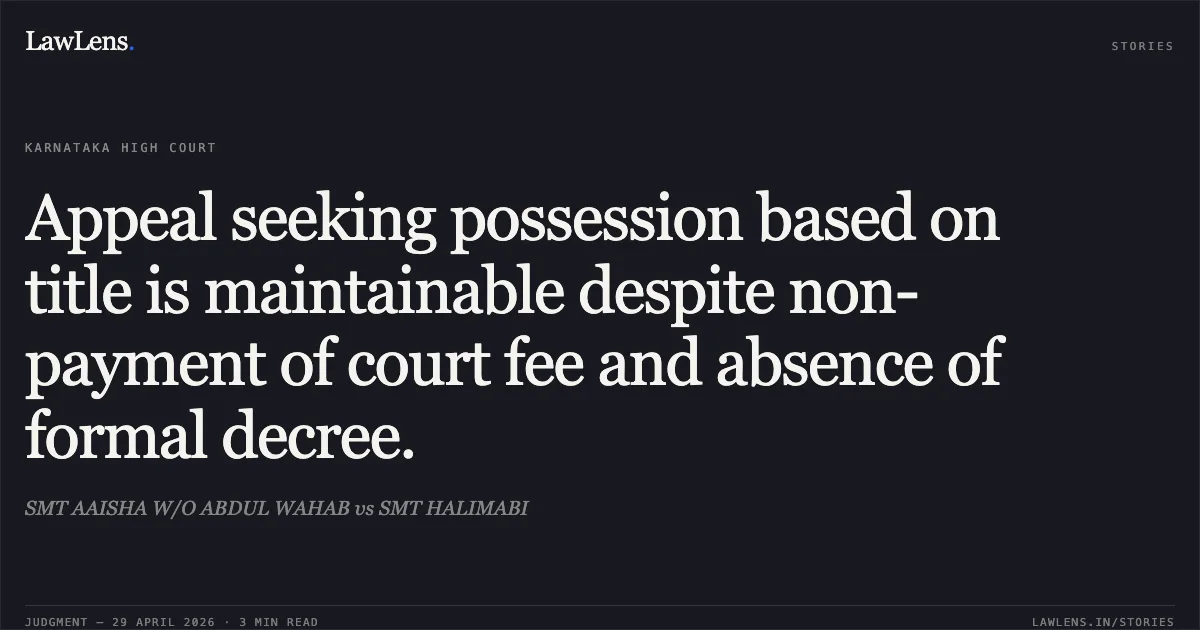
The High Court dismissed the Regular Second Appeal and confirmed the judgment and decree of the First Appellate Court
(1) the suit was within limitation as the defendants failed to establish the start of adverse possession; (2) the first appeal was maintainable because, under Order XX Rule 6-A, a judgment is treated as a decree for appeal purposes if no formal decree is drawn; and (3) the subsequent payment of court fees validated the proceedings.
Source reference: p.28, 45, 44The defendants were ordered to vacate the property
Source reference: p.48Acts & Sections Cited
13 provisions across 3 statutes referred to in this judgment. Each provision opens on LawLens.
Code of Civil Procedure, 1908
Limitation Act, 19632
KARNATAKA COURT-FEE AND SUITS VALUATION ACT, 1958.1
Original Court PDF
SMT AAISHA W/O ABDUL WAHABvsSMT HALIMABI
Click to open original judgment
Original judgment, available to read, download and summarize on LawLens.in


