Facts
The National Company Law Tribunal (NCLT) admitted a Section 9 application under the Insolvency and Bankruptcy Code, 2016 (IBC) against the Corporate Debtor (CD), Ambro Asia Private Limited, on 18.04.2024
Source reference: para. 1Piyush Moona was appointed as the Interim Resolution Professional (IRP)
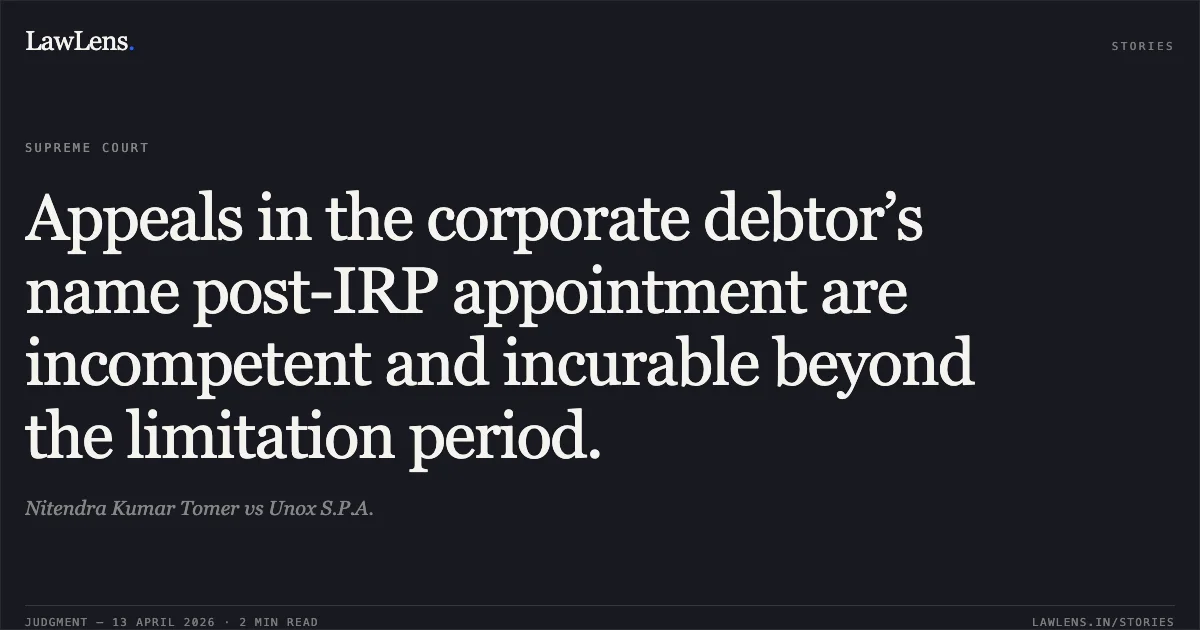
Source reference: para. 4On 24.04.2024, the appellant (a suspended director) filed an appeal before the National Company Law Appellate Tribunal (NCLAT) in the name of the CD, verified by himself
Source reference: para. 4On 12.08.2025, the NCLAT noted the appeal was maintainable only if filed by the director in his own name, as management had vested in the IRP
Source reference: para. 2Despite this, the NCLAT permitted the appellant to amend the memo of appeal in August 2025 to prosecute it in his personal capacity
Source reference: para. 3The NCLAT subsequently dismissed the appeal on merits on 07.01.2026
Source reference: para. 3Issues
1. Whether a suspended director can validly file an appeal in the name of the Corporate Debtor after the appointment of an Interim Resolution Professional
Source reference: para. 62. Whether the NCLAT has the jurisdiction to permit the conversion of an incompetent appeal into a maintainable one after the expiry of the statutory limitation period prescribed under Section 61(2) of the Code
Source reference: para. 7-8Law Applied
Section 16 and Section 17(1)(a) of the IBC, which mandate that from the date of appointment of the IRP, the management of the affairs of the corporate debtor vests in the IRP
Source reference: para. 5-6Section 61(2) of the IBC, which prescribes a strict limitation period of 30 days for filing appeals, condonable by only 15 additional days, leaving no discretion for further extensions
Source reference: para. 7The Court distinguished procedural irregularities discussed in Uday Shankar Triyar v. Ram Kalewar Prasad Singh and Varun Pahwa v. Renu Chaudhary, which allow for the correction of "curable" defects.
Source reference: para. 9, 10Reasoning
The Court reasoned that once the IRP was appointed on 18.04.2024, the suspended director lost the authority to represent or file legal proceedings in the name of the CD
Source reference: para. 6Consequently, the appeal filed on 24.04.2024 was not merely "defective" in procedure but "wholly incompetent" at its inception
Source reference: para. 4, 8The Court observed that while procedural defects like a missing signature or misdescription of parties can be rectified, a lack of standing or authority cannot be "cured" after the limitation period has expired
Source reference: para. 8, 11By permitting the amendment in August 2025—well beyond the 45-day maximum window allowed under Section 61(2)—the NCLAT "desecrated" the statutory mandate of the Code
Source reference: para. 7-8The Court emphasized that time-bound mandates under the IBC are sacrosanct and cannot be bypassed through procedural amendments that effectively entertain time-barred appeals
Source reference: para. 9, 13Holding
The Court held that the appeal filed before the NCLAT was maintainable neither as framed nor as subsequently amended, as the amendment occurred long after the limitation period expired
The NCLAT erred in permitting the amendment and adjudicating the matter on merits
Source reference: para. 13Consequently, the Supreme Court dismissed the appeal on the grounds of maintainability and incompetence without entering into the merits of the NCLT’s admission order
Source reference: para. 13Acts & Sections Cited
5 provisions across 1 statute referred to in this judgment. Each provision opens on LawLens.
Insolvency and Bankruptcy Code, 2016.5
Original Court PDF
Nitendra Kumar TomervsUnox S.P.A.
Click to open original judgment
Original judgment, available to read, download and summarize on LawLens.in