Facts
Twenty-nine persons jointly sought gratuity under the Payment of Gratuity Act, 1972.
Source reference: para. 3The Controlling Authority issued orders on 12 and 18 December 2024.
Source reference: para. 3The petitioner filed one composite appeal against all 29 orders on 12 March 2025.
Source reference: para. 3The Appellate Authority returned it on 10 October 2025, directing the petitioner to file separate appeals with certified copies and valid bank drafts.
Source reference: para. 3The petitioner filed separate appeals on 31 October 2025; the Appellate Authority dismissed them as time-barred on 23 June 2026.
Source reference: para. 3The petitioner challenged that dismissal and the Controlling Authority’s orders by writ petitions.
Source reference: para. 3Issues
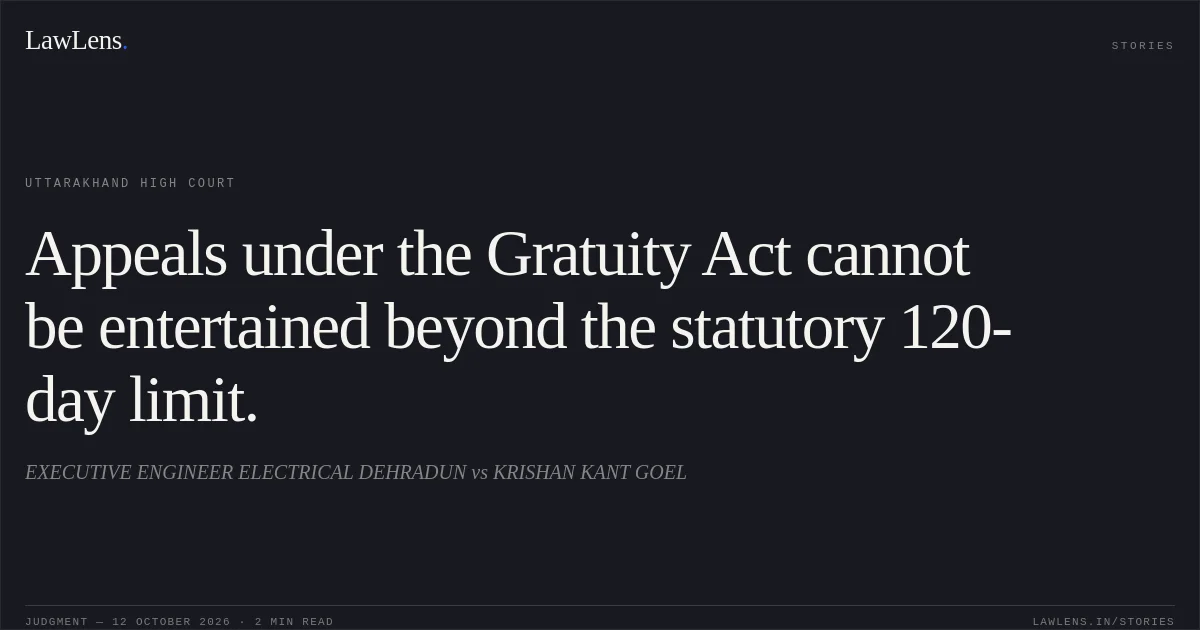
1. Whether the Appellate Authority could condone delay in an appeal under Section 7(7) of the Payment of Gratuity Act beyond the statutory maximum of 120 days from receipt of the Controlling Authority’s order.
Source reference: paras. 4–7, 152. Whether filing a single composite appeal against 29 separate orders within 120 days preserved limitation for the separate appeals filed after the composite appeal was returned.
Source reference: paras. 8–11, 14Law Applied
Section 7(7) of the Payment of Gratuity Act, 1972 permits an appeal within 60 days of receipt of the order and allows the appellate authority, upon sufficient cause, to extend that period by a further 60 days; the statutory maximum is therefore 120 days, beyond which delay cannot be condoned.
Source reference: paras. 4–6The Court relied on Chhattisgarh State Electricity Board v. Central Electricity Regulatory Commission, (2010) 5 SCC 23, which held that where a statute specifies a further, capped period for filing an appeal, the outer limit is mandatory and the appeal cannot be entertained after it.
Source reference: para. 7Section 7(4)(b) permits joint applications to the Controlling Authority, but Section 7(7) requires a separate appeal against each order.
Source reference: para. 11The Limitation Act, 1963 does not apply to proceedings under the Payment of Gratuity Act.
Source reference: para. 15Reasoning
Although the composite appeal was filed within 120 days, it challenged 29 separate orders and was not entertained as a valid appeal under Section 7(7).
Source reference: paras. 10–11, 14The separate appeals were filed only on 31 October 2025, well beyond the statutory period.
Source reference: paras. 10–11, 14The petitioner’s reliance on the return of the composite appeal did not overcome the limitation bar; moreover, the separate appeal memorandum did not explain the delay or refer to the composite filing and its return.
Source reference: paras. 10–11, 14The Appellate Authority therefore lacked power to condone the delay beyond the statutory maximum.
Source reference: paras. 6, 15Holding
The Court held that the separate appeals were time-barred and that the Appellate Authority’s dismissal was consistent with the Payment of Gratuity Act.
It dismissed the writ petitions and declined to interfere with the challenged orders.
Source reference: paras. 16–17Acts & Sections Cited
3 provisions across 2 statutes referred to in this judgment. Each provision opens on LawLens.
Electricity Act, 20032
Limitation Act, 19631
Original Court PDF
EXECUTIVE ENGINEER ELECTRICAL DEHRADUNvsKRISHAN KANT GOEL
Click to open original judgment
Original judgment, available to read, download and summarize on LawLens.in


